Signed in as:
filler@godaddy.com

The Revelation of Jesus Christ is the final Book of the Biblical Canon. It announces its purpose and content in Revelation 1:19 as the Lord directs John, “Therefore write the things which you have seen, and the things which are, and the things which will take place after these things." We will find "the things which you have seen" in Chapter 1, "The things which are" in Chapters 2-3 and "the things which will take place after these things" listed in Chapters 4-22. Selecting the link to the right will take you to the list of specific studies, the Bible reference and the date on which the presentation is scheduled. Simply click on the word "Here" below any topic and you will find yourself in the PowerPoint presentation including the Word format commentary on that study. To hear the study taught, send an email to the author and the information including Teams URL for the live study at the time indicated. Welcome to our study of The Revelation of Jesus Christ. For a more detailed introduction to Revelation click here.
John was one of the earliest Apostles to join Jesus Christ of the twelve. Andrew was a disciple of John the Baptist and found Jesus through the Baptist. In turn, he told his brother, Peter. They were a fishing team who had a second boat manned by James and John who they invited to meet Jesus as soon as they discovered whom Jesus is. He was sentenced to life at the Island of Patmos. Released in about 96 AD, he was able to see the Gospels of Matthew, Mark and Luke before writing his own. The Canon also includes John's three letters and the Revelation described here.

Our blog is a place where you can find articles, stories, and reflections on faith and religion from a wide range of perspectives. We believe that everyone's spiritual journey is unique and valuable, and we hope that our blog can be a source of inspiration and encouragement for you. Whether you are looking for practical guidance, thought-provoking ideas, or simply a place to connect with others who share your beliefs, we invite you to explore our blog and join the conversation.
The Apostle John was on the island of Patmos when he received the Revelation of Jesus Christ. When John was released as a very elderly man, he published this inspired Word from God regarding what came before, what was and what was yet to come.

The Revelation of Jesus Christ (Rev 1:1-3)
This Book of the Bible is entitled, “The Revelation of Jesus Christ” (Rev 1:1a). It was given by God, Himself, to Jesus Christ (see capital “H” on “Him,”) to show or present to His bond servants (the saved of Jesus Christ) the things which must soon take place (Rev 1:1:1b,). In other words, these words come directly from God’s Word. The title of the Book is God-inspired, through John to us, the believers in Jesus Christ – the saints of God. The things which are in this Book are those things which God says will happen soon. How much closer this timing must be than when John first wrote it. The third phrase of verse 1 says that God “sent and communicated it by His angel (messenger) to His bond-servant, John” (vs, 1:1c). The “send” verse says more about why God gave this revelation to John. It says that God gave it to John because he testified or communicated “the word of God and the testimony of Jesus Christ, even to all that he saw” (vs. 2).
So, we know that this Book is the Revelation of Jesus Christ, and it was brought by an angel to John because he would take it to everyone he saw. Many have called this Book by several names and many of those are equally true. For example, some have called this Book “The Apocalypse.” The Greek word used here for “Revelation” is, in fact, ἀποκάλυψι or apokálypsis, which is exactly the word from which we get our word “apocalypse.” Using that name also helps define the Book well. It means, “disclosure:—appearing, coming, lighten, manifestation, be revealed, revelation.” But it also reveals the type of literature we are about to study. Apocalyptic literature is a separate type of literature characterized as containing language as symbols and figures to better illustrate important views or themes. It will apply numerology to express ideas of secular or religious wholeness or partial wholeness, and secular or religious organizations or people. For example, The Trinity represents the Holy or unholy trinity of the Father, Son and Holy Ghost or Satan, the antichrist and the false, respectively. Seven is a perfect and holy number while six is incomplete and unholy. For example, the number of the Beast is three times unholy or 666 (Rev 13:18). Twelve is organizational completeness, like the 12 gates, 12 apostles, 12 tribes, etc.
,
This first point closes with the promise from God that the one who reads this Book, hears the words of the prophecy and heeds (or applies) the things written in it is blessed because the time is near. So, we are to receive the blessings of this Book because we read it thoroughly, heard it with the mind’s intellectual ear – not just the physical ear, and heeded or understood and applied the things we read, heard and applied. Lastly, verse 3 tells us we will be blessed because the timing of its message is near. Therefore, if we know the time is near, we can use the warning signs to know the truth of this Book and its prophecies will begin when the signs are presented. For example, Chapter 13 describes an Antichrist who will erect a statue of himself on Jerusalem’s Temple Dome and demand that all people of all religions worship him through that statue, i.e., a one-world religion. We saw moves of this truth, to unite Christians, Jews and Muslims in the Middle East, as recently as last week (third week of December 2025). This is what it means to “read, hear and heed the words of this Book.” God promises blessings to us as we do.
Message to the Seven Churches (Rev 1:4-8)
Hear John tells us to whom the Book was addressed first; they are the seven churches that are in Asia. He wishes God’s grace and peace to them from Him (the Christ) who is and who was and who is to come and from the seven Spirits who are before His throne (vs. 4). John continues the list of from whom this Book is sent by adding “and from Jesus Christ, the faithful witness, the firstborn of the dead, and the ruler of the kings of the earth” (vs. 5a). Verse 5b adds the “To” list beginning with “Him who loves us and released us from our sins by His blood” (This is certainly referring to Jesus Christ). Adding to the description of Christ in a somewhat parenthetically, John says, “and He has made us to be a kingdom, priests to His God and Father – to Him be the glory and dominion forever and ever. Amen. So, the brief section addressing this letter would be, “From: The Apostle John, To: The Seven Churches.”
And the first line of the message to the seven churches would be, “Behold, Jesus Christ is coming to you in the clouds!” What a fantastic start of the multitude of Good News that comes from God through Jesus Christ, Our Lord. This great message is backed up scripturally through the words of the angels gathered at the Ascension of Jesus in Acts 1:9-11. The “two men dressed in white apparel” in those verses have been unanimously accepted as angels of God, and here they have a message that everyone wants to hear, that is, “Jesus is coming back, He’s coming back on a cloud, He’s coming back so that every eye can see Him, including those who crucified Him and all the tribes of the earth can mourn over Him. So, it is to be, Amen” (vs. 7). Then, Jesus finishes the sighting by saying, “I am the Alpha and Omega who is and who was and who is to come, the Almighty!”
This idea of Jesus returning for His saints is one of the most important in the Christian canon of Scripture. This issue separated the seventy-one members of the Jewish Sanhedrin in Jesus’ time because the Pharisees believed in resurrection and the Sadducees did not (that is why they were sad, you see!). So first, they could not accept that Jesus was resurrected from the dead, and furthermore, since He could not have been resurrected, He certainly could not be coming back for anyone. Concurrently, one of the issues that divides Christians is the sequence of events of the end times of which Jesus’ return is certainly a big part. As we will study later, there are actually two times that Jesus will return. The first is called “The Rapture of the Saints” and the second is called “The Second Coming of Christ” (Rev 4:1 & 19:11). Paul covers the separation of these very well in 1 Corinthians 15:22-24. Paul says simply, “22 For as in Adam all die, even so in Christ shall all be made alive. 23 But every man in his own order: Christ the firstfruits; afterward they that are Christ's at his coming. 24 Then cometh the end, when he shall have delivered up the kingdom to God, even the Father; when he shall have put down all rule and all authority and power.” So, we all agree that Christ was the first resurrected person who remains alive forever. He was, therefore, the first fruit of the Resurrection. Then Paul says in the same verse, “afterward they that are Christ's at his coming.” That is the Rapture of the Saints and it is addressed again later in 1 Corinthians 15:51-57, in 1 Thessalonians 4:13-18 and Revelation 4:1. Jesus comes back on a cloud with the souls of those who had already died but does not come to the earth, but rather, calls for His saints and the bodies of those who are dead are raised and join their souls on the cloud to be completed. Next, He calls for the living saints and they are raised to join Him on the cloud, but their bodies are changed (glorified) on the way to the cloud. With that, all the believers are taken to Heaven with Christ. Non-believers are left behind, and they must go through the Tribulation Period of seven years on earth (Rev 4-19. The Second Coming is in Revelation 19. That time Jesus does come to earth and defeats all evil including chaining Satan and sending the Antichrist and the False Prophet into the eternal Lake of fire (Rev 19:20). That’s the order of the two more times Jesus comes for His people.
The Patmos Vision (Rev 1:9-13)
The Apostle John identifies himself as a person just like all others. He reminds the readers that he is their brother and fellow partaker in the tribulation, kingdom and perseverance which are in Jesus Christ. He adds that he is now on the prison island of Patmos in the Aegean Sea because he preached the word of God and provided frequent testimony regarding the life and works of Jesus Christ. Nero likely sent him to Patmos around 65 AD, and he was released when Domitian died around 95 AD. Patmos was a small island where Rome banished its political enemies to a life of hard labor. When John was released, he went to Ephesus where he published the notes he had from Patmos. He authored the fourth Gospel, 3 New Testament letters and the Revelation of Jesus Christ. Revelation 1:10 says that John was in the Spirit on the Lord’s Day when he heard the voice of one sounding like the voice of a trumpet from behind him. Now, “the voice that sounds like a trumpet” is one of the first figures we see. A voice that sounds like a trumpet is a loud voice that almost demands the hearer to listen. It is penetrating and authoritative. The trumpet is the instrument used to announce the great leaders. Allow these descriptions to generate a vision in your mind that will repeat whenever you read of another trumpet later in the Revelation.
In verse 11, John describes what the voice of the trumpet was saying to him. The voice told him, “Write in a book what you see, and send it to the seven churches: to Ephesus and to Smyrna and to Pergamum and to Thyatira and to Sardis and to Philadelphia and to Laodicea.” These were the seven churches in Asia that the voice of the trumpet told John to use in his book documenting what he received from the Lord. Looking at the names of the seven churches, there are at least two interesting truths. First, the order of the churches is clockwise beginning with Ephesus and finishing with Laodicea, no the order in which they were founded. Second, there are about twice as many cities in the area of these churches than those selected by God for John’s book.
So, John turned around to see the source of the voice he was hearing. Verse 12 finishes saying that John saw seven golden lampstands. The example of lampstands to represent each of the churches is fitting in that the lampstands provide physical light for those all around, just as the churches provide spiritual light. In the middle of these seven, light-producing lampstands, John sees “one like the Son of Man.” The man was dressed in a white robe reaching all the way to his feet. The vision also had John seeing a golden sash across the man’s chest. The white robe signifies the holiness or sinlessness of the wearer. The Son of Man is the name used often by Jesus when He is describing Himself. The golden sash represented His value, purity and righteousness.
The Patmos Vision, Cont. (Rev 1:14-20)
The hair on the head of the Son of Man was like white wool (vs. 14). The white showing the wisdom of the ages lived and the consistency of wool showing the thickness and completeness. Together they signify the wisdom of age with the virility remaining despite the years. Add to those the flame of full focus and force in His eyes. His feet were like burnished bronze, when it had been made to glow in the heat of the furnace. To see Jesus of Nazareth was to see a person with whom there was nothing strange or unusual (Isa 53:2). He looked like a person who was born and lived in the middle east; not the western European Jesus as depicted in earlier movies of Him. His voice was like the sound of many waters; attractive but powerful. He held seven stars in His right hand – the hand of honor and security for the pastors of each of His churches. From His mouth was a sword with two edges (vs. 16). His face looked like the sun shining in its full strength.
As soon as John saw Him, he fell down at His feet like a dead man. But the Son of Man in all His strength and power reached out with His right hand saying, “Do not be afraid; I am the first and the last, and the living One; and I was dead, and behold, I am alive forevermore, and I have the keys of death and Hades. Because of these representations He established, he said “Write the things which you have seen, and the things which are, and the things which will take place after these things.” This establishes John’s tasking by the Son of Man: he is to write down what the Lord will reveal about the things which were, the things which are and the things which are to come shortly. This is the whole message of the Book of the Revelation of Jesus Christ.
But the Lord, the Son of Man, wants to reveal or solve a few mysteries before His time in this conversation ends. He says, “As for the mystery of the seven stars which you saw in My right hand, and the seven golden lampstands: the seven stars are the angels (or messengers – pastors) of the seven churches, and the seven lampstands are the seven churches.” So, what the Son of Man has revealed is that the seven lampstands are the seven churches of Asia and the seven stars are the seven pastors of those churches. The fact that the Son of Man is situated in the midst or the middle of the seven lampstands means that Jesus is standing prominently in the middle of His churches and associated Pastors. He lives and breaths whatever happens to the seven churches. He is with them always. Jesus promised every believer “I am with you always, even until the end of the age” (Matt 28:20). The age the Son of Man is referring to is the Church Age, that is, the time between the giving of the Holy Spirit at Pentecost and His Rapture of the Saints.

The Seven Churches of Revelation (Rev 2:1-29)
The Book of Revelation is divided into three distinct segments: Things Which Were (Rev 1:1-20), Things Which Are (Rev 2:1-3:22) and Things Which Will Be (Rev 4:1-22:21). Last week’s study presented the first element of the outline, The Things Which Were (Rev 1:1-20). This week and next (Jan 04 and Jan 11, 2026), the studies will examine Chapters 2 and 3 of the Revelation delivered from John regarding a set of seven churches of Asia. Now, this is another piece of evidence for the character of the Bible being the inspired Word of God, Himself. The organization of the two Chapters show four churches in Chapter 2 (Ephesus, Smyrna, Pergamum and Thyatira) and three churches in Chapter 4 (Sardis, Philadelphia and Laodicea). He follows the same elements of characteristics for each church. He starts by identifying the church by name to which it is addressed and specifies the “angel” (or the messenger) of that church as the intended recipient for the letter. Next, in each of the seven letters, he identifies its writer by listing one or more of the characteristics of God used in Chapter 1:4-8. Next, the main part of the letter presents positive attributes, negative attributes, warnings to the church and promises. He ends each of the seven letters by selecting from the list of self-descriptions at the end of Chapter 1:17-20. The complete list for all seven churches is found in the web site www.fishersinc.net/revelation listed in the Blog Index as The Seven Churches. Chapter 2:1-28 cover the first four of those churches as shown below. Chapter 3:1-22 presents churches 5-7.
One of the greatest miracles of Revelation’s Seven Churches is that the churches, in their biblical order of presentation, perfectly follow the character of the Christian Church throughout its history. In the second column of the chart above, Ephesus has the characteristic of being the apostolic church. That means its primary characteristic was that it was managed and functioned directly under the care of the Apostles of Jesus Christ as it was until the last Apostle, John died about 100 AD. The next church, Smyrna, was the Persecuted Church and represented the ways of the church from about 100 through 313 AD. More will be said about this characteristic for each church below.
Ephesus, The Apostolic Church (Rev 2:1--7)
In the standard format John chose (or better, God revealed) for writing these letters to the seven churches, John addresses this letter to the “angel of the Church at Ephesus” in the southwestern area of the Asian peninsula. We will see the other six churches addressed clockwise from this starting location. This church is called the Apostolic Church because it was managed and led by the original Apostles of Jesus Christ from its founding through the next 100 years. The end was with the parting of John who was the last of the living Apostles. The letter is addressed to the angel (or messenger) of the church and sent from “The One who holds the seven stars in His right hand, the One who walks among the seven golden lampstands” as written in Revelation 1:12 & 16. Therefore, its author was Jesus Christ in His place in the glory of the Throne Room of Heaven.
He assures the readers that He knows the deeds of those in this original Church. He also knows of their toil and perseverance. He likes the fact that they do not tolerate evil men, tests those called Apostles but are not, have persevered and endured for the sake of God’s name and has not grown weary while doing it.
But He does have a few things against this church. Primarily, they have lost their First Love (vs. 4). Most scholars agree that “the loss of their first love” implies that they have changed their primary focus of worship from Jesus Christ to some other focus. He says to them simply, “remember from where you have fallen, and repent and do the deeds you did at first; or else I am coming to you and will remove your lampstand out of its place—unless you repent” (vs. 5). Being as clear as He can, He is telling the Apostolic Church to change back (repent) from where you have gone to the way you were at first. Even though they may hate the same people Jesus does (the Nicolaitans – an immoral sect that must be separated from the Church), they must refocus.
The Sender then identifies Himself again using the words of Revelation’s first chapter. He is the One who overcomes and promises if they will repent, He will “grant them to eat of the Tree of Life in the Paradise of God. He finishes, “Do you have an ear to hear what the Spirit says?”
Smyrna, The Persecuted Church (Rev 2:8--11)
This letter is to the messenger of the Church at Smyrna and is from, “The first and the last, who was dead, and has come to life,” in other words, Jesus Christ (vs. 8). With the “From” and “To” settled, hearing the message for content remains. Jesus seems to include the tribulation and poverty of the people of Smyrna as a positional characteristic for them. He counters their poverty by asserting that they are actually wealthy (vs. 9). The remainder of verse 9 adds that there is blasphemy in the church generated by those who say they are Jews but are not. In truth, they are members of the synagogue of Satan (Rev 2:9 & 3:9). Like all the works of Satan, his influence here is set up by lies and/or near truths. His primary effort seems to be causing grief and division among God’s people. C. S. Lewis has written volumes on Satan’s successes in dividing the faithful over what should be clear and easily understood doctrine. He introduces conflict and disagreement where there should be none. He majors on false pride and insisting on God’s people making efforts to earn their positions with Christ when we should all know Christ earned salvation for us in open spite of Satan. Nevertheless, churches still split, great leaders fall and our joy is often stolen. If we could only remember that the “Greater is He that is in us than he that is in the world,” we would be immune from the wiles of the Devil and spend more time laughing for the joy of our victories than crying over the devil’s successes in God’s churches (1 John 4:4).
Despite all the power we have through Jesus Christ, John encourages Smyrna to have no fear about what they are about to suffer. He says the Devil is about to have some of us cast into prison in order to be tested there. However, he says, the duration of these tests will be severely limited. He uses the number “10 days” to characterize unholy tribulation that might normally last for months or even years. Once more John, the man who spent most of his born-again life on the Island of Patmos in a prison labor camp, has earned the privilege of telling us not to fear. He says that we should be fruitful and multiply, even to the point of death. He promises to reward those who persevere the Crown of Life. He finishes with the standard call to hear for understanding and guarantees that those who overcome will not be hurt by the second death.
Pergamum, The Indulged Church (Rev 2:12-17)
In this letter, the “One who has the sharp two-edged sword speaks to the messenger of the Church in Pergamum (vs. 12). Just like the other messages, he asserts that he knows that these people live where Satan’s throne is, but they must hold fast to His name and not deny His faith even in the days of Antipas, His witness, His faithful one who was killed where Satan dwells (vs. 13). The mention of Antipas typically refers to Herod Antipas who was the Roman ruler over Galilee and Perea and is called a faithful witness in this Book (bible,com). He was a believer who was martyred during the reigns of Nero or Domitian.
Alternatively, He says that He has a few things against the messenger of this church. There are some in this church who hold fast to the teachings of Balaam, who in turn held fast to the teachings of Balak to put a stumbling block in front of the sons of Israel (vs. 14). The content of this stumbling block will be to have them eat sacrifices to idols and commit acts of immorality. Further, the Lord continues, you have some who in the same way hold to the teachings of the Nicolaitans. Matthew Henry’s Concise Commentary is one of many which mention a direct connection between the Nicolaitans and Nicolas, one of the original seven deacons of Acts 6:5. MHCC states that Nicolas had been overtaken by temptations to be included in this false worshiping style. Nicolas was tempted into this style of worship and was harshly condemned for it. Nevertheless, the is no mention of his withdrawal or repentance to escape it. The associated mentions of Balaam and Balak tie into the same practices of lasciviousness and gross immorality called worship in these false religions.
Christ openly calls for their repentance in verse 16 and threatens that “He will make war against them with the sword of His mouth,” which is frequently used to illustrate the awesome power of the “two-edged sword of His mouth” and the fact that it pierces the recipient of it all the way down to the bone and marrow (Heb 4:12). Again, Jesus says if you have an ear to hear, you had better hear while it is spoken. Jesus promises hidden manna, a white stone with and new name written on it known only to the recipient (vs. 17).
Thyatira, The Pagan Church (Rev 2:18-22)
This church is the fourth and represents the Pagan Church of 538-1500 AD. The Lord opens His message to Thyatira by identifying Himself as the “Son of God, who has eyes like a flame of fire, and His feet are like burnished bronze” (vs. 18 & Rev 1:15). The discussion of the color of His feet reminds me that Jesus was a man from Nazareth. He was not the blonde-haired, blue-eyed man more representative of one born in western Europe but sometimes shown that way in older depictions of Jesus. Isaiah 53:2 describes Him as, “he hath no form nor comeliness; and when we shall see him, there is no beauty that we should desire him.” He fit in with the others like Him. Probably brown eyes, black hair with an olive complexion. If the Shroud of Turin was truly His burial cloth, He would have been taller than most at 5’ 10” to 6‘ 2”, otherwise, He was just ordinary.
Again, Jesus says He knows the deeds of this church, that they have love, faith and perseverance. These attributes are not unlike those of the gifts of the Spirit listed by Paul in Galatians 5:22. Further, their works were greater of late than at first, that is, their performance was improving as time passed. At this point in His description of this church, it sounds very positive and maybe even an example for others to follow.
However, their toleration of King Ahab’s wife, Jezebel, is inexcusable. First, Ahab was described as one who “did evil in the sight of the Lord above all that were before him” (1 Kings 16:30). Second, while Jezebel called herself a prophetess, her teaching and leadership were leading Jesus’ bond servants astray. She has them performing acts immorality and eating things sacrificed to idols. Jesus says He gave her ample time to change what she was doing, but she showed no sign of actually changing. Christ promises that He will cause her to be on a bed of perverse sickness and anyone who commits adultery with her will be condemned to harsh tribulation unless they repent of doing those things (vs. 22).
As we will see later, Jezebel will certainly be punished individually for her deeds, but for now, Christ is talking about the certain punishment for those who were led astray by her.
Thyatira, The Pagan Church (Rev 2:23-29)
Verse 23 continues with what the Lord is promising to do to Jezebel because she is refusing to repent of teaching and leading His bond servants astray. Here He is saying He will cause her children (offspring) to die through the pestilence in the land. He says He is doing this so “the churches will know that I am He who searches the minds and hearts; and I will give to each one of you according to your deeds” (vs. 23b). This is basically saying that He wants everyone to know that He is just in His judgements, holding those who sin accountable for their sin at the level of their sin. He continues that assurance by telling the rest of the people in the church to know that those who do not hold to Jezebel’s teaching nor know the deep things of Satan have any further burden from the Lord (vs. 24). In verse 25, He encourages them to hold on tightly to what they already have until He returns.
Verses 26-29 add the closing language common to each of the letters to the churches. He starts with what He will do for each of those who overcome. If they overcome and keep His deeds (the words of Jesus Christ) He will give them authority over the nations. That person will reign over the nations with a rod of iron, that is, they will rule sternly and strongly. Jesus states an example of what He means by saying that ruling will be like the vessels of a potter are broken into many pieces. Jesus says further that the ruling will be modelled with the same kind of rule that He received from His Father. Jesus says He will give this ruler the morning star (vs. 28). That is, the hope, guidance and new beginnings needed to persevere. He completes the letter with the standard assertion that all “who have and ear to hear, let him hear what the Spirit says to the churches.
Establishing the context of verses 25-28 stems from the opening of the letter and its name as the Pagan Church of 538-1500 AD. When Jesus first talks of what He has against this church, He mentions that He holds their toleration of Jezebel against them (vs. 20). At the end of that verse, He specifies those characteristics as being led astray by Jezebel’s teaching of committing acts of immorality and eating of things offered to idols. That is what false religion teaches - paganism.
The Seven Churches of Revelation (Rev 3:1-22)
The Book of Revelation is divided into three distinct segments: Things Which Were (Rev 1:1-20), Things Which Are (Rev 2:1-3:22) and Things Which Will Be (Rev 4:1-22:21). Last week’s study presented the first element of the outline, The Things Which Were (Rev 1:1-20). This week and next (Jan 04 and Jan 11, 2026), the studies will examine Chapters 2 and 3 of the Revelation delivered from John regarding a set of seven churches of Asia. Now, this is another piece of evidence for the character of the Bible being the inspired Word of God, Himself. The organization of the two Chapters show four churches in Chapter 2 (Ephesus, Smyrna, Pergamum and Thyatira) and three churches in Chapter 4 (Sardis, Philadelphia and Laodicea). He follows the same elements of characteristics for each church. He starts by identifying the church by name to which it is addressed and specifies the “angel” (or the messenger) of that church as the intended recipient for the letter. Next, in each of the seven letters, he identifies its writer by listing one or more of the characteristics of God used in Chapter 1:4-8. Next, the main part of the letter presents positive attributes, negative attributes, warnings to the church and promises. He ends each of the seven letters by selecting from the list of self-descriptions at the end of Chapter 1:17-20. The complete list for all seven churches is found in the web site www.fishersinc.net/revelationlisted in the Blog Index as The Seven Churches. Chapter 2:1-28 cover the first four of those churches as shown below. Chapter 3:1-22 presents churches 5-7.
One of the greatest miracles of Revelation’s Seven Churches is that the churches, in their biblical order of presentation, perfectly follow the character of the Christian Church throughout its history. In the second column of the chart above, Sardis has the characteristic of being the Dead Church of 1500-1790 AD). That means its primary characteristic was that while there were some who were not soiled by totally unresponsive behavior, most have a living name but are dead. The next church, Philadelphia (1790-1840), was the Loved Church that God gave an open door that no one could shut. The last church is Laodicea (1840 to now). It was lukewarm – middle of the road.
Sardis, The Dead Church (Rev 3:1--6)
This letter is addressed to the Church at Sardis, the fifth of the seven churches (vs. 1a). John verifies the identity of the One writing to Sardis by repeating the reference from Rev 1:20. Jesus begins that Sardis has a voice as if it were alive, but it is certainly dead (vs. 1b). Verse 4 contains the positive comment of this letter. John is instructed to tell the messenger (angel) of this church that there are still a few who have kept their clothes clean from sin in this matter and are worthy of walking with Christ clothed in white at the end. The advice the Lord has for the angel of this church is to take advantage of what still remains strong, what he has received and heard, keep it strong and repent (vs. 3). The Lord seems to be saying there is still time for the people of this church, but they need to come alive and active for Christ.
He assures Sardis of the truth in his statements by promising that anyone who overcomes death with life will be clothed in white and will not have his name blotted out of the book of life. Recall that anyone whose name was not found written in the Lamb’s Book of Life would be condemned to the Lake of Fire with death, hell, the devil and his fallen angels (Rev 20:14-15). This is labeled as the Second Death. From Romans 6:23 we see that, “For the wages of sin is death, but the free gift of God is eternal life in Christ Jesus our Lord.” So, we can say that if one is born once, one can die twice; but if one is born twice, one can only die once – no Second Death.
Notice the Date column names this church as the Dead Church, 1500-1790. The name is given in the Scripture as Jesus tells the messenger of this church that its name is alive but its activity is dead (vs. 1b). When the Lord states immediately after that the church should “wake up and strengthen whatever remains,” He shows what has happened to this church – they have fallen asleep, they are motionless, they have no emotion (vs. 2). The character of the period just before the Dead Church was the Pagan Church. During that period, the Church followed the influence of Jezebel, the wife of King Ahab. Human sacrifice, immoral practices even in the worship time. That Church accepted vile practices into itself. Sardis has some who will walk in white with God.
Philadelphia, The Loved Church (Rev 3:7--13) Not only does Philadelphia begin with the Greek word for the love of a friend philao, it is characterized as the Church Period of “Loved” between 1790 and 1840. So, the Lord, the Holy One, the truth and the One who holds the Key of David, addresses the messenger of the Church in the City of Brotherly Love saying that He knows his deeds. What He sees causes Him to establish an “Open Door” for them which no one can open when it is shut or shut when it is open (vs. 8). He states that this church has a little power, has kept His word and has not denied His name. Because of these things, the Lord says the Church at Philadelphia has done, He will cause the those of the Synagogue of Satan to come and bow down at the feet of this messenger and cause him to know that Philadelphia is a church that is loved by the Lord (vs. 9).
First, the Lord wants Philadelphia to know a little more about the people of the Synagogue of Satan. He say the people of this synagogue say they are Jews, members of God’s chosen people, but they are certainly lying and have no relationship to them at all. Recall also that Jesus used the same terminology of the Church at Smyrna as they caused gross tribulation to fall on the members of that Church (Rev 2:9). The terminology along with the open charge that “they say they are Jews but are not” delegitimizes their claims of godly heritage and their attacks against the Church. They are “of Satan” because they reject the name of Jesus Christ as the Messiah God sent, and instead greatly hinder the cause of publishing His Gospel message to a lost and dying generation.
God’s promise to these false Jews should be recognized and remembered because, in the divided Christian Church of today could become guilty of becoming false Christians just as these people became false Jews. When John told Jesus, “Master, we saw one casting out devils in thy name, and he followeth not us: and we forbad him, because he followeth not us.” Jesus said, “Forbid him not: for there is no man which shall do a miracle in my name, that can lightly speak evil of me. For he that is not against us is on our part” (Mark 9:38-40). Jesus allowed those who were not His followers to claim miracles in His name because the claim still glorified His name.
Philadelphia, The Loved Church (Rev 3:10--13) Jesus said to these followers that because they kept the word of His perseverance, He would keep them from the hour of testing which is about to come upon the whole world to test those who dwell on the earth (vs. 10). Many recognize this statement as part of Jesus’ promise that those who follow Him will not go through the seven-year Tribulation Period coming for those who reject Him. In our cases, we will see that the end of these two studies on the Seven Churches of Revelation will end chapter 3 and start chapter 4 by seeing John commanded to come up to Heaven. Further, Jesus’ command in Revelation 4:1, “Come up here, and I will show you what must take place after these things” is the Greek words anabaino ho which means arise or ascend. The Vulgate or Latin version is Ascende. From this point in Scripture until the Marriage Supper of the Lamb (Rev 19:9), the Church is not mentioned again. Jesus says. “As the angel told John to write, ‘Blessed are those who are invited to the marriage supper of the Lamb.’” Most scholars agree that the absence of mentioning the Church shows its absence. This interpretation also drives the Pre-Tribulation, Premillennial view of eschatology.
Of course, John’s statement in verse 11 that he is coming quickly could mean either that he is coming soon or that he is coming very fast or surprisingly when he comes. Since he made this statement in about 96 AD and has not yet returned, the latter is favored. The Lord’s compelling statement to hold fast to what we have in verse 11 is certainly speaking to what we have spiritually and not physically. See last part of the sentence which associates the keeping of our crowns with holding fast (vs. 11).
The familiar reference to “He who overcomes” announces the end of this letter to Philadelphia. The Lord promises that the one who overcomes will be made a pillar in the Temple of My God and in the city of My God, the New Jerusalem, as it comes down out of Heaven. And last, the standard statement to push an apocalyptic stand, “He who has an ear, let him hear what the Spirit says to the churches.” The hearing here is, of course, a plea for sound spiritual discernment.
Laodicea, The Lukewarm Church (Rev 3:14-18)
The letter to the angel of the church at Laodicea is the last of the Seven Churches of Revelation and characterizes his church as the Lukewarm Church for it is neither hot nor cold. He classifies Himself as being the Amen, the faithful and true Witness, the beginning of the creation of God (vs. 14). He assures us that He knows that Laodicea is neither hot nor cold, but He wishes they could take a stand, but because they cannot, He will spit them out of His mouth. He is clearly upset by the fact that Laodicea is merely middle of the road (vs. 16).
There is an obvious connection between the indifference in temperature and the spiritual walk of the church. It appears that this church is neither conservative nor liberal. They are not at the point of being concerned about any issue at all. This is nauseating to the Lord who knows all, sees all and is fixed on the correct side of every issue. Somehow it does not dawn on most people that there are not opinions on the content of the Bible. There is only one correct truth and studying to prove oneself approved of God, correctly discerning and teaching the word of the Lord is the only proper approach to walking with and understanding the Lord (2 Timothy 2:15). It is no accident that those words were written by the most educated, most self-assured, most spiritually tested man in the Scriptures. The Apostle Paul said he knew more languages than anyone else (1 Cor 14:18). He was able to do Greek, Latin, Aramaic, and many others. Few men of Paul’s time had his knowledge and understanding. Thus, when Paul came out with an understanding, his vast knowledge became extraordinary support for the power of the Holy Spirit within him.
He says in verse 17 that because they say “I am rich, and have become wealthy, and have need of nothing, and they ‘do not know that they are wretched and miserable and poor and blind and naked,’” He advises them to buy from Him “gold” refined by fire so that they may become rich indeed, and that they buy white garments in order to clothe themselves to cover their obvious “nakedness,” that is obvious to all but themselves. Further, they need to buy some eye salve for which they are best known in this province, to clean their eyes to see the reality of themselves.
Laodicea, The Lukewarm Church (Rev 3:19-22)
So Jesus, the communicator of truth to the Seven Churches representing all churches and all peoples of the universe, wants to share the basic truths of how He feels about them and their situation spoken to a church, a people and a time period for all churches. He starts by assuring them that they are being disciplined because He loves them. There is no love expressed to the child who is never guided into better applications of the culture they have inherited from his or her parents and entrusted to them to live their generation and train their children to inherit that same unique culture that makes their family absolutely necessary to our country. That awesome responsibility requires adjustment (aka, disciplining) to hone their understanding of that culture and how it shows up or applies in our country for the next generations.
Jesus says to the messenger of the church of Laodicea that they must be zealous to hear the voice of the Lord and understanding where their application of their opportunities no longer supports the importance of taking their contributions to the world and the church to make it better. Jesus’ message in verse 3:20 is even more pungent than it is simple. “Your application of the church that was delivered to you has effectively moved Me to the outside of that church, trying to achieve reentry into the same church I recently bled and died for.” Jesus came to seek and to save that which was lost (Matt 18:11 & Luke 19:10). At Laodicea, He is relegated to asking permission to reenter. But, if anyone will hear His voice and open that door, He will gladly reenter and sit with them over a meal. In other words, He is willing to reestablish the intimate relationship that once existed between God and His people.
But even farther, verse 21 shows that He is so completely dedicated to reestablishing that relationship that He offers to grant them a seat with Him on His throne. Jesus says that this level of overcoming the errors of past performance is exactly what He achieved and was permitted to sit down on His Father’s throne. He repeats the statement that “He who has an ear, let him hear what the Spirit says to the churches” (vs. 22). Getting the key to this understanding is top priority.
Scene in Heaven (Rev 4:1-4)
The first four verses of Chapter 4 provide a brief glimpse of the throne room of Heaven. As we have seen in the first three chapters of Revelation, the Book is written using a word-picture style referred to as apocalyptic language. This language shows images full of meanings which need to be explained to get the full message. The image that John sees immediately after the Church Age closes is that of an open door in Heaven. The voice he hears is loud and penetrating like a trumpet. It spoke loudly and clearly to John saying, “Come up here, and I will show you what must take place after these things” (vs. 4:1). Back in the first chapter, John told us, “Therefore write the things which you have seen, and the things which are, and the things which will take place after these things” (Rev 1:19). So, John is invited to join Jesus in the throne room of God. He realizes in verse 2 that “he is in the spirit.” In other words, he was not translated or raptured bodily up there, he was just there with God looking at the scene as if he was there, but it was his spirit that was actually present. This differs from the Rapture accounts in 1 Thessalonians 4:13-18 and 1 Corinthians 15: 51-57. Those Scriptures tell us that Christ will return on a cloud, just as the angels said He would in Acts 1:11, He would bring the souls (or spirits) of believers already with Him and call forth the bodies of the dead from their resting places, regardless of where that might be. That will reunite their dead bodies with their living spirits to form their glorified bodies for eternity. Then He will call forth those believers still alive on earth, and they will be changed immediately into their glorified bodies. Then He will return to Heaven with all believers, dead and alive, as their new, glorified and everlasting selves to be with Him forever (1 Thess 4:17).
John saw the throne and the One sitting on it. He looked like a jasper stone and a sardius in appearance. Jasper was revered for its grounding, protective, nurturing and healing energies, while sardius is known for transparency and rich reddish orange color. The rainbow around the throne was emerald or green in color. There were 24 elders sitting on 24 smaller thrones dressed in white robes and wearing golden crowns. The white robes are only for those made righteous in Christ.
Throne & Worship Creator (Rev 4:5-11)
Verse 5 presents even more of the sensory-overloading sights and sounds John saw in the throne room of Heaven. There were blinding flashes of lightning and deafening peals of thunder. There were seven lamps of fire burning in front of the throne which are the seven Spirits of God. In front of the throne was a giant sea of crystal glass (vs. 6). In the center and around the throne four living creatures full of eyes in front and in back: they looked like a lion, a calf, a creature with a face like a man and a flying eagle (vs. 7). They each had six wings and were full of eyes within and without. They sang continuously, “Holy, holy, holy, Lord God Almighty, which was, and is, and is to come.” (Sing it!)
Verse 9 states the responses of the four living creatures as they give glory and honor and thanks to Him who sits on the throne for He is that One who lives forever and ever. Verse 10 picks up and adds the responses of the 24 elders as they fall down in front of Our Savior as He remains seated on the throne. They worship Him; the One who lives forever and ever; that is Our God and Savior, Jesus Christ! Note the end of verse 10 as John sees them cast their crowns before the throne saying that “He is Worthy.” (Notice the connection with Four Living Creatures in Ezekiel 1:4-14.)
When Paul was in his last days, he told Timothy that “7 I have fought the good fight, I have finished the course, I have kept the faith: 8 henceforth there is laid up for me the crown of righteousness, which the Lord, the righteous judge, shall give to me at that day; and not to me only, but also to all them that have loved his appearing” (2 Tim 4:7-8). What the 24 elders did is exactly what Paul will do and all that follow after him in Heaven, they (we) will cast our crowns, whether they have many jewels (works for God) or just a few, we will cast the crowns at the feet of the Being who gave us to power and the reason to achieve godly recognition. And they sang, just as we will sing, “11 Thou art worthy, O Lord, to receive glory and honour and power: for thou hast created all things, and for thy pleasure they are and were created” (vs. 11). It is so exciting that we can have the full knowledge and assurance that we will all give honor and glory and praise to Jesus!
Book with Seven Seals (Rev 5:1-10)
Now, John tells us he saw a book (or scroll in those days) in the right hand of the Lord (vs. 1). The scroll was written on the front and the back and had seven seals on it. Invision a scroll, rolled up and sealed, with wax and the appropriate signet ring stamp before the wax cooled and was stamped. A strong angel makes entrance and shouts out, “Who is worthy to open the scroll and to break its seals?” Each seal would allow the reader access to a subsequent part of the scroll. But here, the angel wants to know who is with them who is worthy to break even the first seal. John confesses that he was brought to tears when he learned that there was not one with them who had the authority to open the seals of the scroll (vs. 3). One of the 24 elders announced that the Lion of Judah and the Root of David has overcome all and therefore is the worthy One to open the seals (vs. 5)
Verse 6 says John looked and between the throne with its four living creatures and the 24 elders, he noticed Lamb standing as if slain. He had seven horns and seven eyes which were the Spirits of God sent out into the entire earth. He took the scroll from the hand of the One on the throne. When the Lamb took the scroll, the four Living Creatures and the 24 elders fell down before the Lamb as each one was holding a harp and golden bowls full of incense which were the prayers of the saints of God (vs. 8).
At this point, the full choir of the four beasts and the 24 elders began to sing again. They sang, “Worthy are You to take the scroll and to break its seals; for You were slain, and purchased for God with Your blood men from every tribe and tongue and people and nation (vs. 9). As with the delivery of a scroll from some high-ranking official, the deliverer must find one who is worthy to open the sequential seals of the scroll. So, verse 9 tells us they have found and proven One who is worthy to open the Seals. They sang the new song above to celebrate that success. Notice that it was the blood of the Lamb that purchased the worthiness from God for men of every tribe, tongue, people and nation. Further, God has made these men to be a kingdom and priests (intercessors) for God, and they will reign upon the earth.
Angels Exalt the Lamb (Rev 5:11-14)
The celebration of finding One who was worthy to break the seals in the scroll encompassed all were in Heaven (vs. 11). John says he looked and heard the voices of MANY angels around the throne plus the living Creatures and the 24 elders and the number of the whole group was myriads and myriads and thousands of thousands. They spoke with very loud voices saying, “Worthy is the Lamb that was slain to receive power and riches and wisdom and might and honor and glory and blessing” (vs. 12).
It almost sounded like the night the shepherds heard the voice of one angel telling them of the birth of the King followed by a host of angels subsequently announcing with songs of praise and glory being voiced with a great noise of all of the host singing the song of Jesus’ birth across the land. Of course, the shepherd’s response had to be, “Let us go and see this thing which God has done. Let us go experience this ‘Good tidings of great news.’” So, they left for the little stable in Bethlehem to see for themselves.
It seemed to John that every created thing which is in heaven and on the earth and under the sea, and everything that was under the earth and on the sea, and all things in them began singing a new song to celebrate their victory in finding One who could open the scroll (vs. 13). They could hear Him saying, “To Him who sits on the throne, and to the Lamb, be blessing and honor and glory and dominion forever and ever.” When the four living creatures heard it, they kept saying, “Amen” meaning “Let it be so.” Of course, the 24 elders followed their lead and fell down and worshipped, as well.
Here, rather than celebrating the birth of the newly born King, the Savior of the entire universe, they were worshipping and celebrating that the earlier bad news saying that no one had the credentials to open the scroll, with the update of finding One who was worthy of opening the seven seals on the scroll to read God’s seven messages He had prepared for each member of the nearby towns and villages through the seven seals on this scroll.
White & Red Horses (Rev 6:1-4)
As we begin to look at the earth and the things of the earth after the Church of Jesus Christ is taken off the earth, we can see that only evil dominates the environment in a churchless society. There is no holiness to counterbalance the natural evil of man. No real influence for good remains on the earth. In this environment, everyone literally does that which is right in his own eyes.
Now that “the Lamb that was Slain” is recognized as the only being worthy of opening the seals on the scroll, it is time to open those seals. The first four seals are frequently referred to as “The Four Horsemen of the Apocalypse” (vss. 1-8). Each of four horsemen will come out in sequence as the first four seals are opened. The first of the four is a white horse (vss. 1-2). He came out of the heavens announced by one of the four living creatures as the first seal was opened. His rider had in his hand a bow and a golden crown on his head. He came upon the earth to conquer for the sole purpose of conquering. The Bible is clear that there was no purpose to his conquering, no revenge or righteous reason for his actions. He just went out to indiscriminately acquire land by killing anyone or destroying anything in his path. Purposeless killing to conquer is the purest form of military evil.
Verses 3-4 show us the Lamb opening the second seal as the second living creature commands the red horse and his rider to come forth. This rider was granted the power to take peace from the earth. It establishes a global atmosphere of war and all the misery that comes with it. The rider was given a great sword to wield across the entire globe to establish the desire for all men to kill one another. Notice again there is no purpose nor grand scheme for the killing, it was simply the establishment of a global, evil drive for man to annihilate other men. So goes the opening of the first two seals of the seven seals.
Black & Pale Horses (Rev 8:5--8)
When the Lamb broke the third seal of the seven-sealed scroll, a third member of the four living creatures spoke saying, “Come.” John looked and saw a black horse coming forth while his rider held in his hands a pair of scales. Then John says he heard a voice sounding like it came from the middle of the four living creatures saying, “A quart of wheat for a denarius, and three quarts of barley for a denarius; and do not damage the oil and the wine” (vs. 6). The quotation speaks to the excessive inflation of the cost of goods (here the goods are food) during the Tribulation Period. Specifically, a Denarius was the amount of money typically paid a laborer for a single day’s labor (see Jesus’ parable in Matt 20.2). John is saying that enough wheat to feed one person or enough barley to feed three people could be had for a full day’s pay. In contrast, as a young child in 1955, I could by a foot-long loaf of Italian bread for twenty-five cents. So, John is saying that the basic essential food items went from costing roughly 15 minutes’ pay to a full day’s pay. While, surprisingly, the cost of oil or wine remained approximately unchanged. We will learn later in Revelation that one could only buy bread at this excessive rate if one had the mark of the Beast on ones hand or forehead. People who had become Christians in the Tribulation would have to buy bread through the black market for much more.
The Lamb broke the fourth seal and John heard the fourth of the four living creatures give the command for the fourth horseman to come. This horse was an ashen or pale horse named death and Hades, and his rider went forth with authority over one-fourth of the earth to kill by the sword and famine and pestilence and wild beasts. So, the rider of the pale horse had the authority to kill one-fourth of the population of the earth by using one or a combination of methods including the sword, famine, pestilence and wild beasts.
Fifth Seal – The Martyrs (Rev 6:9-11)
Now, the Four Horsemen of the Apocalypse have completed their roles, and the fifth and sixth seals remain for Revelation Chapter six. Recall, we have the Lamb of God which was slain for the salvation of all humankind, being found to be the only One worthy of opening the seals of the scroll with seven seals. The Lamb is now breaking the fifth seal, and it revealed a view underneath the altar at the throne. John saw the souls of those who had been slain because of the Word of the God and because of the testimony they had maintained. John heard them crying out with loud voices asking how long the Lord would delay in judging and avenging their blood on those who dwell on the earth?
This is certainly not an uncommon question. For two millennia, Christians have been persecuted and harmed greatly just because they chose to believe in Jesus Christ and practice that faith. The idea of mutual toleration of differing ideas just does not exist in many communities. The liberal communities in our country insist that we tolerate their ideas of promiscuity of all types, same sex marriage, abortion up to and including full term and many others. Christians find these practices totally intolerable but at least partially tolerate them. However, toleration on abortions is a death penalty for a child.
So, Christians who have already passed (martyrs) are asking God to start interceding for them and taken revenge on their persecutors. God gives them the advanced reward of their white robes and asks them to wait somewhat longer. The most pungent part of the Lord’s reasoning is that there are many like them who still need to be pulled out to join them in their wait. God is saying simply that He wants them to rest and wait until the number of those who have yet to join them, can take that action. It seems reasonable to most that if there are more who can be saved, should be allowed to be saved.
Sixth Seal - Terror (Rev 8:12--17)
John starts here by saying he watched as the Lamb broke the sixth seal in the scroll and it resulted in a massive earthquake, the sun becoming as black as sackcloth, the moon becoming like blood, the stars of the sky falling to the earth like a fig tree releases its figs, the sky splitting apart like a scroll and every mountain and island moving out of its place (vss. 12-14). Each of these events is massive and will have far-reaching impact on the rest of the world. The first three of these natural events have occurred several times in the past, so we know something of what to expect. The “falling of the stars of the sky upon the earth” would of course look like more of a severe meteor shower than stars falling. Each of those stars we see are several hundred thousand or millions of light years away and bigger than the earth. Any one of those would more likely knock earth completely out of orbit and destroy it rather than simply showering on us.
John says the results of these terrible natural events coming upon us would be that the kings of the earth, the great men, commanders, rich men, strong men and every slave and free man would hide themselves in caves and among the rocks and the mountains. They would cry out for the mountains and rocks to fall on them and hide them from the presence of Him who sits on the throne and from the wrath of the Lamb (vs. 16). They would ask, ”the great day of wrath has come, and who is able to stand?”
The people of the earth, regardless of how humble or how great and powerful they might be, would realize that these events coming on them all at once is no natural occurrence; it must be the promised wrath of the Lord coming on them. They would realize that none of them would be able to endure this massive attack save protection available only from God. They pray that the mountains will fall on them to hide them from this day of wrath.
The Interlude (Rev 7:1-3)
So, Chapter 6 ends with the earth in total terror of the wrath of the Lamb. Even the greatest of those on earth were praying that the rocks and the mountains would fall on them, so they would not see the continued wrath of the Lamb. They knew there was no one on earth who could stand it (vss. 15-17). But in contrast, Chapter 7 begins with the “four angels standing at the four corners of the earth” being held back from allowing the wind of the earth to blow on the earth, nor on the sea, nor on the trees (vs. 1). Further in verses 2 and 3, the angel holding another seal of God (likely that seventh seal) was shouting with a loud voice to the four angels who were in place to hurt the earth and the sea and the trees, forbidding them not to hurt anything until they (he?) had sealed the servants of God in their foreheads. Therefore, the horrors scheduled for after the first six Seal Judgements are stayed until the servants of God could be sealed on their foreheads.
The statement that angels of God were stationed at each of the four points of the compass, i.e., north, south, east and west, was not the focus here. Rather, it was that the impact of their work would be global. There would be no place on the earth without impact of the Seal Judgements. Nevertheless, the angel holding the seal of God forced a delay until God’s servants could be sealed.
So, we have a global harm which is delayed until God’s servants could be protected by God’s seal on them. This is still further evidence that all the Seal Judgements were under some level of divine limitation. God could have eliminated everything with these judgements, but He was in control, and His redemptive actions on behalf of those who served Him would be accomplished before any further harm could be levied on the earth. It is highly significant that even during a full outpouring of the wrath of the Lamb, God’s mercy and care for His own would trump any action which might hurt them.
This truth speaks very strongly against those who suggest that God, who has the power to do anything He wishes, would take arbitrary actions to harm His own. God is good all the time!
The 144,000 (Rev 7:4--8)
Jeremiah 30:7 says, “Alas! for that day is great, so that none is like it: it is even the time of Jacob's trouble; but he shall be saved out of it” (KJV). As we have discussed previously, Isaac’s second son is called Israel when he is being addressed by God as the faithful son but Jacob when he is being his normal rebellious self. Further, the Jewish faith has never accepted Jesus of Nazareth as the promised Messiah. And we know that “And there is salvation in no one else; for there is no other name under heaven that has been given among men by which we must be saved” other than Jesus (Acts 4:12). Therefore, Jacob (or Israel) is without a Savior because of their rejection of God’s true Messiah. As we read here however, and in conjunction with Jeremiah 30, God uses all the Tribes of Israel not only as those who have accepted Jesus as the Messiah of the Old Testament but the Christ of the New Testament. The sealed of Israel for whom the angel held up the torment to hurt the earth through the Seventh Angel was 144,000 witnesses from all the tribes of Israel, specifically, 12,000 for each of the 12 tribes.
John goes on to list the tribes as Judah, Reuben, Gad, Asher, Levi, Naphtali, Manasseh, Simeon, Issachar, Zebulun, Joseph and Benjamin. Notice that Judah is listed first while he was actually the fourth son. Could that be because these 144,000 witnesses would be preaching the salvation of Israel and the whole earth during the Tribulation Period though the “Lion of the Tribe of Judah,” Jesus the Christ? Levi is also mentioned in the list while he is usually left out because of his assignment to care for all the issues of the Tabernacle of God and later His Temple (Josh 13:14). Here, however, Levi will have 12,000 witnesses for Jesus Christ throughout the Tribulation Period just like all his brothers.
Notice also that Dan is replaced in the list by Manasseh, one of Joseph’s sons. This essentially gives a double portion, usually held for the eldest son while Joseph is the eleventh son. Here is where Israel recognizes Joseph as the eldest son of Rachel, the woman he loved, but was substituted out for Leah, Laban’s oldest daughter. Israel worked seven more years for Rachel.
Multitude from Tribulation (Rev 7:9-12)
Now, we are privileged to see through John the results of the work of the 144,000 Jewish witnesses for Jesus Christ during the Tribulation Period. First, recall the covenant God made with Abram, and then to Isaac, and then to Jacob. He promised, “And I will bless them that bless thee, and curse him that curseth thee: and in thee shall all families of the earth be blessed” (Gen 12:3, KJV). The key here is that God promised Abram several millennia ago that he would be a blessing to all the families of the earth, and here we have the final evidence of the fulfillment of that promise. A team of 144,000 of Abram’s offspring will be blessing people of all tribes, nations and people during the end times resulting in an innumerable crowd of converts to Jesus Christ during a time when all appeared hopeless. John is seeing the astonishing evidence of a great outpouring of evangelistic penetration into the lost crowds by Jewish Christians.
The fact that these are arrayed around God’s throne dressed in white robes tells us that they had been saved by the grace of Jesus Christ and likely lost their lives in doing so. At this point in the Tribulation, that is, at the end of the Seal Judgements in the first three and a half years, would likely mean the organization of this evangelistic outreach was intended to endure throughout both of the 3½ year periods of the Tribulation.
Verse 11 begins to report on the massive gathering at God’s throne to see and celebrate these results. This may be a look forward to see the outcome, that is, the report sees to the end of the period in order to measure these astonishing results. Further, Christ showed John this part of the Tribulation for the simple purpose of revealing us the tremendous hope that remains even in the Tribulation. God simply will not stop seeking to save the souls of the lost until all time is gone. This is exceptionally good news during this first half of the tribulation when people just learning of the severity of God’s just wrath. The Saints who have been in Heaven since the beginning of this period are rejoicing and worshipping God and His Christ. They know they can no longer help in any tangible way, but they are driven to provide some support or help for those who can
Multitude from Tribulation (Rev 7:13--17)
Now the question comes to John from one of the 24 elders in the throne room of God. He asks, “These who are clothed in the white robes, who are they, and where have they come from?” John must have been totally astonished that one of them would ask him that question. He responded that surely the elder would know better than he. The elder responded to eliminate any misunderstanding about who these people were. He said point blank, “These have comer out of the Great Tribulation.” The elder adds that they had washed their robes in the blood of the Lamb making them the purest of white, that is, these are born-again believers in Jesus Christ who were saved out of the Tribulation Period (vs. 14). Because of their gratitude to the Lord for their salvation when all seemed hopeless, they stay near His throne and serve Him day and night. They are in His Temple and He spreads His tabernacle or tent of protection over them (vs. 15).
John documents the result of their overwhelming gratitude and His endless care the Savior has for them and us. Verse 16 says their period of suffering hunger and thirst, unable to buy without receiving the mark of the beast has ended. He will also shield them from the scorching heat of the sun. John explains that the One making the comments is none other than the Lamb of God in the center of the throne and He will be their Shepherd (See Psalms 23). He will lead them to the springs of the water of life and God will wipe away every tear from their eyes (see Rev 21:1-5).
The similarity in God’s words of detailed care for those coming out of the Tribulation Period and those entering the New Heven in Chapter 21 is no mistake. God is showing John that there is no difference between the captives held in Paradise until “He who ascended first descended into the lowest parts of the earth and led captivity captive,” the saints who walked with or accepted Christ during His time on earth or those who came out of great tribulation. The salvation of Jesus Christ comes with the robe and crown Paul mention in saying his farewells to Timothy in 2 Timothy 4:6-8). Paul had fought the fight and finished the course. He was looking forward to his white robe of salvation and his golden crown of righteousness.
7th Seal & 4 Trumpets (Rev 8:1-13)
Recall when we ended the Sixth Seal Judgement in Revelation 6, we anticipated the Seventh Seal but an angel ascending out of the East delayed the four angels who were prepared to bring harm to the earth, seas and trees (Rev 7:2-3). Instead, we heard of the 144,000 Jewish witnesses for Jesus Christ on the face of the earth during the terrible Tribulation Period. Further, we were blessed to hear of the astonishing results that there would be an enumerable harvest of souls resulting from their efforts. But this week, we see the Seventh Seal opened in Verse 8:1 as the Lamb broke the Seventh Seal which immediately brought about silence in Heaven for a half hour. God obviously causes a nonspecific delay before He continues. Recall that the first half of the Tribulation is listed as a time, times and a half time which is 3.5 years. So, the half hour may well represent a longer or shorter period of time rather than a half hour. When God says wait, we wait.
Verse 2 shows us God’s seven angels with seven trumpets to begin the Seven Trumpet Judgements. But first, an angel comes with a golden censer containing the prayers of the saints along with a large amount of incense. The intent is to present the incense along with the prayers on the golden altar (vs. 4). The angel then takes the censer and fills it with fire from the altar and throws it to the earth causing peals of thunder, flashes of lightning and an earthquake (vs. 5).
The seven angels prepared to deliver the Seven Trumpet Judgement upon the earth are ready to start (vs. 5). The first caused hail and fire mixed with blood to be driven to the earth causing one-third of the earth and its trees plus all the green grass to be burned up. The second caused a great mountain burning with fire to be cast to the sea causing one-third it to turn into blood resulting in one-third of the creatures to die and one-third of ships to be destroyed. The third trumpet sounded and a great star fell from Heaven on one-third of the rivers and springs causing them to turn to wormwood (extremely bitter) and many men died because the water was made bitter. The fourth trumpet sounded and one-third of the sun, moon and stars were struck with darkness making one-third of the day and night to be without light (vs. 12). Only one of three woes has passed.
The 5th Trumpet (Rev 9:1--12)
The fifth angel sounded his trumpet, and John saw a star (mighty angel) from heaven which had fallen to earth and given the key to the bottomless pit (vs. 9:1). When he opened the pit, smoke came out as if it were a great furnace and sun and air were darkened by it (vs. 2). The disaster begins to take shape when the bottomless begins to empty myriads of locusts out on the earth (vs. 3). They were given power like scorpions have. Verse 4 says they were directed not to hurt the grass or any other green thing or tree but only hurt the men who do not have the seal of God on their foreheads. Remember that God stopped everything until the 144,000 Jewish evangelists were sealed (vs. 7:3). Here He directs that the locusts can only harm those who do not have the mark of God on their heads. John writes that in those days men will seek death and not find it.
The description of these locusts looked like horses prepared for war or battle. On their heads they had crowns that looked like gold and their faces looked like faces of human males (vs. 7). They had long hair like women of those days and they had teeth that looked like lion’s teeth (vs. 8). Verse 9 says they had breastplates of iron, and the sound of their wings was like the sounds of chariots. Consider these sound by holding your control key and double right click Bing Videos. Imagine an attack force of a dozen of these with guns in front and to the rear. The pilot aims the guns by turning his head. Could this kind of equipment be the locusts of Revelation 9?? Verse 10 says they have tails like scorpions and stings in their tails to hurt men for five months.
The locusts have a king over them. He is the angel of the abyss. His name is Abaddon in Hebrew and Apollyon in Greek. GotQuestions.org says it like this, “Throughout history, Abaddon has been interpreted as demonic influence. For instance, John Bunyan's "The Pilgrim's Progress" features a character named Apollyon, representing spiritual opposition and temptation. Abaddon is a complex figure within biblical literature, embodying themes of destruction, judgment, and the spiritual battle between good and evil. His role serves as a reminder of the consequences of rebellion against divine authority and the ultimate judgment that awaits during the end times.”
The 6th Trumpet (Rev 9:13-21)
This is the sixth angel ready to sound the sixth trumpet of the Seven Trumpet Judgements of God. John said he heard a voice from the four horns of the golden altar which was before God. This is not the altar where the general sacrifices are made. The sentence states that “it is before God” or immediately in front of God. In order to be immediately before God, it would have to be between the table with the shewbread and the curtain to the Holy of Holies which is where God committed to be physically present on the Day of Atonement. This one is gold while the one in the courtyard is of stone. The voice from that altar spoke to the sixth trumpet angel and told him to release the four angels which were bound near the great river Euphrates. The most recent four angels who were bound were those who were at the beginning of Revelation 8:1. God’s angel had prevented those four angels standing at the four corners of the earth from blowing a wind on the earth. This angel is sent to release those 4 angels specifically prepared for just this time in the history of man. Sufficiently precise such a time by the hour, day, month and year as this. Their mission was to kill one third of all men (vs. 15). Verse 16 tells us that he will use an army of 200,000 men to accomplish this effort.
The horses the soldiers were riding are described in verses 17-19. They had breastplates of fire with jacinth stones and brimstone. The heads of the horses were like heads of lions and out of their mouths issued fire, smoke and brimstone (vs. 17). Verse 18 says that out of these three were the one-third of the men killed. Their power was in their mouths and in their tails because their tails were like serpents and had heads, and with them did they hurt the men of earth.
Now, the two-thirds of men not killed by these beasts refused to repent of their sin and the works of their hands and their worship of the devils and idols of gold, silver, brass and stone (vs. 20). These are idols which cannot see or hear or walk. Neither would these men repent of murder, sorceries, fornications nor thefts. One-third of the men physically dead and two-thirds so spiritually dead that they could not turn their heads the other way!
The Angel & Little Book (Rev 10:1-11)
John said he saw still another strong angel coming out of heaven (vs. 10:1). This one was clothed with a cloud, had a rainbow upon his head, had a face like the sun and had feet (legs) like pillars of fire. This angel had a little open book in his hands. He was so massive that he could place one leg on the sea and the other on dry land. He cried out with such a loud voice that it sounded like a roaring lion and caused seven peals of thunder to follow. His voice was so piercing that it sounded like seven (religiously complete) peals of thunder.
After the thunder. John was beginning to write down what the voice from Heaven had said when he heard another voice from Heaven saying, “Seal up the things which the seven peals of thunder have spoken and do not write them.” Then the angel who had one leg on the sea and the other on land reached his right hand to Heaven and swore by Him who lives forever, “There will be delay no longer, but in the days of the voice of the seventh angel, when he is about to sound, then the mystery of God is finished, as He preached to His servants the prophets” (vss. 6-7).
But John heard the voice from Heaven again and it said, “Go, take the book which is open in the hand of the angel who stands on the sea and on the land.” So I went to the angel, telling him to give me the little book. And he said to me, “Take it and eat it; it will make your stomach bitter, but in your mouth, it will be sweet as honey.”
So, John did that which the angel had said. He took the book out of the angel’s hand and ate it. Just like the angel said, it was sweet in his mouth. The food was sweet tasting as he consumed it. It was very good to eat. But when the food sat in the stomach for a few seconds, he could feel it becoming sour and bitter.
And all of those gathered in that place looked at John and told him he must preach, teach and prophecy again. They insisted that he had to “speak again to a much wider audience including many peoples and nations and tongues and kings.” A message too big to be left with just a few!
The Two Witnesses (Rev 11:1-6)
Revelation 11:1 begins the chapter with John being given a measuring rod that looked like a walking staff, and someone told him to “Get up and measure the Temple of God and the altar, and those who worship in it.” The unknown voice further directed him to “Leave out the court which is outside the temple and do not measure it, for it has been given to the nations, and they will tread it under foot the holy city for forty-two months (vs. 2). The complete seven-year Tribulation Period will be divided into two 3.5 -year periods as named. The “forty-two months” was the three and a half years of the first half of the Tribulation Period as told by Our Lord (Matt 24:4-51). Specifically, Matthew 24:15 and Mark 13:14 mention “the abomination of desolation, spoken of by Daniel the Prophet, standing in the Holy Place,” as a division between the “beginning of sorrows” (vs. 8) and “the Great Tribulation” (Dan 9:27). Three and a half years is also spoken of as 1260 days, using Israel’s prophetic calendar of 30 days per month, and the 42 months mentioned elsewhere. The “treading of the court by the Gentiles” in verse 2 means the separation between the Jews and the Gentiles on Temple land will no longer be honored. God’s two witnesses (many believed to be Moses and Elijah, as on the Mount of Transfiguration) will prophesy for 42 months wearing in sackcloth (Matt 17:2, Mark 9:2).
John is told these two are “the olive trees and lampstands that stand before the Lord of the earth in the earlier vision of the throne room. The reference to olive trees eliminates any doubt they were Jewish. Verse 5 warns that “if anyone wants to harm them, fire would flow out of their mouths to devour them.” The fact that they were witnesses for Christ was sufficient cause for many to want to harm them during the Tribulation, but here we learn how they must be killed.
Verse 6 states that these two witnesses will have the power to shut up the sky, so that rain will not fall during the days of their prophesying; and they will have power over the waters to turn them into blood, and to strike the earth with every plague, as often as they desired. That is an awesome amount of power in the hands of these two. No wonder everyone would fear them.
War with the Beast (Rev 11:7--10)
Verse 7 says that “when the (Two Witnesses) have finished their testimony, the beast that comes up out of the abyss of the bottomless pit will make war with them, and overcome them and kill them.” This makes a strong statement concerning the power of these beasts we will study and how they seem to have the highest power among the evil beings of Satan’s domain. We will see the primary two beasts in Chapter 13: the first of these beasts is described as the beast out of the sea (vss. 1-9). He will be identified as the Antichrist. The second is called the beast out of the earth (vss. 10-18). The second beast will be identified as the False Prophet. This beast in Chapter 11 is not mentioned with either of the two beasts of Chapter 13.
The bodies of the Two Witnesses will be allowed to remain on the street of that great city which is “mystically” called Sodom and Egypt but is where the Lord was crucified (vs. 8). So, the actual name of the city where the Two Witnesses will be killed is Jerusalem. “Those from the peoples and tribes and tongues and nations will look at the dead bodies of the Two Witnesses for three and a half days, and will not permit their dead bodies to be laid in a tomb (vs. 9). This kind of disrespect and humiliation of the dead is still practiced today among the lost and godless peoples of the world today. Nevertheless, the people who live on the Earth will rejoice over the dead bodies and celebrate their deaths. They will even exchange gifts with each other to celebrate because the two prophets tormented all those who dwelled on the Earth.
It is clear that during the Tribulation Period, with the Church of God absent, that evil will prevail across the world and good will be mocked and persecuted. The Earth will be dominated by terror and pain, and whatever thing God does to penetrate that evil with good will be further persecuted by the forces of evil. God sent 144,000 Jewish Christians to deliver the Gospel message of Jesus Christ across the entire planet, but evil would prefer to persecute it or destroy it while at the same time pray that the mountains would fall on them so they would not face the wrath of God. But here, God tries again to reach them through to Two Witnesses, but evil killed them and rejoiced.
But After 3½ Days (Rev 11:11-14)
But, PRAISE GOD, the story does not end there, and one has to love those places in the Bible where terrible things happen, but the next verse begins with the words, “But after!….” Revelation 11:11 is one of those verses. The Two Witnesses have been overcome and killed by the evil society during the first half of the Tribulation Period. All seemed lost. Surely, the power of these two Old Testament prophets, Moses and Elijah, could not have been silenced, but there they were dead, decaying, humiliated and reduced to putrid ugliness. “But after three and a half days, the breath of life came from God into them, and stood on their feet!!” Verse 11 closes with telling us that “great fear fell upon those who were watching them.” I can believe it was more than fear, but more like astonishment or marvel or shock. Everyone knew these two had been killed; they watched them after their deaths and saw the disrespect and abuse of their bodies. They were most certainly dead and gone. When God’s breath of life returned to them, it was believed to be impossible. The messengers of Satan had overcome the messengers of God – or did they?
Those who were standing nearby the freshly reborn bodies of the Two Witnesses stood by in complete amazement as they heard the voice of God from Heaven calling to them saying, “ἀναβαίνω ho (anabaínō ho)” or in English “Come up here!” These were the same Greek words spoken to the Apostle John in Revelation 4:1 capturing the Rapture of the Church when Jesus called John to come to Him. Now, it is the “Rapture of the Two Witnesses” and the Two Witnesses immediately went up in a cloud just as Jesus did in Acts Chapter 1. The Scripture says it happened while their enemies watched them, and I can imagine that sight was to the full shock of those who killed them.
But then God sent a massive earthquake that caused a tenth of the city to fall and 7,000 people to die. Seven is the number for the righteous completion and 1,000 is the great number spoken of throughout the Scriptures. Everyone who was left behind was terrified at what they saw and immediately gave glory to God for what happened! This was the second woe. One more follows.
7thTrumpet & Christ’s Reign (Rev 11:15-19)
Now another waiting period comes to an end. We have anticipated the Seventh Trumpet for two chapters and now, here it is. Revelation 11:15 says, “Then the seventh angel sounded; and there were loud voices in Heaven.” The voices were saying, “The kingdom of the world has become the kingdom of our Lord and of His Christ; and He will reign forever and ever.” Those who interpret the seven-year Tribulation Period as a time when evil wins and good loses need to read this small section of Scripture in the Revelation of Jesus Christ. Verse 17 said that the twenty-four elders who sat on their thrones in front of God, fell on their faces and worshipped God saying, “We give You thanks, O Lord God, the Almighty, who are and who were, because You have taken Your great power and have begun to reign.” There was not nor has there ever been a time in the history of our planet, before or after, that the Lord God, Almighty has not been in full control of everything that goes on in all of the Universe He Created. Any teacher who says otherwise needs to sit down! Recall that every one of the seven seals and the seven trumpets had limits on the destruction brought on the Earth regardless of what humankind might have deserved. Even as totally terrible these judgements will be, they are mild compared to what humankind has earned. He sent His Son to pay the full price of our salvation. He paid for our sin with His blood. Romans 8:1 says simply, “Therefore there is now no condemnation for those who are in Christ Jesus” (NASB95). Folks, there are no charges pending payment for us! We are Justified and working at Sanctification, looking forward to our promised Glorification in our Brother Jesus Christ in front of Our Father, Jehovah, the Universal God and Creator of all (Rom 5:1-6).
The reaction of the crowds was predictable. They were absolutely enraged, but it mattered not because the wrath of God had landed on them and the time for God’s judgement of the dead and the rewards of God’s bond servants, the prophets and His saints and those who fear His name, the small and the great, and to destroy those who destroy the Earth” was at hand. And last, the Temple of God which is in Heaven was opened; and the Ark of His Covenant appeared in His Temple, and there was lightening, peals of thunder and an earthquake and a great hailstorm (vs. 19).
The Woman with Child (Rev 12:1-2)
As we examine “The True Church,” it is necessary to introduce each of the three entities involved to understand how they contribute to the title of “True Church.” First, Revelation 12:1-2 introduce “The Woman” as a great sign appearing in heaven. The headline included with the New American Standard Bible, 1995 Version (NASB95) adds the word “Israel” after “the Woman” which suggests those writers believe the woman represents Israel. Before accepting that assumption, let us look briefly at the other two widely accepted assumptions about the identity of the woman.
Note there is hardly any controversy surrounding the identities of the other two beings in Revelation 12:1-6. First, the “Red Dragon” is almost exclusively identified as Satan. In Revelation 20:2 John specifically says he is, “the red dragon, the old serpent, the devil, none other than Satan.” So, that identity is fixed. The “Male Child” of Verse 12:5 is generally accepted to be the Messiah, Jesus of Nazareth, the Christ. However, one of the three identities of “The Woman” forces His identity to be the Church, or all believers, and that is where the title, “The True Church” comes from having “The Woman” identified as “The Church” instead of “Israel.” J. D. Pentecost solves that problem by reminding us the Psalms 2:9 specifically identifies “The Male Child” as the one who “rules the nations with a rod of iron.” (vs. 5). So, “The Woman” is not “The Bride of Christ” nor “The Virgin Mary,” but she is “Israel.”
Verse 1 identifies her as “a great sign in heaven who is clothed with the sun and has the moon under her feet.” It is made clearer when one examines the prophecies that the Christ must be a Child of David and descendant of the Tribe of Judah, that is “the Lion of Judah. Matthew and Luke document the ancestry of Jesus to prove that heritage in Matthew 1:1-17 and Luke 3:23-38). Matthew, being a tax collector, shows the legal descendants of Joseph while Luke, a physician, lists Mary’s ancestry because Joseph was not Jesus’ physical father. So, whether using the legal or the physical definitions, Jesus is the Lion of Judah and a son of King David.
The Red Dragon & The Male Child, Christ (Rev 12:3-6)
Verses 3-4 show us the second sign in Chapter 12. This one is the Red Dragon, the old serpent, the devil, and is none other than Satan (Rev 20:2). He has seven heads with seven diadems on their heads and another 10 horns. This is the seven hills upon which Rome was built and her seven kings (like Egypt, Assyria, Babylon, Medo-Persia, Greece and Rome) dedicated to devouring Christianity (the Child). The ten horns are the ten other kingdoms (or Roman nations) who will rise up and use their power to attempt killing Christianity either with or after Rome. Satan, once known as Lucifer, decided to exalt himself beyond God and take His place in Heaven (Isaiah 14:12-15). Instead, he and one-third of the angels were cast into Hell as created for him (vs. 4 & Matt 25:41). Everyone reading this page knows the best works of Satan had no success against the God of the universe and His angels. The massive number of revolting angels who followed Lucifer are the demons of today. Nevertheless, verse 4 leaves with Satan standing over the Woman to devour Christianity before it could be born or generate a significant following.
None of the Dragon’s attempts to prevent the birth of the Male Child succeeded, and the Woman gave birth to the Male Child, Jesus of Nazareth who is the Christ. Psalms 2:9 says that the Christ will “rule all the nations with a rod of iron.” He would be fully empowered by God and be directed straight from His throne. These believers as empowered by the indwelling Holy Spirit and made even stronger by the testing of their faith through Roman and Jewish religious persecution would persevere to multiply the church. The old saying is that faith which has not been tested is not faith at all, and the more faith is tested the greater it grows. Think of the earlier study of Revelation 7 where 144,000 Jewish Christians were commissioned by the Lord won an innumerable group of lost people in the Tribulation Period were won the Jesus Christ. The Christian faith has won the faith fight in every generation since Christ lived on Earth. Every attempt to shut them down has resulted in more strength and greater growth in the Church. After birthing the Christ Child, the Woman was taken up to a place God prepared for her and was nourished by Him for 1260 days.
The Angel Michael (Rev 12:7-12a)
Now, this piece of history describes the fall of Satan and his angels which did not take place after the birth of the Male Child, rather, it happened thousands of years before the birth of Jesus of Nazareth. (I did not say before Jesus Christ because there was nothing before Him!) We know Satan still had access to Heaven in order to tempt Eve and then Adam to eat the forbidden fruit in the Garden of Eden (Genesis 3). Most scholars agree that the Bible Book of Job was written before Moses wrote the Pentateuch. Satan was allowed into Heaven to argue with God that Job was not the most perfect man ever (Job 1:6). So, sometime after these two events, Lucifer decided that he was greater than God and would overtake Him (Isaiah 14:12-15). The “casting down to the sides of the pit” was not yet done when this war broke out in Heaven and Michael to challenged Lucifer, the Dragon, to war. Nevertheless, Satan had insufficient strength to hold his own against the Archangel Michael and his angels, and he was cast out of Heaven to the Earth along with the one-third of the angels that revolted against God with Satan.
Then John heard a loud voice in Heaven saying, “salvation, and power, and the kingdom of our God and the authority of His Christ have come, for the accuser of our brethren has been thrown down, he who accuses them before God, day and night” (vs. 10). And the power of the Heavens overcame Satan because of the awesome power of the blood of the Lamb and because of the truth of their testimony (vs. 11a). John continues to document the fall of Satan and his angels by saying that those revolutionaries did not even care about continuing to live their lives as they faced the power of God to their own deaths (vs. 11b).
It is difficult to understand how supernatural beings such as these could possibly follow Lucifer to war against the great forces and superior numbers they had against them. With the wisdom of the ages they must have lived, there had to be a drive for doing that which was right, yet the turned against the Creator of the Universe who created even them. I cannot help but think of the numbers of millennia that they have remained dedicated to opposing God and leading others to do the same.
The Angel Michael (Rev 12:12b-17)
But the ill-informed actions of Satan and his followers did not end with opposing the greatest force in the universe and waging war against forces with at least twice their numbers. Even the earth was sorry they were cast down to where they were. It said, “Woe to the earth and the sea, because the devil has been cast down to where we are.” They came to the earth with such evil intentions and glaring lack of judgement. They lacked the basic wisdom to know their time was severely limited (vs. 12b). And the dragon, seeming to have desire to multiply his errors, the dragon after seeing that he was thrown down to earth, began to persecute the woman who gave birth to the male child. (Recall the one who gave birth to the male child was Israel.) But John records that God gave the woman two wings as great as eagle’s wings, so she could fly into the wilderness to that place that God had made for her where she could be nourished for times, a time and a half time (three and a half years) from the presence of the serpent (vs. 14).
Verse 15 says the serpent began by pouring water like a river out of his mouth after the woman hoping she would be washed away like a part of a great flood. But the Earth helped the woman by opening its mouth and receiving all the water that came from the dragon’s flood. John documents the reaction of the dragon by saying he was enraged with the woman.
Now this behavior reveals even more of the character flaws in the dragon. He was enraged with the woman because the earth drank of the flood, he had intended to persecute her. It was not the woman who drank up the flood; it was the earth. So, the rage of the dragon was misplaced as he focused his anger on the woman.
Nevertheless, the dragon continued trying to wage war on the woman by going after the rest of the woman’s children (vs. 17). Earlier in our study, we learned that the woman was Israel and the male child she birthed was the Christ, so if the dragon is going after the rest of the woman’s children, that meant he is going after the brothers and sisters of Jesus, the Christians (John 1:12).
The Beast from the Sea (Rev 13:1-5)
As we prepare to study the revealing of Satan’s Antichrist and False Prophet, we observe Satan (the Dragon) standing on the shore ready to welcome them (vs. 1). Verses 2 – 10 reveal the Beast from the Sea; or the Sea of Humankind, that is. In other words, this Beast will come from among us and be accepted as a great leader. This Beast will have some features that will help us identify him. These features are figures that will not likely be visible but will point to his background. He will have ten 10 horns and 7 heads with 10 diadems on his 10 horns and blasphemous names on each of his 7 heads (vs. 1). The ten horns with the 10 diadems represent the ten kingdoms which will be subject to the Beast and come out of the fourth great world empire, or Rome (Dan 2:38-43). The first three were Babylon, Medio-Persia and Greece. Verse 2 says the Beast will have the characteristics of the leopard, bear and lion. These are the reverse order of the animals in Belshazzar’s dream which Daniel interpreted (Dan 7:1-8). Daniel gave the list looking toward the future while John gave it looking toward the past.
The Beast will establish an empire that resembles a resurrected Roman empire with the kings of the 10 nations under his diabolical leadership (Rev 13:3). The whole world will be so amazed at his resurrected Roman Empire that they will follow him as if he was a deity. Because the Beast was given the authority of the Dragon, the people worshipped the Dragon, but said of the Beast, “Who is like the beast, and who is able to wage war with him?” (vs. 4). So here, we see the Beast and learn of the sources of his power and authority.
Verse 5 finishes by saying that the Beast will be given permission to speak by the Dragon and his words will be arrogant and blasphemous. In other words, he will be speaking to lift himself up to a position higher than God (i.e., blaspheme) in order to advertise power and authority greater than God’s. It is clear the devil never learns from his errors. The last time he tried to lift himself higher God, God cast him out of Heaven into Hell. The Beast will rule for 3 ½ years.

The Beast from the Sea (Rev 13:6-10)
Verse 6 shows the Beast as he begins to speak, “he opened his mouth in blasphemies against God, to blaspheme His name and His tabernacle, that is, those who dwell in Heaven.” So, his words will be designed to lift himself up in arrogance, while he will attempt to bring God and those in Heaven down in his blasphemies. He will be trying to take the place of God again (see Isaiah 14:12-15). Recall that Revelation 11:19 said all these things of the Temple were temporarily in Heaven and that this was done to meet the specific need for those of Israel hearing this prophesy. There will be no need for a future tabernacle or temple in Heaven (or the New Jerusalem), for God Himself and the Lamb will be the Temple thereof (Rev 21:22). The Beast’s real target will be discouraging people on Earth from looking forward to life in Heaven with the Lord. This will be coupled with outright war against the saints still on Earth. His goal will be to overcome them, and he will be given authority over every tribe, people, tongue and nation to achieve that end.
Verse 8 predicts that everyone who dwells on the Earth will worship him but puts a disclaimer on the comment to include “everyone whose name had not been written from the foundation of the world in the book of life of the Lamb who has been slain.” This is that same book as in Revelation 20:11-15 describing the final judgement of all those standing before the Great White Throne of Judgement. There is a terrible sense of finality associated with that judgement because only those who had not already been judged by Christ are present at the Great White Throne judgement. While the Scripture says they are judged out of the book of works first, the content of the Book of Life is the final determinant of where a person spends eternity: no temporary assignments, no partial awards, no merit badges. Every person standing judgement at the Great White Throne was condemned already. Very sad!
So, the “prophetic” John is warning us that anyone who an ear to hear, needs to hear this last statement. “Anyone destined for captivity, to captivity he goes; anyone who kills with the sword, by the sword he must be killed. Here is the perseverance and the faith of the saints (Rev 13:10).
The Beast from the Earth (Rev 13:11-14)
Now we switch from the Beast from the Sea (the Antichrist, vss. 1-10) to the Beast from the Earth (the False Prophet, vss. 11-18). John begins by introducing “another beast coming up out of the earth” (vs. 11a). This one had two horns like a lamb (ram?) and spoke like a dragon. Pentecost identifies him as a Jew “since he comes up out of the earth, or land, that is Palestine” (13:11 & Pentecost, 336). He wore great influence as a religious authority because “he had two horns like a lamb and spoke as a dragon” (vs. 11b). Identifying with a lamb has significant impact in Christology, but a lamb with horns of authority implies power and authority not in the original figure. In case that was not a sufficient statement, John continues that this Beast exercises all the authority of the first Beast (vs. 12). He has so much power and influence that he causes the Earth and those who dwell in it to worship the first Beast, whose fatal wound was healed (intended to sound like a fake resurrection).
The second Beast performs great signs, even having fire come down from Heaven in the presence of men. This sign is intended to repeat the miracle of Elijah as he prayed down fire on the soaking wet sacrifice he offered to the Lord when 450 prophets of Baal and 400 prophets of the grove failed to generate a spark (1 Kings 18:17-40). The Prophet Malachi prophesied that God would send Elijah back again before the coming great and dreadful Day of the Lord. So, the second Beast attempts to get power and authority from the already recognized religion of Israel and its associated icons and writings. He is truly the False Prophet.
He performs the signs he is permitted to do in the presence of the first Beast to add more credibility to his ministry while also inflating his own. It is interesting that Pentecost will not call the first Beast the Antichrist (Pentecost, pp. 337-339). He says it is because “antichrist” is only referred to in Scriptures as an attitude or teaching and not a person. I agree with the observation of Pentecost but will continue to teach of the person, Antichrist, because of its extremely wide recognition. So, the unholy trinity is formed with Satan, the Antichrist and the False Prophet. Let’s continue.
The Beast from the Earth (Rev 13:15-18)
Recall that the False Prophet had the worshippers of the Antichrist erect an image of that First Beast in the rebuilt Temple on the sight of Solomon’s Temple from the Old Testament (the Temple Mount). This site was overcome by Islam, and there is a Muslim Mosque standing there at this writing. Only the “Wailing Wall” (western wall) remains, and that is where dozens of Orthodox Jews gather daily for prayer while touching the wall of the Temple. This is the holy place where a temple advertised as the Temple of Jehovah will be built by the Antichrist with an image of him occupying the central space as a worship image. In verse 15, we see the False Prophet giving breath to the statue of Antichrist, animating the inanimate object of worship as a miracle showing him as the false messiah of god. Further, this animated image is said to have the ability speak and cause those who will not worship him to be terminated.
The Antichrist causes the small and the great, the rich and the poor, and the free men and slaves to receive a mark, either the name of the Antichrist or his number on their right hand or forehead. The False Prophet establishes the requirement for the display of that mark to be shown in order to purchase or sell. This requirement eliminates the practice of any form of commerce to support the person, the business and/or the family. The combined work of the Antichrist and the False Prophet, forces every person in the global environment to worship the Antichrist or suffer death and receive the mark of the Antichrist or have no way to purchase or sell. And, just to be clear, the regime will publish the unambiguous description of the mark which will be accepted as the mark of the beast. He says, “here is wisdom. Let him who has understanding calculate the number of the beast, for the number is that of a man; and his number is six hundred and sixty-six (vs. 18).
The religion is now formed and complete. The unholy trinity consists of Satan, the Antichrist and the False Prophet. They copy and attempt to replace God the Father, Son and Holy Spirit. If any person wishes to continue living, that person must have to mark of the Beast (666) on their forehead or right hand. This mark must be displayed to buy or sell within the whelm of control of the Beast.
The Lamb & 144,000 on Zion (Rev 14:1-5)
In Chapters 12 and 13, we saw the introduction of the worst of the worst characters in history. We saw the Dragon, the Beast out of the Sea (Antichrist) and the Beast out of the Land (False Prophet). Recall how terrible the first six seal judgements were in Chapter 6, and it could not have gotten worse. But God inserted Chapter 7 to show us the glory of 144,000 born-again Jews, 12,000 from each of the sons of Israel, sealed by God and witnessing for Jesus Christ on Earth. We were elated that they had won a number of souls out of the Tribulation Period that were too numerous to be counted. Well, here we are finishing up Chapter 13 and life on Earth is even worse, but once again God inserts GOOD NEWS by showing us that all 144,000 sealed Israelis are still serving as Jesus stands with them at the beginning of the second three and one-half years, the Great Tribulation. He reminds us that they are special servants. He described harpists in Heaven playing an new song and no one could learn the song except this unique 144,000 Jewish witnesses for Christ.
Somehow there was a fantastic marriage between Heaven and Earth as the 144,000 believing Jews sang a new song that only they could learn before God’s Throne with the gathering of the four living creatures and the elders listening in and honoring this great presentation for the Lord. The specificity of their number after three and one half years of tribulation, celebrating success and ready for their second half of even greater tribulation is intended. There has not been a single loss in their number, nor will there be. God has sealed them and no man can undo it.
John continues to write down God’s revelation by describing a few special attributes of these 144,000 witnesses. These are Jewish converts to Christianity who have never been defiled by women (vs. 4). They have kept themselves chaste for their entire lives. They follow the Lamb wherever He goes; not that they are physically present with Him but are certainly faithful to his calling on them. And, not only have they been faithful to the Lamb in the past, but verse 4 says this group has been purchased of God as first fruits of God and the Lamb. They are truly set aside.
Angel with Gospel (Rev 14:6-8)
After this extremely encouraging revelation of seeing the 144,000 sealed witnesses with the Lamb on Mount Zion, another angel is seen flying in midheaven, having an eternal Gospel to preach to those who live on Earth (vs. 6). The message from the angel is for every nation, tribe, tongue and people on Earth. The angel spoke the message in a loud voice so that all around could clearly hear, “Fear God, and give Him glory, because the hour of His judgement has come; worship Him who made the Heaven and the Earth and sea and springs of waters” (vs. 7).
Angels are the messengers of God, and this one delivers the unchanging message from God of His never-ending Gospel of Jesus Christ. Recall that the universal Gospel message that God offers the peace that passes all understanding (Phil 4:7). It announces salvation from the penalty of all sin through Jesus Christ for all of humankind regardless of situation or circumstances. God is telling the peoples of all nations, lands, tribes and tongues that there is still hope in the middle of their trials and tribulations. Their situation is not hopeless in God’s eyes.
But in stark contrast, John writes the words of the second angel saying, “Fallen, fallen is Babylon the great, she who has made all the nations drink of the wine of the passion of her immorality” (vs. 8). Babylon is the symbolic name for all false religions regardless of types or kinds. Recall that the first commandment God gave of the ten was, “2 I am the LORD your God, who brought you out of the land of Egypt, out of the house of slavery. 3 You shall have no other gods before Me” (Ex 20:2-3). As He gave the Ten Commandments, this was the first, nevertheless, even a casual reading of the Old Testament would show a frequent, almost regular disobedience to this very basic tenant of the God/Human relationship. Baal and Astaroth have been open and often parts of Israeli relations with deity. The open acceptance of immorality at every level being included in so called worship and the sacrifice of infants are repugnant to our God. Even in modern times, the Muslim Mosque sitting at the same site where Solomon’s Temple once stood is an open afront to the Jewish race as well as Christians aware of our Judeo-Christian heritage. This is Babylon!
Doom of Beast Worshipers (Rev 14:9-13)
A third angel followed the other two, speaking with a very loud voice warning anyone who “worships the beast and his image, and receives a mark on his forehead or on his hand, he also will drink of the wine of the wrath of God, which is mixed in full strength in the cup of His anger” (vss. 9-10). The simplicity of the warning is clear, but the angel continues with specifics of God’s response to such a person. He says, “he will be tormented with fire and brimstone in the presence of the holy angels and in the presence of the Lamb. And the smoke of their torment goes up forever and ever; they have no rest day and night, those who worship the beast and his image, and whoever receives the mark of his name” (vss. 10-11). The warning included with the original Ten Commandments says, “You shall not worship them or serve them; for I, the LORD your God, am a jealous God, visiting the iniquity of the fathers on the children, on the third and the fourth generations of those who hate Me” (Ex 20:5). So there, the punishment had impact on the children to the third and fourth generations. In either case, it was clear that the basic tenant of relationship between God and His people was one of faithfulness to one another. In this very volume of the Word, we are called the “Lamb’s wife” (vs. 21:9). This is a closeness offered by the Lord which demands faithfulness certainly not to be taken lightly.
The context of the failure in that relationship here is the acceptance of the mark of the beast upon one’s person (vs. 11). The angel says, “the smoke of their torment goes up forever and ever; they have no rest day and night.” The characterization of torment should serve to keep most people away from receiving the mark, but the context of not being able buy or sell either for yourself nor for your family is a very strong motivator for taking the mark just for the sake of survival.
Verse 12 offers a consolation that “the perseverance of the saints who keep the commandments of God and their faith in Jesus.” I cannot help but think of the thousands of faithful during the reign of Nero, for example. They saw their friends offered to wild animals for sport in the colosseums or burnt alive in the place of city night lights. Those who died for their faith are to be lauded!
The Reapers (Rev 14:14-20)
Verses 14- 20 talks of two harvests. The context of a white cloud coming out of Heaven with one like the Son of man sitting on it with a golden crown on His head comes pretty close to that description by the angels watching Jesus return home in Acts 1. They told them watching that the Lord would be returning in the same way He was leaving. So, this looks like another piece of encouragement from the Lord to ease the fear generated by the entrance into the Great Tribulation in Chapters 11-13. With all the judgements taking place on earth, it seems like a great time to think of leaving the Earth for an eternity with Christ starting right away. At any rate, an angel came out of the Temple crying and saying to the One wearing the golden crown and having the sickle while sitting on the cloud to reap. Verse 16 says he obliged and swung the sickle over the earth, and the earth was reaped. This description looks like a harvest of souls by the Lord.
Verse 17 talks of another angel who came out of the Temple which is in Heaven, and he also had a sharp cycle. This scenario also has a second angel, one who has the authority over the fire in the altar, calling for angel out of the Temple to thrust in his sickle to gather all the clusters from the vine of the earth, because her grapes were ripe. So, this angel thrusts in his sickle and reaps the clusters of the vine from the earth (vs. 19). He threw the clusters into the great wine press of the wrath of God. When the wine press was trodden down outside the city, the blood came out of the wine press, up to the horses’ bridles, for about a distance of about two hundred miles (vs. 20).
Unlike the first scenario where the One sitting on the cloud looked like he Son of man, this one dispatching the angel from the Temple looks a lot more like the final judgement of the Lord. The 200 miles of blood up to the horses’ bridles is probably a prophetic look at the Great White Throne Judgement and illustrates the great number facing that final judgement and the suffering as it takes place. Further, there will likely be many surprised looks and saddened hearts. Look at Matthew 7:22 where those denied entrance into Heaven protested telling of all the great things they did in His name, but Jesus said simply, “Depart from me for I never knew you.”
The Scene in Heaven (Rev 15:1-8)
Chapters 12-14 have set the stage for what kind of characters we would have on Earth during the second, three and a half years of the Tribulation Period or the Great Tribulation. We recall the red dragon (Satan), the woman (Israel) who would soon deliver the man child (the Messiah or Christ). Chapter 13 gives us the Beast out of the Sea (Antichrist) and the Beast out of the Earth (False Prophet). Chapter 15 now moves from what was happening on Earth to a glimpse of Heaven.
The scene is introduced as another “great and marvelous sign in Heaven” (vs. 1). Seven angels had seven plagues, which would be the last, or final plagues on the Earth. This would be the end or finish of God’s wrath. In Verse 2, John says he saw something that looked like a sea of glass mixed with fire and those who had been victorious over the beast and his image and the number of his name. They were standing on the sea of glass and holding harps of God. They sang the song of Moses, the bond servant of God, and the song of the Lamb. It looks like the song deliverance Israel sang after God opened the Red Sea, giving them victory over Egypt (Gen 15).
The song celebrates God as doing “great and marvelous works.” He is the Lord and the Almighty One. He is righteous and true in His ways. He is the King of all nations, and all will fear Him and glorify His name. The song says He is the only Holy One, and all nation will come and worship before Him because His righteous acts have been revealed (vss. 3-4).
After the song, “the temple or sanctuary of the tabernacle of testimony in heaven was opened” (vs. 5). From it came seven angels with the seven plagues. They were clothed in clean, bright linen, with golden sashes around their chests. Verse 7 says one of the four living creatures gave the angels seven golden bowls full of God’s wrath, the one who lives forever and ever. When they took the seven bowls, the temple was filled with the smoke of the glory of God and His power. Verse 8 closes with fact: no one could enter the temple until the seven plagues on those seven angels were finished. This is an obvious sign of Israel’s victory as the New Heaven has no temple.
Six Bowls of Wrath (Rev 16:1-12)
Chapter 16 opens with John hearing a loud voice from the temple telling the seven angels to “Go and pour out on Earth the seven bowls of the wrath of God.” Even though, like the seven Seals and the seven Trumpets, the angel received all seven plagues together, the pattern of delivery seems to be the first four in rapid fire, followed by two in more purposeful delivery followed by the seventh being anticipated, but not delivered until chapters later. The seven Bowls seem to follow the same pattern showing the seventh Bowl separated by Armageddon.
Verse 2 shows the angel poured the first Bowl out on the Earth delivering loathsome and malignant sores on the people who had the mark of the beast and worshipped his image (the image in the earthly temple in Jerusalem). The second angel poured out his bowl on the sea, causing it to become like the blood of a dead man (vs. 3). This caused every living thing in the sea to die. The third angel poured his bowl out into the rivers and springs causing them to become blood. This angel delivers a message along with his plague saying, “’Righteous are You, who are and who were, O Holy One, because You judged these things; for they poured out the blood of saints and prophets, and You have given them blood to drink. They deserve it.’ And I heard the altar saying, ‘Yes, O Lord God, the Almighty, true and righteous are Your judgments.’” It sounded like a testimony of the Angel of the Waters that God was doing the right and perfect thing.
The fourth angel poured out his bowl on the sun, causing it to scorch men with fire! As they were scorched with the fierce heat, they blasphemed the name of God who has the power over these plagues. They did not repent nor give God glory. Once again proving God’s plagues were earned. The fifth plague was pored out on the throne of the beast causing his entire kingdom to be darkened as the people gnawed their tongues because of the pain. Nevertheless, they blasphemed God because of their pain and sores but did not repent of their deeds (vss. 10-11). And last, the sixth angel poured out his bowl on the great river Euphrates so that its water dried up, preparing the way for the kings from the east. The Euphrates was seen as a natural border with the Roman Empire.
Armageddon (Rev 16:13-16)
As God dries up the Euphrates River, He makes specific plans for removing the natural barrier of that massive river. In John’s day, the Euphrates formed the eastern border of the Roman Empire. Its width, depth, and seasonal flooding made it a formidable obstacle. Drying it up literally opens a land corridor from the Far East to the land of Israel. In the past, God dried up the Red Sea and the Jordan River so His people could cross. Here He dries the Euphrates so hostile armies can cross. It is the same miracle-working power for opposite purposes (Ex 14:21, Jos 3:17). Scripture states the purpose plainly: “to prepare the way for the kings from the East.” God Himself clears the path, so these armies arrive on schedule for judgment (for Armageddon).
If the evil nature of the unholy trinity was in question before, it should certainly not be after reading Revelation 16:13. Evil (unclean) demons in the form of frogs come from the mouths of Satan, the Antichrist and the False Prophet. They are spirits of demons, performing signs to invite the kings of their evil, yet global confederacy. This is in specific opposition to the Almighty God as time for the Battle of Armageddon approaches.
God repeats His promise of the return for the Rapture of the Saints and His Second Coming to address the unholy trinity as they prepare for this battle. Jesus, the Lamb has already begun to acquire key real estate to wage war against the evil forces. He says to His forces, “Blessed is the one who stays awake and keeps his clothes, so that he will not walk about naked, and men will not see his shame.” Pentecost says, “This evidence points, then, to a literal interpretation of Revelation 16:12 in relation to the Euphrates” (p. 357). Verse 16 marks the point where the armies are gathering together to that place which is called Armageddon (Hebrew: Har-Magedon) which is literally Mount Megiddo.
This Scripture regarding Armageddon points forward in time to the literal battle in Revelation 19 after the Lord’s second coming (Rev 19:11). The Scripture shows the forming of the armies for the massive fight and then, “the beast was taken!” (Rev 19:20). “It is finished” AGAIN!!!
Seventh Bowl of Wrath (Rev 16:17-21)
Verse 17 finally shows us that seventh angel with the seventh and final Bowl of God’s judgement – the final plague of Revelation. The angel with the seventh Bowl of God’s judgement poured out his Bowl on the air and a loud voice announced, “It is done.” The Greek word for “done” here is gínomai (γίνομαι). The “ai” in the ending of the word signals a final, continuously ending as in the Greek word for one of Jesus’ final words before He gave up His Spirit to His Father, “It is finished.” The Greek there is tetelestai, with the same “ai” ending signifying Jesus’ payment for our sin is paid eternally without end. The loud voice from Heaven’s Temple stated that the plagues were caused to be in the past forever. This wrath is forever terminated (vs. 17). As with several of the judgements, God adds supernatural significance to the judgement by having flashes of Lightning. Loud peals of thunder and a massive earthquake. This earthquake is documented as “such as there had not been since man came to be upon the Earth” (vs. 18). The earthquake was so mighty, it split the great city into three parts. Further, the cities of the nation fell. The city of Babylon was remembered before God to give her the cup of the wine of His fierce wrath (vs. 19).
Every island fled away, and the mountains were not found. Great hailstones weighing about one hundred pounds each came down from Heaven upon men. And the men blasphemed God because of the horrible plagues of hailstones, because its plagues extremely severe, but repented not.
The wonder of all the supernatural events that were happening was celebrated as the worst of all times. Recall these are the final acts of what Jesus called perilous times in Matthew 24:15-22. He said, “15 Therefore when you see the ABOMINATION OF DESOLATION which was spoken of through Daniel the prophet, standing in the holy place (let the reader understand), 21 For then there will be a great tribulation, such as has not occurred since the beginning of the world until now, nor ever will. 22 Unless those days had been cut short, no life would have been saved; but for the sake of the elect those days will be cut short.” Pentecost said “The seventh seal has to do with a great convulsion and completely overthrows the ordered affairs of humankind” (p 364).
Doom of Babylon (Rev 17:1-13)
Many years ago, I was touring the Philadelphia Mint. When the topic of identifying counterfeit money came up, I asked the tour guide how they kept track of all the counterfeits to prevent people from accepting them. He smiled and said, “We concentrate on being the experts on the real money.” That sounds like a great rule of thumb for the Christian Religion, as well. The best sources of expertise we have are two: First, all born-again believers in Jesus Christ are given the indwelling Holy Spirit of God at the instant of our rebirth (2 Cor 1:22, 5:5; Eph 1:13-14; Php 1:20). When we see or hear something that deviates from true Christianity, God within us troubles our souls to move away from it (disassociate ourselves or cast it out, but do not tolerate it). Second, God gave us His Word in written form. Like the man at the Mint, if we are experts on what is real, we will immediately recognize that which is false (2 Tim 2:15-18).
Verses 1 & 2 of our text introduces Babylon as the “great harlot who sits on many waters.” Babylon is represented as the overall title of the false church. When it talks of her as the “great harlot,” it is a reference to those who are the Chosen of God (OT) or the Bride of Christ (NT) who are unfaithful to our Husband, Jehovah or His Son, Jesus Christ. Babylon is the name used because of Nimrod, the King of Babel who instead of worshipping God, chose to build a great tower to reach Him (Gen 11:4-9). Even earlier, we have the sacrifices of Cain and Abel. Abel gave the required blood sacrifice while Cain gave a vegetable sacrifice (Gen 4:3-4). God accepted Able’s offering but rejected Cain’s offering, so Cain killed Able (go figure??), making himself guilty of murder in addition being guilty of false worship.
Here, we see the harlot, Babylon (false religion), sitting on the backs of many waters (nations) and riding on the back of the scarlet beast (vs. 3). The Beast which has the seven heads and ten horns is the Antichrist and cannot share his power and authority with any other, so he takes the power and authority away from the woman in favor of worshipping the Dragon thru the Beast.
Victory for the Lamb (Rev 17:14-18)
Verses 17:14-18 provide the evidence or interpretation for verses 17:1-13, above. So, these (the harlot and the scarlet beast) will wage war against the Lamb and the Lamb will overcome them (vs. 14). That’s plain enough to understand, but let’s look at the characters shown here and how John reveals them. First, we are offered direct evidence that the Lamb is the Lord of lords and the King of kings. This is certainly the Lamb of God or Christ, Himself (vs. 14). Those who are with the Lamb (the called and chosen and faithful) are Saints of God already departed from this earth. We will see them in all their awesome glory when Chapter 19 shows us the Second Coming of Jesus Christ riding on His mighty white charger with all His saints coming back with Him for the great war of Armageddon (Rev 19:14).
As stated earlier, the waters on which the harlot sits are the peoples, multitudes, nations and tongues of the earth to carry her and her false faith to deceive even the strongest among them. These believers have already passed from this life and will not be deceived in any future case. Notice at the first mention of that beast, and here in verse 16, that it is the one who has the seven heads and ten horns are how we know that the scarlet beast is the Antichrist. This is clearly the Beast from the Sea in verses 13:1-10. (The second beast has only two horns.)
Verse 16 reveals that the beast will hate the harlot and he will take all she has and totally humiliate her as he eats her flesh and burns her up with fire. Even with all the enemies of God populating the earth in this period, Verse 17 reveals that He controls their hearts and minds to have them accomplish God’s purposes here on earth. The evil ones think they are battling to get more control while the Lord’s purpose is to eliminate the multiple powers to focus on just one. We will see that objective accomplished in Chapter 19 when the Lamb casts the Antichrist and the False Prophet into the Lake of Fire forever and chaining Satan for one final battle shortly after. Finally, John identifies the woman as the great city, which reigns over the kings of this earth. The great city was identified as Babylon, the False Religion and harlot.
Babylon is Fallen (Rev 18:1-8)
As Verse 1 tells us that John saw another angel coming down from Heaven, with great authority and the Earth was lit up with the glory of the angel as he made an announcement with a loud voice. He said, “Fallen, fallen is Babylon the great! She has become a dwelling place of demons and a prison of every unclean spirit, and a prison of every unclean and hateful bird. 3 For all the nations have drunk of the wine of the passion of her immorality, and the kings of the earth have committed acts of immorality with her, and the merchants of the earth have become rich by the wealth of her sensuality” (vss. 2-3). The words tell the story of a once great and powerful entity that drew in its prey by using the wine of her sensuality and immorality to dull the senses of her victims while the kings of the earth used her for immoral pleasures and the merchants of the earth used the magnetism of her sensuality to bring them customers for their goods. False religions like those of Baal and Astaroth used sex, drugs and alcohol as parts of their worship experiences.
But the voice from Heaven reminded the people of God that they were still His people and He wanted them to turn their backs on all the harlot of false religion had to offer in exchange for the peace of doing God’s will while setting the example for others of His people. Unlike God’s people who worship with sacrifices of repentance, confession and reconciliation, the blessings of False Religion are pain, broken relationships, loss of God’s favor and the sorrow of watching their children follow them into the pit of broken promises.
God says the harlot’s payback for enticing His people into these horrors is at the door, and it is multiplied twice the amount of what her deeds have earned. Likewise, to the degree she has glorified herself and lived sensuously, she will be returned in torment and mourning because she says in her heart, “I sit as a queen and I am not a widow and will never see sorrow.” The voice continues to promise that the harlot, in one day shall receive these plagues of “pestilence, mourning and famine will come as she is burned up and consumed with fire.” This is because the Lord God of Israel, who does this judging of her, is full of strength and commitment.
Lament for Babylon (Rev 18:9-24)
It should surprise no one that the kings of the earth, who lived in her ruthless and totally immoral sin, would weep and sorrow over the end of her life. What will not end are the disastrous attempts of immoral people to select a group of morally repugnant practices and name it worship. This practice is just another satanic attempt to call evil good and good evil. This will only stop when evil influence and the complete misuse of God’s gifts to humankind end. Recall that John summed the work of Satan against God’s crowning creation, humankind, by tempting him with “the lust of the flesh, the lust of the eyes and the pride of life” (1 John 2:16). Satan was so egotistic that he shamelessly tried the same three temptations on Jesus of Nazareth after He starved for forty days.
The kings lament because they lost a source of self-defilement when the Harlot of false religion was eliminated along with a primary source of meeting their most vile imaginations. Notice the others who lamented over her termination. Next, we see in verse 11 that the merchants, who used her sensuality and open immorality to draw in the customers to make purchases of all they sold. The thousands who come to indulge in her sin provided sales and profits for these merchants. They said, “15 The merchants of these things, which were made rich by her, shall stand afar off for the fear of her torment, weeping and wailing, 16 And saying, Alas, alas, that great city, that was clothed in fine linen, and purple, and scarlet, and decked with gold, and precious stones, and pearls! 17 For in one hour so great riches is come to nought” (vss. 15-17a, KJV). Who else lamented over her death? Picking up at verse 17b, “And every shipmaster, and all the company in ships, and sailors, and as many as trade by sea, stood afar off, 18 And cried when they saw the smoke of her burning, saying, ‘What city is like unto this great city!’ 19 And they cast dust on their heads, and cried, weeping and wailing, saying, ‘Alas, alas, that great city, wherein were made rich all that had ships in the sea by reason of her costliness! for in one hour is she made desolate’” (vss. 17b-19, KJV). Verse 20, however, calls on heaven to rejoice along with the holy apostles and prophets. No more will the blood of prophets and saints be found in her (vs. 24).
Fourfold Hallelujah (Rev 19:1-6)
So, now we have the great harlot, the queen of false religion overthrown by none other than the Beast (Antichrist). Verses 1-6 see celebration in Heaven via four, loud Hallelujahs coming out. Chapter 19 begins by announcing that John’s attention is directed back to Heaven as he hears the loud voices which sound like a large multitude. They were shouting, “Hallelujah! Salvation and glory and power belong to our God; because His judgements are true and righteous; for He has judged the great harlot who was corrupting the earth with her immorality, and He has avenged the blood His bondservants on her” (vss. 1-2). The exclamation point, and the bold characters in the text dictate this is a very excited statement of agreement from the heavenly voices with the judgement God allowed on the great harlot. This is the first of four Hallelujahs in verses 1-6. This one centers on the heavenly voices recognizing that God has begun His judgements of evil with the great harlot. It almost seems too late because the Beast took the harlot out of business to eliminate her competition against him for worship in Chapter 18. Nevertheless, the termination of the great harlot (false religion) by the Antichrist is celebrated with the first Hallelujah!.
The second Hallelujah is in verse 3 and celebrates the smoke of the great harlot sacrifice continues to come up in the skies forever and ever. Recall how “the sweet savor from the fat of the sacrificed animals” reached the nostrils of the Lord for His blessings on Israel.
In the third Hallelujah, the twenty-four elders and the four living creatures get involved. The Hallelujah announces worship to God as He sits on His throne (vs. 4). He tells the bondservants to, “give praise to our God, all you bondservants, you who fear Him, the small and great (vs. 5).
Verse 6 contains the fourth Hallelujah as again, John hears a voice sounding like a great multitude, like the sound of many waters and like the sound of peals of thunder. But the message seems almost anticlimactic as a conclusion in contrast to the more grand, previous three Hallelujahs. This one is a Hallelujah, for “the Lord our God, reigns!” (Recall Handel’s “Messiah.”)
Marriage of the Lamb (Rev 19:7-10)
The Marriage Supper of the Lamb is an event that is cherished and anticipated across the millennia of Christendom. It is that time when all believers in Jesus Christ, both Old Testament and New Testament, will gather to celebrate their marriage to their Messiah and Christ. Like verses 16:13-16 of our study two weeks ago announced the Battle of Armageddon, verses 19:7-10 announce the Marriage Supper of the Lamb. At Armageddon, the battle is not concluded until Satan is totally defeated. In verses 19:20-21, we see the Antichrist and the False Prophet seized and thrown into the Lake of Fire. We find Satan chained for a thousand years, released and condemned to the Lake of Fire to join the Antichrist and the False Prophet forever (Rev 20:10).
Likewise, the Marriage Supper of the Lamb is advertised here in verses 19:7-10, but is held after the Lord gets all us into Heaven to enjoy the meal in victory with Jesus Christ (Rev 19:17).
Verse 19:18 provides more detail of the Marriage Supper of the Lamb as it says that we will “eat the flesh of the men and their animals” of those we defeated as a final symbol of Christ’s total victory over al1 who stood against God and His Christ. The attendees will be all those under the blood of Christ. Some name them as the “Elect of God.” Others call them “the Bride of Christ.” In either case, it is the same group of people.
The doctrine of “The Elect” sometimes causes some confusion. It defined as the group of all people who would ever be saved or born again. Th definition bridges the border between the finite and the infinite minds. In God’s infinite mind, He already knows who will be listed in the Elect because God knows the end from the beginning of time. In the finite mind (like our minds), we know God is not willing the any be left behind (1 Peter 3:9), rather, He wills that all would be saved (2 Tim 2:4) and states to Nicodemus in John 3:16 “For God so loved the world, that he gave his only begotten Son, that whosoever believeth in him should not perish, but have everlasting life.” The solution is that all souls were listed in the Book of Life and could only be removed if they denied Jesus Christ. That way, infants, the aborted and the ignorant would remain there.
Christ’s Second Coming (Rev 19:11-19)
Revelation 19:11-19 describe the culmination of our faith in Jesus Christ. There are so many Scriptures that attest to the fact that those who are in Jesus Christ will never die (John 11:26). Jesus told those at the Last Supper, “1 Let not your heart be troubled: ye believe in God, believe also in me. 2 In my Father's house are many mansions: if it were not so, I would have told you. I go to prepare a place for you. 3 And if I go and prepare a place for you, I will come again, and receive you unto myself; that where I am, there ye may be also” (John 14:1-3). Here we see the heavens open and a white house coming out with his rider being called the Faithful and True. He comes for the purpose of judging and waging war in His righteousness (vs. 11). Verse 12 tells us, we can see the flames of fire in His eyes, and on His head there are many diadems. His name is written on Him which only He knows. He wears a robe made clean by the blood of righteousness, and His name is called “The Word of God” (vs. 13). Verse 14 tells us that His armies are gathered in Heaven and are clothed in fine linen which is white and clean, and we will follow Him riding on white horses, as well. (I suppose the born-again passivists will have trouble with this verse until they discover the war is over before it starts!) Christ will have in His mouth a sharp, two-edged sword He will use the strike down the nations that He will rule like a rod of iron, and He will tread the wine press of the fierce wrath of God, the Almighty (vs. 15). Verse 16 says His name will be written on His robe and on His thigh saying, “King of Kings and Lord of Lords.”
Now, we hear another announcement as John sees an angel standing in the blinding light of the sun, loudly crying out for all the birds which fly in the midheaven, to come for the Great Supper of God, so they may eat the flesh of all the men and horses of the attacking forces without exception. And finally, John saw the Beast and the kings of wrath, and the armies assembled to make war with Him who sat on the horse and against His armies.
Now we have “the parade formed,” as the military forces say when the set up is done and it is now time for the fight to begin. The noise of anticipation is deafening! Who will strike first?
Doom of Beast & False Prophet (Rev 19:20-21)
The old Bill and Gloria Gaither song goes: “There's a line that is drawn through the ages. On that line stands an old rugged cross. On that cross, a battle is raging, To gain a man's soul or its loss. On one side, march the forces of evil. All the demons, all the devils of hell. On the other, the angels of glory, and they meet on Golgotha's hill. The earth shakes with the force of the conflict, and the sun refuses to shine. For there hangs God's son in the balance, and then through the darkness He cries, It is finished, the battle is over. It is finished, there'll be no more war. It is finished, the end of the conflict. It is finished and Jesus is Lord.” Somehow Gaither captures the grand build up as the forces of both sides form up for the battle of the entire existence. Their massive forces and the awesome power represented by both sides. But, as they wait for the firing of the first shot in what is surely going to be the war of all ages, the voice of the Lord cries out, “IT IS FINISHED!”
Here, we have the Bible true from which the song was written. All the pomp and preparation drive the anticipation of what might be the worst war of all the centuries as described on the previous page. The power of either leader is far beyond supernatural in scope and capacity. But, as we see it all come together, The Lord God of Israel reaches out “And the beast was seized, and with him the false prophet who performed the signs in his presence, by which he deceived those who had received the mark of the beast and those who worshiped his image; these two were thrown alive into the lake of fire which burns with brimstone” (Rev 20:20). The evil leaders who have spent millennia tempting and corrupting the saints of God, are grabbed and thrown into the Lake of Fire, which was created for the Devil and his angels, at Lucifer’s first rebellion (Isa 14:12-17).
And verse 20 talks of how all the rest of the evil warriors being killed by the sharp sword coming out from Jesus’ mouth. The sharp sword coming from His mouth is the spoken Word, just like Gaither’s song said, “It is finished; the battle is over. It is finished; there’ll be no more war. It is finished, the end of the conflict. It is finished, and Jesus is Lord!” Let it be so!
Satan Bound (Rev 20:1-3)
Recall in Revelation 19:20-21, John tells us that the Lord takes the Beast (Antichrist) and the False Prophet and throws them into the Lake of Fire, which is the second death. As we start in Revelation 20, we see an angel coming down from Heaven and he has the key to the Abyss and is dragging a very long chain. Verse 2 says, he grabbed that old Dragon, Satan, and hooked him to that chain for a thousand years, threw him into the Abyss, shut it and sealed it over him. That terminated his deception of men and nations for the next thousand years. After that time, he would be loosed for a short period, and then he would be thrown into that deeper hole where he would join the Antichrist and the False Prophet in the Lake of Fire for all eternity.
I used to be greatly bothered that the Lord would not just throw Satan into the Lake of Fire like He did the Antichrist and the false prophet and be done with it. But I started meditating on the messages of apocalyptic literature and realized it was a message of complete control of the Lamb over the Dragon, and what a picture it is! Everyone hears the stories of the fire-breathing dragons and gets the picture of how mighty and totally indestructible dragons are. Likewise, they get the picture of the little lamb and how cute and dependent they are. Now, I know that someone will say that in chapter 20, we see Jesus as that mighty Savior riding on the back of the might white stallion. They would say there were no more pictures of the helpless Lamb, but rather, the mighty Savior who did the slaying. Still, no matter how mighty and powerful the returning Savior is, He is was the One who paid the debt for all our sins. He is still the One who willingly dragged a cross meant for another man to that hill called Calvary. And when I think of my Jesus, I can still see the Lamb who paid it all. I can still hear him in total exhaustion yelling out that Greek word tetelestia as He breathed His last. The word with the root of telos meaning the debt has been discharged, but with the ia, perfect tense ending it captures the complete set of verbs saying the debt was discarded, is being discarded and has been discarded for all time in the future. One commentator says, “. It signifies that Jesus had completed his arduous work, overcoming sin, Satan, and death.”
The Millennium (Rev 20:4-6)
At the Second Coming of Christ after the Tribulation Period, we will see two judgements. Notice first that the context of each of these leave out all of us who were in Jesus Christ, whether living or dead, at the time of the Rapture of the Church. I Thessalonians 4:13-18 and I Corinthians 15:51-57 states that all of us have been taken out of the world and entered Heaven prior to these judgements. But notice also that those judged in these verses do not face judgement either. They are those who were born again during the Tribulation Period. Recall the 144,000 Jewish witnesses of Revelation 7 and the great, innumerable group of people mentioned there. Like us, these are people whose sins were judged and completely paid for (Greek tetelestia) on the cross of Jesus Christ (John 19:30). Like us, they have no sin remaining to confess (Rom 8:1). Those who had no knowledge of Jesus Christ and received the mark of the Beast can still repent and still be saved during the Tribulation Period. Remember, the only unpardonable sin is the rejection of Jesus Christ. But, by the time they reach this time of judgement, however, it is too late to repent.
Now, notice that John calls this raising “the First Resurrection” (vss. 5-6). Paul does an outstanding job of listing the resurrections for us in I Corinthians 15:20-24. He says that the First Resurrection has three parts: Christ is certainly the first fruit (vs. 23), afterwards all those at His coming (Rapture – vs. 23), and then comes the end, when He shall deliver up the kingdom to God, the Father (vs. 24 & Rev 20:4). So here, John is calling this resurrection the First Resurrection because Parts 1 and 2 have already taken place and this is the First Resurrection – Part 3.
Notice also that John is mentioning that “the Second Death” has no power over these (vs. 6). The Second Death is defined later as being consigned the Lake of Fire where all those without Jesus Christ go for eternal punishment (vs. 10). Here John tells us the rest of the dead, those who were not in Jesus Christ, will not be raised until the thousand years has been completed (vs. 5). He calls those who are raised here “Blessed and Holy” (vs.6). They wear the blood of Christ and have no charges against them (Rom 8:1). They will serve as priests and reign for 1,000 years with Him.
Satan Freed & Doomed (Rev 20:7-10)
Verse 7 starts by reminding us that we are now talking about what happens after the thousand years are completed. Satan will be released out of his prison for a short period. He will go out and deceive the nations of the world (recall this happens on earth while the previous section was in Heaven). Satan will go across the entire earth including Gog and Magog mounting a vicious attack on the Lord and His people. Gog and Magog point us in the direction of the sons of Japheth which populated the areas of Syria and have been a major source of trouble for Israel across the entire Old Testament (Eze 38:2). The trouble never completely dealt with returns in the end times to help populate the atrocious army to attack God and His people. But as in pass attacks, God intervenes, rains fire on them and they are once again put down in quick order (Eze 38:22).
Verse 10 tells us that Satan, who deceived these armies was casted into the Lake of Fire where the Beast (Antichrist) and the False Prophet were already condemned, and he will be tormented along with them and all their followers, day and night, forever. Just like all the promises of the Scripture, there is never good news associated with the unholy trinity or their followers.
Jesus gives advanced warning of this in his story of the rich man and Lazarus in Luke 16:19-31. There, Jesus talks of a greatly rich man who dressed in purple (royalty) and lived extravagantly every day. Jesus then introduces the poor man named Lazarus, who was placed at the rich man’s gate, full of sores. He hoped to catch just a few morsels of food from the plenty that was on the rich man’s table. The story continues that both men died. Lazarus opened his eyes whole and comforted Abraham’s bosom. The rich man opened his eyes in the torments of hell. He was able to see Lazarus in Abraham’s bosom and asked him to send Lazarus to get water for his parched tongue. He said, “But Abraham said, Son, remember that thou in thy lifetime receivedst thy good things, and likewise Lazarus evil things: but now he is comforted, and thou art tormented. And beside all this, between us, there is a great gulf fixed: so that they which would pass from hence to you cannot; neither can they pass to us, that would come from thence. Both met their end.
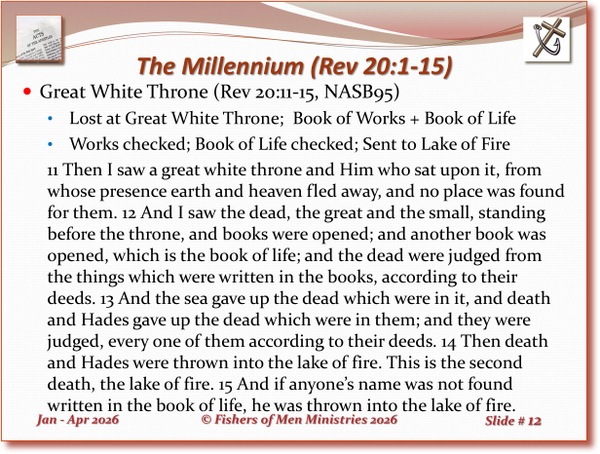
Great White Throne (Rev 20:11-15)
The Great White Throne of Judgement is that place where only those without Jesus Christ as Savior are judged. The questions around this judgement help the understanding of it. First is, who is this judge? The words of verse 11 say simply, “Him who sat upon it, from whose presence earth and heaven fled away” (Rev 20:11, NASB95). Matthew Henry’s Concise Commentary states, “After the events just foretold, the end will speedily come; and there is no mention of anything else, before the appearing of Christ to judge the world. This will be the great day: the Judge, the Lord Jesus Christ, will then put on majesty and terror” (MHCC, v11-15). Henry’s Whole Bible Commentary says, “This will be a great day, the great day, when all shall appear before the judgment-seat of Christ” (MHWBC). This definition adds ambiguity to the Judgement Seat of Christ at which all born again people must stand (Rom 14:10 & 2 Cor 5:10). The context of the latter is clearly a stand against judging one another because we must all (brothers in Christ) be judged at the Judgement Seat of Christ. The former (the Great White Throne) is where “the dead are judged.” Recall that John says clearly, “But the rest of the dead lived not again until the thousand years were finished” (Rev 20:5). The “dead” to be judged here are those “rest of the dead.” It is those who were not invited to the Marriage Supper of the Lamb. They are those who do not have a relationship with God through Jesus Christ. They are the lost; the unregenerated.
They have opportunity to defend themselves through two sets of documented evidence. The first is the Book of Works. The question is what they have done in their lives which prevents God from issuing condemnation to them. What is it that they have done which equals the work Jesus Christ did on the cross? The second book is the Lamb’s Book of Life. It is simply the list of all those who have Jesus Christ as their Savior and Lord. It is easy to see that there are no victories for those judged at this venue. Those whose names were found in the Book of Life were already judged at Calvary and Romans 8:1 applies. Those dead judged here were none of those. The Judge righteously condemns them to the Lake of Fire which is the Second Death. They are guilty of the only unpardonable sin: they have rejected Jesus Christ as their Lord and Savior (Acts 4:12).
New Heaven & Earth (Rev 21:1-9)
Revelation Chapters 21 and 22 reveal what God showed the Apostle John about our lifestyle in the future when we leave this place. John starts by saying he saw the New Heaven and New Earth. He adds that he saw the “new” because the “old” had been taken away (vs. 1). First, he saw the New Jerusalem coming down out of Heaven from God, and it was made ready like a bride would make ready for her husband. I started thinking of make-up and eye shadow. Applying that thought to a city might be streets cleaned and building power-washed to bring out their full beauty. We are told of the streets of gold (Rev 22:2), so maybe a shining of the gold would be in order.
The next phrase of glory is the loud voice stating that the tabernacle (Greek skene or tent) of God is among men, and He will dwell among them, and they shall be His people, and God Himself will be among them (vs. 3). His personal presence with us has not been possible since we fell from the Garden of Eden. Further, He will wipe away every tear from their eyes; there will be no more death; nor mourning; nor crying; nor pain; for all the passed things will have passed away (vs. 4). This lifestyle is foreign to us on nearly every level stated. Not only will God be physically with us, but He will provide intimate care for us on a routine basis. We had already heard and read about how much He cared for us, but the level of intimacy in this level of care is far beyond our imaginations and certainly beyond our expectations.
Verse 5 continues with His revelation by saying that the One who sits on the throne says He is making ALL things new. It just would not be the same as our current experiences of life in any way. He sets a contrast by adding that His words are true, and it is already done or completed (vss. 5-6). He will be our God, and we will be His sons. This comment echoes the same words in John 1:12. The other side of the contrast is that the cowardly, unbelieving, abominable, murderers, immoral persons, sorcerers, idolaters and all liars will have a part in the second death and certainly not with us. This is a commitment to separation from evil influencers.
New Jerusalem (Rev 21:10-27)
The second topic of new things in Chapter 21 is the New Jerusalem. John writes that he was carried away in the Spirit to a great and high mountain where he was shown the holy city, Jerusalem coming down out of Heaven from God (vs.10). This sets up a supernatural origin for the new city and not just a physical rebuilding of that which had been from antiquity. He adds that it had the very Glory of God and was as brilliant as crystal clear jasper stones. The New Jerusalem also had a great and high wall with twelve gates and twelve angels. The gates were named after the twelve tribes or sons of Israel. There were three gates on each side of the city. Further, the great wall had twelve foundations named for each of the Apostles of the Lamb (Christ). The One who spoke with John told him to measure the size of the city and it was discovered that the city was a cube of 1,500 miles (vss. 15-16). Verse 17 tells us that the wall measured 72 yards or 216 feet. Because 216 feet is such a small part of the city’s 1,500-mile cubical structure, the 216 feet must be the thickness of the wall. The foundation stones of the city were adorned with twelve different precious stones capped by each gate being a precious pearl. Verse 21 finishes the description by repeating that the streets are of pure gold, but appearing as transparent as glass.
John emphasizes that he saw no Temple in the city because the Lord God and the Lamb are the Temple of the city. Further the City needs no light from the sun or the moon because the glory of the Lord is the light of the city (vs. 23). All nations will walk in its light, and the kings of the earth will bring their glory into it (vs. 24). Verse 25 states that in the daytime, the gates of the city will never be closed, and there is never any night there. Verse 27 finishes the discussion by advising that nothing unclean, and no one who practices abomination and lying shall ever come into it. Finally, only those who were found to have their names written in the Lamb’s Book of Life were permitted into the city.
In summary, the New Jerusalem shall be holy unto the Lord. The needs of the city whether great or small are supplied by the Lord God and the Lamb. God meets all the needs of the new city.
River & Tree of Life (Rev 22:1-9)
Revelation 22:1-5 talks about of the sources of everlasting life when we get to Heaven. One is the Tree of Life and the other is the River of Life. I both cases, our eternal life depends on our access to the tree or the river of life. Recall from Genesis 3:22, that when man fell because he ate of the tree of the knowledge of good and evil, God removed man’s access to the Tree of Life which also removed man’s access to eternal life. This was the source of Paul’s comment in Romans 6:23 that says the wages of sin is death. While Adam and Eve had access to the River of Life or the Tree of Life, they would live forever. When they sinned and God took that access away from them, they no longer had eternal life. So, death entered the human experience because of sin (Rom 5:12).
Here, God shows John the River of the Water of Life (vs. 1). He tells John it comes from the throne of God and of the Lamb in the middle of its street. On either side of the River of Life was the Tree of Life which provided twelve kinds of fruit, one kind for each month. Further, the leaves of the tree were for the healing of the nations (vs. 2). So, the wages or curse of sin is death, but the gift of God is eternal life. The leaves of the Tree of Life take away that curse. The idea of death from sin speaks of a separation between man and God, but the words of Revelation 22:3-5 reveal that God and the Lamb are once again with humankind, and they will see His face, and they will be sealed on their foreheads. Further, there will be no night there, but they will have no need for a lamp or candle because the Lord God will be the light of the place, and they will reign forever and ever.
In Verses 6-9, the Lord assures John that His words are faithful and true, and that the Lord, the God of the spirits and prophets, sent His angel to show His bondservants the things which would soon take place. He advises that He is coming quickly and blessed is he who listens and acts on the prophecy of this Book. John assures us that he was the one who heard and saw these things, and he fell at the feet of the angel revealing these truths. The angel corrected John and told him he was not to worship any one or thing except God alone and listen to the words of this Book.
Final Message (Rev 22:10-21)
So, the last message of the Book of Revelation is that the time for these prophecies is near. Verse 11 suggests that it is far too late for trying to make significant changes in lifestyle – let things remain the same. Verse 12 says He is coming quickly and He is bringing His rewards with Him to render to each person based on what they have done. But verse 14 goes right back to the greatness of the Savior’s protection and promises. He says, “Blessed are those who wash their robes, so that they may have the right to the tree of life and may enter by the gates into the city.” He says all dogs, sorcerers, immoral, murderers, idolators and liars are outside the city (vs. 15).
Now, Jesus puts His personal wish on His sharing of the Book. He says, “The Spirit and the bride say, “Come.” And let the one who hears say, “Come.” And let the one who is thirsty come; let the one who wishes, take the water of life without cost” (Rev 22:17).
The paragraph of Scripture in Revelation 22:18-19 has strong warnings to anyone who hears the words of this prophecy and adds or subtracts from the Book. Those who add to the Book will have the plagues listed in this Book added to them (vs.18). Likewise, anyone who takes away from the words of this Book, God will cause his name to be taken from the tree of life and from the holy City, which are written in this book. He assures the reader that it is He who is saying these and “Yes, I am coming quickly.” And John replies for all of us, “Amen, Come, Lord Jesus” (vs. 20). And John closes with a personal wish for “The grace of the Lord Jesus be with all. All. Amen’ (vs. 21).
So ends our study of the great Book of the Revelation of Jesus Christ. It is one of the most difficult of the Bible Books because it replies so heavily on the content of the Old Testament. Many of the difficult visions of the Book have as illustrations equally difficult visions from the Old Testament. Interpreting those visions require going back into the Old Testament to get the context and application of the original vision along with any special applications. It is always well worth the effort to bring those timeless truths into New Testament application. We are blessed!!