Signed in as:
filler@godaddy.com

Esther was a little Jewish girl who was orphaned as her mother and father met their deaths in captivity in the Media-Persian Empire. She was taken by her uncle Mordecai to be raised by one of the most wealthy and powerful Jewish men in the Empire. When the King divorced his wife and had a beauty contest to pick a new Queen, God had Esther win. She became the Queen "at such a time as this" to prevent the execution of all the Jews in the empire (Esther 4:14). From an orphan to a queen; from a queen to the voice which saved the race. Learn more on Esther by clicking here.
Ruth was a Moabitess who married Chilion, the youngest of Elimelech and Naomi's two sons. She returned to Bethlehem with her mother-in-law while her sister-in-law returned to the land of her birth. Ruth married her kinsman redeemer and became an ancestor of Jesus, the Christ. Learn more about Ruth by clicking here.

Samuel, the last Judge and first Prophet of Israel, was the writer of 1 and 2 Samuel and Judges, of which the Book of Ruth was likely, originally a part. Put briefly then, Samuel was the writer of Ruth. That helps us fix the date of Ruth to be near 1130 BC because that famine seems to correspond to the oppression by the Midianites and Israel’s subsequent deliverance in Judges 6:3-4. That famine also begins the story of Elimelech, an Ephraimite of Bethlehem in Judah, Naomi, his wife, and their two sons, Mahlon and Chilion, as they sought food in Moab for their physical survival. Elimelech and his two sons died in Moab leaving Naomi and her two daughters-in-law as widows in that foreign land. With the famine ending, Naomi led Orpah and Ruth in returning to Bethlehem in search of a kinsman redeemer for Naomi to rescue her from the loss of all she had. The title of the Book is the name of the wife of Naomi's second son, Ruth..
Ruth was a Moabitess, and as such, was a child of a cursed land. When Ruth wed Boaz, they became ancestors of King David and eventually, Jesus of Nazareth, the Messiah. She went "From a Cursed Child to a King's Mother."
The purpose of the Book of Ruth is to view the significance of it separate from the Book of Judges to emphasize the importance of this particular woman to God's laws of maintaining the inheritance of every member of the tribes of Israel for all future generations to fulfill all aspects of the Abrahamic Covenant. Further, Ruth shows to divine care and providence for bringing the Messiah, Jesus of Nazareth into this world. These two facts blend to see Naomi's kinsman redeemer marry Ruth, bringing Elimelech's inheritance back to Naomi through Ruth's marriage to Boaz. But even beyond that, Boaz and Ruth birth Obed who is Jesse's father and the eight son of Jesse is Kind David in whom is the promise of the Messiah.
Israel and all generations to follow read this Book that sounds like a simple love story and discovers the divine providence of God through the doctrine of the kinsman redeemer in Boaz, but even more so in Jesus Christ.
Naomi is a type of lost person; a person who has lost everything and has realized she is hopeless and helpless for personal survival on her own. The possessions and property she had through her husband left her with his death. Normally, she would have retained her husband's inheritance through her eldest son, but he died in Moab as well. She still had a second son through whom her husband's inheritance would stay in the family, but he too died leaving Naomi and her two widowed daughters-in-law She is in need of a Savior. She has lost everything she once had and finds herself helpless and hopeless in a foreign land. But she was raised in Israel and knew God's Law that the nearest male family member to the dead husband had to marry the surviving widow to maintain the husband's inheritance and have a male child through which the dead husband's legacy could flow to the widow and the family line. The Law's terminology called that person a Kinsman Redeemer (Leviticus 25 & Deuteronomy 25). Naomi knew she was too old to marry and produce another male child, but Ruth was also the widow of an Ephraimite, Naomi needed to seek a kinsman redeemer for Ruth. The documentation of the work of that relentless redeemer makes him a "Type of Christ." He shows how God through Christ comes after every lost person to redeem him for His Father. Hopelessness becomes hope and helplessness become strength through the Redeemer. Naomi lost everything she had including her husband and their two sons. She had nothing and no hope. But she remembered God and came back to Israel out of Moab, that is, she came out of sin into promise. She came out of curse into salvation.
Literal. Ruth will be taught by a verse-by-verse study of the Book. The emphases of the kinsman redeemer and the fact that Ruth became part of the ancestry of Jesus Christ will be proven through the text and related references.
The name of Esther was the Persian name given to a Jewess named Hadassah. Mordecai, a Jew who was exiled with King Jehoiachin by Nebuchadnezzar,, King of Babylon. When Hadassah's father and mother died, Mordecai took her to raise as his own daughter. Esther was the name given Hadassah to conceal her Jewish origin for fear she might be taken into slavery because of her beauty. The title of the Book was given that Persian name. The author of the Book is not given nor implied. Scholars have suggested it was likely Mordecai, the Jewish Leader shown throughout the book in prominent roles including one of saving the King from assassination. Josephus has agreed with that award. The Book was likely written in 483 BC.
This Book is another showing the divine providence of God. and His miraculous care for even the smallest issues of life. This beautiful young woman was a part of the Jewish captivity and could have been swept up as a slave had Mordecai not interceded. It also shows the redeemed of God how He watches over the daily aspects of life as well. He groomed her and gave her the gifts to excel among the other ladies competing with her to be the new queen of Media-Persia.
The audience for Esther is any person living under the care of God. It shows believers what they can expect from God in the form of blessings and empowerment. A believer cannot help being blessed to see God deliver on His promises almost routinely. They can watch Esther move from being a little orphan child in her family to being a queen over the Media-Persian Empire.
The Book of Esther certainly reveals the divine providence of the Lord on an individual level as He takes Esther from being a little orphan girl to becoming the Queen of the Media-Persian Empire, but far beyond that, King Ahasuerus has signed off on a plan that will kill Jews throughout the Empire. As he begins to implement that plan, Esther is the only person who might be able to cause him to reconsider. In verse 4:14, Esther is deathly afraid to enter the throne room of the King without an invitation, but Mordecai asks a question of her which guided and will guide people in unique positions forever. He asks her, "And who knows whether you have not attained royalty for such a time as this?" The question causes her to risk her life because no one else can save her and Jews all across the empire but her. The Scripture shows how she causes the King to reconsider that plan but also directs the righteous revenge on Haman, the author of the plan. The Book ends as Haman is hanged on the very gallows he had constructed for hanging Mordecai.
But even beyond that, Nehemiah 2:6 says, "And the king said unto me, (the queen also sitting by him,) For how long shall thy journey be? and when wilt thou return? So it pleased the king to send me; and I set him a time." That was the command that started the clock on fulfilling the prophecy of Daniel 9:25, "Know therefore and understand, that from the going forth of the commandment to restore and to build Jerusalem unto the Messiah the Prince shall be seven weeks, and threescore and two weeks: the street shall be built again, and the wall, even in troublous times." History shows that on that day, 69 weeks of years (173,880 days) after that command by the King with Esther at his side, Jesus of Nazareth rode a donkey into Jerusalem revealing Himself as the Messiah of God.
Literal. The Book of Esther will be taught verse by verse, chapter by chapter until its content is fully revealed.

This chart helps to understand where life events of Esther fit into the historic setting of other events during her time.

The Bible Book of Ruth has four chapters. We will be studying each chapter weekly beginning on April n26, 2026 and ending on May 17, 2026. Study materials are sent to participants listed. To join the group, simply make a request and send you email address to Dr.Dave@FishersInc.net.
The schedule for studying the Bible Book of Esther begins on May 24, 2026 and ends on July 26, 2026.
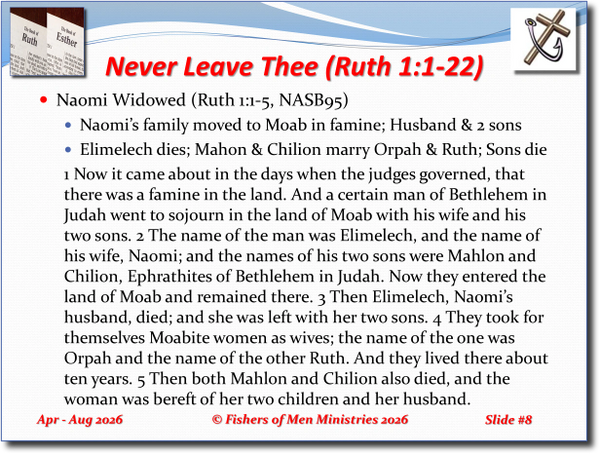
Naomi Widowed (Ruth 1:1-5)
There are two sentences in the opening verse of the Bible Book called Ruth. First, we have time reference established. Samuel, the author of the Book, tells us that this treatise is about the days when Judges ruled the nation of Israel, and there was a great famine in the land (vs. 1a). Second, we learn there is a man of Bethlehem in Judah who decided to take his family to live in Moab for their survival. There is no apparent attempt to abandon their citizenship nor leave their inheritance rather, they want to feed their family in Moab until the famine passes in Israel. We also see in Verse 1b that this family is comprised the man, his wife and his two sons. Verse 2 reveals the names of these main characters. The man’s name is Elimelech, his wife’s name is Naomi, and his two sons are Mahlon and Chilion. In this family, Elimelech is the property owner in Israel. The is no indication that he had sold that land or intended a long-term residence in Moab. According to Israeli law, if something was to happen to Elimelech, Mahlon would be the inheritor of a double portion of his father’s estate with Chilion getting the remaining one-third part. We also learn that Elimelech is an Ephrathite of Bethlehem in Judah. Ephrath is a name historically linked with Bethlehem as in Genesis 35:19 saying, "So Rachel died and was buried on the way to Ephrath (that is, Bethlehem)." This links Ephrath with Bethlehem and with notable figures of the Old Testament like Rachel (Jacob’s favored wife), King David and our Savior Jesus of Nazareth, the Messiah (Micah 5:2).
Verse 3 is where Naomi’s calamity begins. Samuel tells us that Elimelech died leaving Naomi with their two sons. The two boys took Moabite women to marry and lived in Moab another 10 years (vs. 4). Verse 5 goes on to tell us that Naomi then lost both her sons, Mahlon and Chilion, to death. It becomes horrific for Naomi because, in addition to the full bucket of grief in losing a husband and her only two sons, she is now left with the Moabite widows of her two sons and their associated grief. Verse 4 advised that the names of those two women were Orpah and Ruth. (Oprah Winfrey’s first name was given as Orpah Gail but mispronounced as Oprah and stuck!)
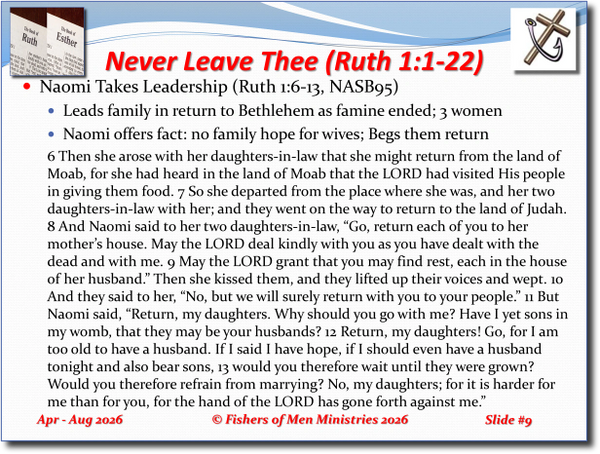
Naomi Takes Leadership (Ruth 1:1-5)
At this point, Naomi departed with her daughters-in-law for Bethlehem of Judah in Israel because she had heard while in Moab that the Lord visited His people in Israel by providing food (vs. 6). So, Naomi left Moab for Judah believing that God was supporting Israel and had ended the famine in the land. But even after she made another plea to them saying, she was very concerned about how they would be received in the Israeli world knowing of the curse of which they were all aware. She wondered if the world that appeared so welcoming and loving would stay that way after the Moabites arrived. Naomi made one more plea to her daughters-in-law saying, “Go, return each of you to her mother’s house. May the LORD deal kindly with you as you have dealt with the dead and with me. 9 May the LORD grant that you may find rest, each in the house of her husband” (vss. 8-9). She was so sure she communicated the advantages of their returning home that she kissed them with a farewell greeting and turned to go. But not so! They lifted up their voices and wept and said, “No, but we will surely return with you to your people” (vs.10).
But Naomi knew the laws of Israel and the process they were about to enter. The process was that Naomi would have to marry the kinsman redeemer to produce a new offspring, and she knew she was far too old to make that happen. Further, even if she could have another child that vary day, he would be a newborn, and they would have to wait almost two decades before the child could marry and be a husband to them. So Naomi said, “11 Return, my daughters. Why should you go with me? Have I yet sons in my womb, that they may be your husbands? 12 Return, my daughters! Go, for I am too old to have a husband. If I said I have hope, if I should even have a husband tonight and also bear sons, 13 would you therefore wait until they were grown? Would you therefore refrain from marrying?” Naomi was resolute in telling her daughters-in-law that there was just no way that she could make it work. She insisted, “No, my daughters; for it is harder for me than for you, for the hand of the LORD has gone forth against me” (vs. 13). I think it is possible that Naomi was only looking at her being the one to approach the kinsman redeemer? What if it were them?
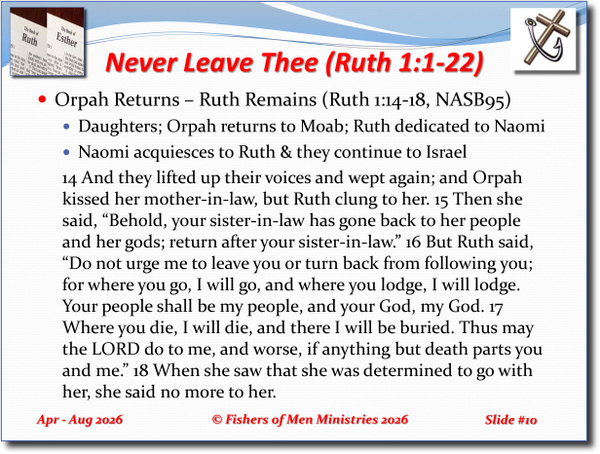
Orpah Returns – Ruth Remains (Ruth 1:14-18)
After Naomi tries again to tell Orpah and Ruth of the hopelessness of the situation in Bethlehem, the Moabitess women lifted up their voices to protest Naomi’s suggestion that they return to their families in Moab still again. But this time Orpah finally gave in and agreed to return to Moab. Naomi described the truth of the situation if it were to be solved by her providing two more sons for the young Moabites women to married. To restore normality to Orpah and Ruth, Naomi would have to allow them to marry two other of her sons. But as Naomi told them she had no other sons and was just too old to have more. She continued that even if it were possible, they would have to wait almost two decades before the babies could marry them. In fact, the two Moabites women would also be too old by then. Orpah heard the reasoning and agreed it would be better to leave.
But Ruth clung even more strenuously to her mother-in-law (vs. 14). It was clear that Ruth was not looking for Naomi to provide another son to be her husband, she was focused on taking care of the mother of the son she loved so dearly. Even so, Naomi tried once again to get Ruth to do the same as Orpah. She said, “Behold, your sister-in-law has gone back to her people and to her gods; return after your sister-in-law” (vs. 15). Ruth’s response was so absolutely compelling that it has been used in more weddings than any other Scripture. It also spoke highly of Ruth’s love and commitment to Naomi that it is not repeated anywhere else. Ruth said, “Do not urge me to leave you or turn back from following you; for where you go, I will go, and where you lodge, I will lodge. Your people shall be my people, and your God, my God. Where you die, I will die, and there I will be buried. Thus may the LORD do to me, and worse, if anything but death parts you and me” (vss. 16-17). These words were so strong that Naomi was convinced of Ruth’s sincerity and dedication. She stopped trying to convince her to return to Moab even though she sincerely thought it best for her. There is no doubt that Naomi even considered the Kinsman Redeemer concept to recover her estate from Elimelech’s death, but she realized it would be very difficult to find such a kinsman who would try to have a son with her even if she was young enough to have one. The Bible simply says Naomi said no more on the subject (vs. 18).

Naomi Returns to Bethlehem (Ruth 1:19-22)
So, both widows travelled until they came to Bethlehem. They entered the city; one returning after several years and the other having never seen Israel but knowing that her and all the people of Moab were under God’s curse. Recall that when God destroyed Sodom and Gomorrah, their father, Lot, escaped before the destruction began. His daughters believed they would never have a normal life so, they decide to have children by him after causing him to be heavily intoxicated. Their plan worked and their two cursed offspring began the nations of Moab and Ammon (Gen 19:31-38). So, the two Moabitess women who Naomi’s sons married, carried that curse on them. Neither Naomi nor Ruth knew how the people of Bethlehem would react to them.
But when they arrived, the entire city was excited to see Naomi (vs. 19). The women asked if she was really Naomi, both because it had been so long and they loved and missed her. She was under so much pressure in those days and felt so much different than before, she asked, “Why do you still call me Naomi” (Hebrew Noʻŏmîy meaning pleasant)? She said, “Call me Mara, instead” (Hebrew Mârâʼ meaning bitter)! For the Almighty has dealt very bitterly with me. I went out full, but the Lord has brought me back empty.” Naomi said she felt like calling her Naomi instead of Mara, pleasant instead of bitter, caused pain for her. Naomi felt like God had witnessed harshly against her, and He has singled her out for affliction and suffering. She had lost her husband and both her adult sons while in Moab. She told the women of the city, “I left here full, but have returned completely empty.” I am certain that the added responsibility she felt toward Orpah and Ruth added to that despair.
So, Chapter 1 finishes its set up by summing that Naomi had returned, and with her Ruth, the Moabitess, her daughter-in-law. Ruth returned from the land of Moab, and they came to Bethlehem at the beginning of the barley harvest (vs. 22). Ruth’s friends were witnessing the results of an afflicted woman. She left pleasant but returned bitter; left full but returned empty. Arriving at the beginning of the barley harvest meant they could “glean the edges of the field.”
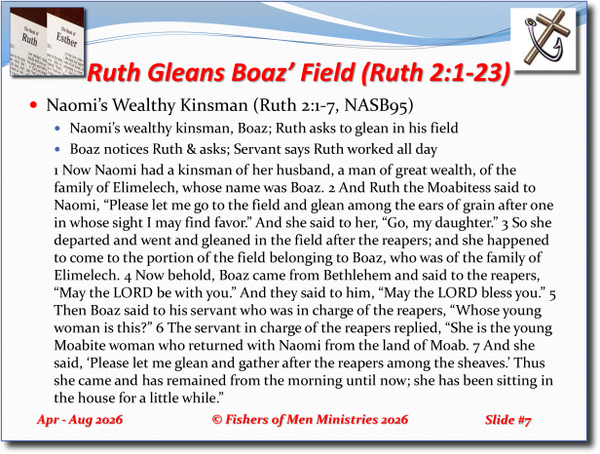
Naomi’s Wealthy Kinsman (Ruth 2:1-7)
Chapter 2 introduces the idea of the Kinsman Redeemer and a specific kinsman related to Naomi’s late husband, Elimelech. His name is Boaz and he is a very wealthy man, probably the wealthiest man near Bethlehem. He was a landowner and the barley harvest had just begun. Naomi told Ruth about the Jewish law concerning the requirement for landowners to leave the corners of the crops for harvesting by the poor and needy people of the community, so Ruth suggested she go to the fields of Boaz to harvest or glean from the corners of his fields. So, she began gleaning just after the professional reapers. The Bible may have been a little facetious as it said, “and she happened to come to the portion of the field belonging to Boaz, who was of the family of Elimelech” (vs. 3). It was clearly the plan of Naomi and Ruth that Ruth would glean in the fields of Boaz because they knew he was a near kin to Elimelech (vs. 1). Nevertheless, when Boaz came to the field from Bethlehem, he asked the leader of the reapers, “Whose young woman is this?”
The Bible provides no clues for why Boaz picked Ruth out from all the others who must have been gleaning in his fields that morning, but the fact that he did notice her may have been because of her appearance, the way she dressed or simply divine intervention. Whichever reason is true, it matters not as much as the fact that Boaz asked about Ruth. The encounter hoped for by Naomi happened on the very first day Ruth was in the field.
The servant in charge of reaping replied, “She is the young Moabite woman who returned with Naomi from the land of Moab” (vs. 6). Verse 7 continues that Ruth had asked Boaz’ servant to allow her to glean and gather after the reapers among the sheaves. The servant evidently agreed and was reporting that Ruth came early in the morning and had been in the field all this time except for a short visit to sit inside the house.
So, Ruth had not only gone to the field as agreed with Naomi, but she had asked permission of the leader of the reapers to reap beyond the corners into the area reaped after the professionals.
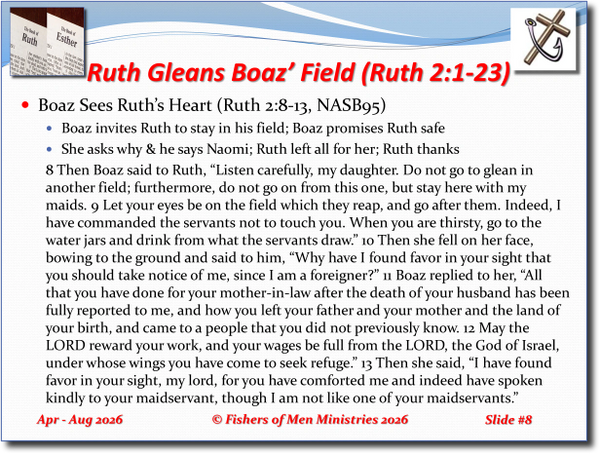
Boaz Sees Ruth’s Heart (Ruth 2:8-13)
Hearing the report, Boaz speaks directly to Ruth instructing her, “8 Listen carefully, my daughter. Do not go to glean in another field; furthermore, do not go on from this one, but stay here with my maids. 9 Let your eyes be on the field which they reap, and go after them. Indeed, I have commanded the servants not to touch you. When you are thirsty, go to the water jars and drink from what the servants draw” (vss.8-9). Boaz is not only going a long way toward making Ruth feel welcomed in his fields but making sure she looks nowhere else.
Notice also that Boaz, being previously notified that Ruth was a Moabitess, was not discouraged by that part of Ruth’s background. The curse on her nation of origin will not be a part of their relationship. This fact seemed strange to Ruth as well. After humbly falling on her face and bowing to the ground before him, she asked, “Why have I found favor in your sight that you should take notice of me, since I am a foreigner?” (vs. 10).
Boaz’ answer shows that he has already researched at some depth concerning her. He replied, “11 All that you have done for your mother-in-law after the death of your husband has been fully reported to me, and how you left your father and your mother and the land of your birth, and came to a people that you did not previously know. 12 May the LORD reward your work, and your wages be full from the LORD, the God of Israel, under whose wings you have come to seek refuge.” Boaz recognized that not only was Ruth a widow suffering the loss of her own husband (another Israeli brother who had an inheritance in Israel which must be redeemed), but she is ministering to her widowed mother-in-law who is renowned among the citizens of Boaz’ hometown, Bethlehem. His reply to her question was full of respect, admiration and gratitude, and included a blessing from the Lord as well. Boaz was impressed by Ruth’s service to her mother-in-law and her personal work ethic shown that same day. Ruth is grateful for the favor and the comfort he has shown to her and that he does all this knowing she is not like the rest of his people (a reference to her heritage again?) (vss. 11-12). He even recognized her religious conversion!
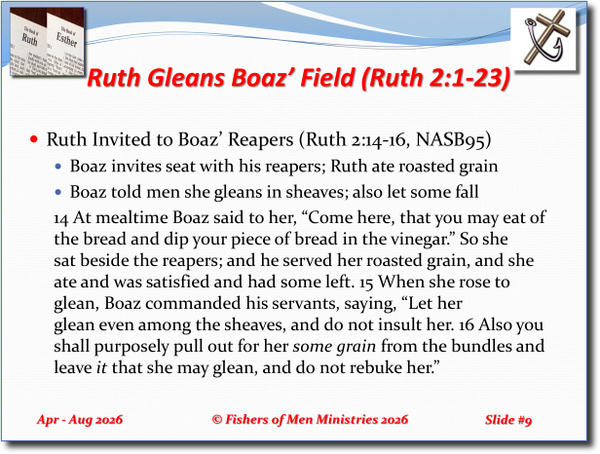
Ruth Invited to Boaz’ Reapers (Ruth 2:14-16)
But Boaz has not finished, yet. When the time of the noon meal came, he called Ruth to him and said, “Come here, that you may eat of the bread and dip your piece of bread in the vinegar.” This move is akin to that of David inviting Mephibosheth, Jonathan’s lame son, to sit at his table when he became king. Boaz obviously knew a great deal about Ruth, including those things he has now, personally witnessed. Anyone disagreeing with his treatment of her would be facing the risk of his rage. After inviting Ruth to join him and dip her bread in the same plate of vinegar, and to sit with him and his professional reapers to enjoy some roasted grain, she ate to her full and had some left over (vs. 14).
When they arose from the meal, Ruth headed off to continue gleaning in the field, but Boaz directed his servants to let her glean among the sheaves (vs. 15). This means that instead of gathering from what was left by the reapers, she could take some of what they had already harvested. This is another of Boaz’ efforts to make sure that all involved knew Ruth would not be abused, threatened or insulted (vss. 9 &15). He anticipated and acted to prevent anything that would cause Ruth to leave his fields and companionship for any other field or group of people.
Verse 16 directs even more allowance for Ruth to gain reward for her labor in his fields. Here, he directs his professional reapers to allow some of the grain already reaped to fall from their baskets to allow Ruth to collect it. Notice again that Boaz is adding words of protection for Ruth to every element of his care for her. Here, he makes sure that she will not be rebuked for collecting the grain purposely allowed to drop for her. Some might believe this to be an unnecessary restriction, but while hungry people are trying to get food for survival, some might be so focused on that survival that they become unreasonably aggressive against those working near them. In this case, it might result in harm against Ruth or another person seeming to collect more than they are. Boaz has probably seen too much of this in the past and is merely reacting to prevent those things from happening to Ruth. Those lacking the experience of poverty may never understand its results.
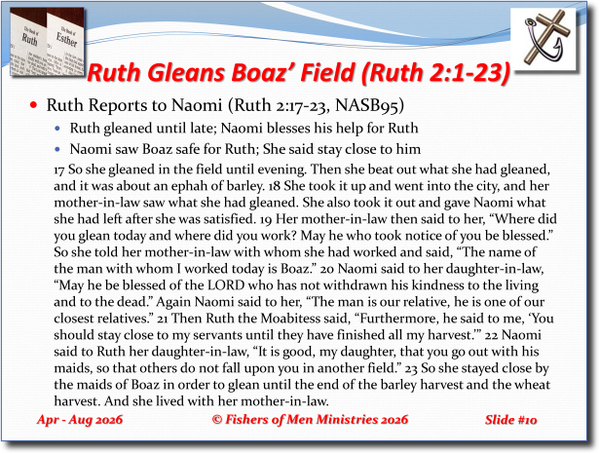
Ruth Reports to Naomi (Ruth 2:17-23)
Verse 17 begins the measure of the results of Ruth’s efforts in Boaz’ fields that day. First, we see that she stayed in the fields the full day. Time was generally based on sunrise and the number of hours after that event. Familiar biblical events, like the crucifixion, talk of what happened to Jesus on the third hour or the sixth hour. These comments measure time as the number of hours after sunrise. By the comments quoted earlier, it appears that Ruth appeared at Boaz’ fields early in the morning and did not retire from the fields until evening or maybe sunset. This is far beyond a full day’s work. Nevertheless, when Ruth beat out the grain from the grain staffs, she had more than an ephah (about 22 liters or 3/5 of a bushel). AI Summary suggests that 22 liters of barley would feed Ruth and Naomi 275 meals total. At 2 meals per day, Ruth’s one day of work could last about 138 days or over four (4) months. Both Ruth and Naomi appreciated what that amount of barley could mean. It was nothing short of astonishing!
Ruth also told her mother-in-law about the meal of roasted grain she had at the mid-day meal and how she had eaten her full and still had a sizable amount left over for Naomi. All Naomi could do was to ask her where she had gleaned that day. Naomi spoke a blessing over him even before she had an answer. When Ruth told her it was Boaz who blessed her, Naomi was even more excited. She told Ruth that Boaz was a very near relative, and she blessed him again. She said, “May he be blessed of the LORD who has not withdrawn his kindness to the living and to the dead” (vs. 20). Naomi’s statement already looked forward to the possibility that Boaz might be their kinsman redeemer. That is, Boaz might be the one designated by Jewish law to redeem that which had been lost to the death of Elimelech, a Jewish man and father (Lev 25:25-35). That is the reference Naomi used about him blessing the living and the dead (vs. 20).
Naomi also sees the immediate blessing Boaz put upon Ruth by having her glean among his maids in his fields. She would certainly be protected from anyone harming her for fear of retaliation of Boaz’ soldiers. Verse 23 looks ahead to the completion of the barley and wheat harvests.
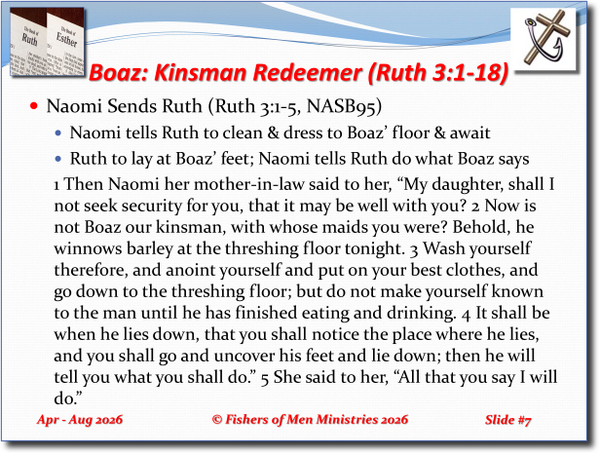
Naomi Sends Ruth (Ruth 3:1-5)
So last time, we saw Naomi establishing procedures for Ruth while she was implementing real behaviors. This chapter, we see all those plans coming together to establish measurements of actual work being done. Naomi begins the third chapter by making sure Ruth has her sights firmly on the objectives and is working with Naomi on one side and the laws of Israel on the other. Recall that Naomi explained the Kinsman Redeemer concept and role to help Ruth know how to make that program work. Naomi had Ruth go to the right places to get Ruth noticed, and Ruth evidently had the right skills to exploit her talents. But it was God who took the gifts and works to cause Naomi, Ruth and Boaz to desire the outcomes made available by Him.
Now, the work of God’s hands can be seen. Naomi guided Ruth to be in her Kinsman Redeemer’s field to be noticed by him. Boaz even made comments and commitments in Chapter 2 concerning his role in the work of that Kinsman. Boaz gave Ruth privileges which were certainly beyond any he gave to any others. He moved her inside the areas of the harvesters to make her work in that harvest much easier. Naomi and Boaz both see and are willing to move forward in that context.
Naomi now identifies Boaz to Ruth as a near kinsman of Elemilech as a potential redeemer for Ruth. Naomi makes sure she looks and dresses the best she possibly can. Ruth has been prepared to know when, where and how to approach Boaz. It would be after he ate and drank his full, and went to retire for the night (vss. 1-3). When his heart is still merry and he has retired, Ruth is to make note of where he is lying. At that time, Ruth is to slip closer to him, uncover his feet and lay down with him, and he will tell Ruth exactly what to do from that point forward. Naomi added that Boaz would then tell Ruth the next steps.
Ruth finished her interaction with Naomi by assuring her that she heard what she said and understands how it is used. Ruth tells Naomi that she will do everything that she showed her. Ruth will be prepared to follow Naomi’s instuctions.
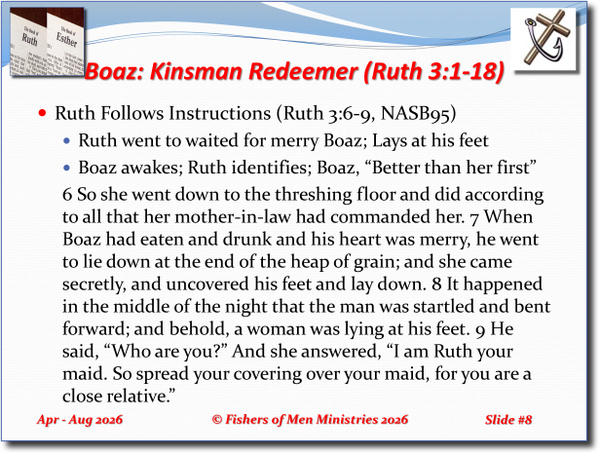
Ruth Follows Instructions (Ruth 3:6-10)
So now, the stage is set and the script is in place. The first players we see are Ruth and Boaz and the scene is the threshing floor of Boaz as Ruth enters the picture. The Scripture says simply that, “She went down to the threshing floor and did according to all her mother-in-law had commanded her” (vs. 6). Ruth was an excellent person of study. Naomi had the knowledge of Israeli Law. She had the experience. She had lived among Boaz and all the others a little over a decade before. Verse 7 continues that when Boaz had eaten and drunk and his heart was merry, he went to lie down at the end of the heap of grain. Now, we see Ruth enter the picture. She came in secretly, discretely. She bent down and uncovered the feet of her mother-in-law’s near kinsman, the one who might be the redeemer of the property and rights of the dead husbands of Naomi and Ruth. His required work was to produce a son for the inheritance of the decease countryman, Elimelech. But all of us watching are seeing something more dear, tender and loving happening here.
Verse 8 finishes with Ruth laying at the feet of Boaz. The symbol of humility and surrender to the laws of ancestral redemption as Moses wrote in Deuteronomy 25:5-6 saying, “5 If brethren dwell together, and one of them die, and have no child, the wife of the dead shall not marry without unto a stranger: her husband's brother shall go in unto her, and take her to him to wife, and perform the duty of an husband's brother unto her. 6 And it shall be, that the firstborn which she beareth shall succeed in the name of his brother which is dead, that his name be not put out of Israel” (KJV).
As Ruth takes her position at the feet of Boaz, he was startled and bent forward to find a woman at his feet (vs. 9). Boaz asked, “Who are you?” Ruth responded to him, “I am Ruth your maid. So spread your covering over your maid, for you are a close relative.” Notice that Ruth specifically ties her actions to the Scriptures associated with the responsibilities of the near kinsman or Kinsman Redeemer. The Scripture specifically states that part of that responsibility is to prevent the wife of one’s deceased brother from going outside the brotherhood of near kin to have a male child for preserving her inheritance (Deut 25:5).
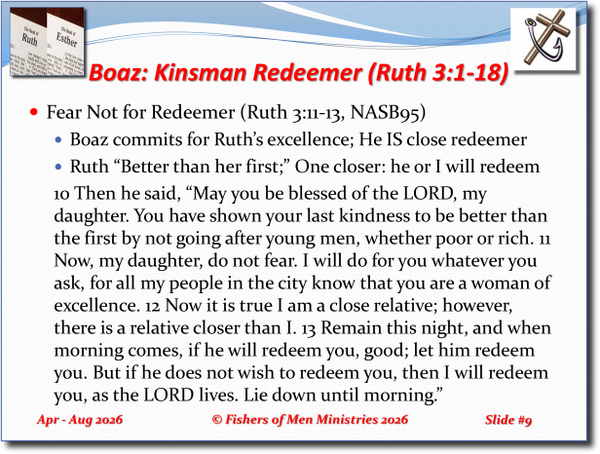
Fear Not for Redeemer (Ruth 3:11-13)
As Boaz continued to recover from his shock of finding a young woman at his feet on the threshing floor, he tells Ruth that the blessing she showed to him in this last kindness to him is even greater than that of not going after the younger men, whether poor or rich from outside Israel (vs. 10). Boaz was in the process of fulfilling the Scriptural requirement (as already quoted) to take the widow to himself to wife and provide for her a male child to carry his father’s inheritance among all the brothers of Israel. Boaz recognizes that a woman of such quality would have no trouble finding a husband who might be richer that he. No, Ruth is following the leadership of the woman, the mother-in-law, she loves. Ruth said it much earlier when she spoke her commitment to Naomi, “Do not urge me to leave you or turn back from following you; for where you go, I will go, and where you lodge, I will lodge. Your people shall be my people, and your God, my God. 17 Where you die, I will die, and there I will be buried. Thus may the LORD do to me, and worse, if anything but death parts you and me” (Ruth 1:16-17). Boaz recognized early that Ruth had left everything to stay with Naomi and the people of Israel under the God of Israel (Ruth 2: , 2:11-12).
What is the result of Ruth’s extraordinary dedication? Verse 11 expresses the promise of Boaz in direct and simple language. Boaz said, “Now, my daughter, do not fear. I will do for you whatever you ask, for all my people in the city know that you are a woman of excellence.” Boaz goes on to explain the bad news he had discovered, he said, “Now it is true I am a close relative; however, there is a relative closer than I.” With this comment, Boaz reveals his personal commitment to Ruth, to see her redeemed regardless of whether he is the redeemer or the nearer kinsman is the redeemer (vs. 13). He tells her to remain with him the rest of the night on the threshing floor, and “when morning comes, if the nearer kin will redeem you, good; let him redeem you. But if he does not wish to redeem you, then I will redeem you, as the LORD lives. Lie down until morning.” It is abundantly clear that Boaz is totally committed that he will cause this issue to be gone in the early light. Boaz stands ready to redeem Ruth if the nearer kinsman refuses.
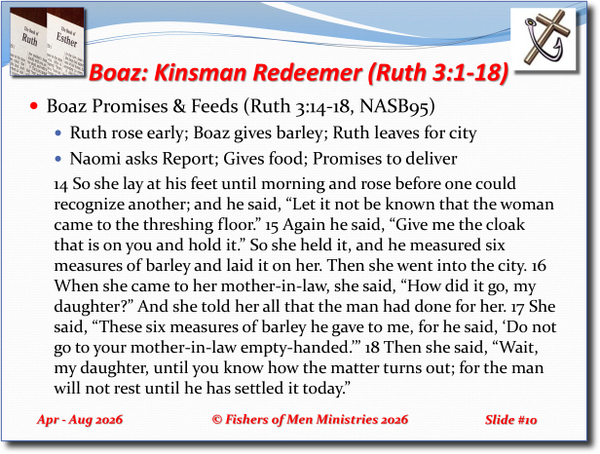
Boaz Promises & Feeds (Ruth 3:14-18)
We pick up Ruth as she continues her evening sleep with the near kin who committed to see her redeemed. She remained lying at his feet and arose before she could have been seen by anyone. Boaz spoke of it saying, , “Let it not be known that the woman came to the threshing floor” (vs. 14a). But as she prepared to depart, Boaz called to her to gift her with more food. He asked her to spread her cloak again, and he filled it with another six measures of barley (vs. 14b). Some commentators say the significance of the six measures of barley was that the number six was incomplete or unfinished. Boaz might have been suggesting he committed to more, and it is not yet completed. His strongest commitment was to see Ruth redeemed, or better stated, he would see the belongings of Elimelech, Maylon and Chilion redeemed. Naomi was the most senior, Orpah had returned to Moab and Ruth was the subject of this Bible book.
As in the previous cases, Ruth returned to the city where her mother-in-law was waiting. As usual, Naomi asked how things went. Ruth briefed her on all the follow-on efforts apparently following the very impacting statements made by Boaz. Ruth seemed to have an inexhaustible source of great worth. Samuel gives an abbreviated summary of what took place with Boaz and her (Ruth). There was, of course, The incomplete business redeeming Ruth.
As she was describing all the great words and deeds Boaz did for the team, she was running out of words of gratitude. The most significant was that Boaz had personally committed to Ruth’s redemption of Elimelech’s belongs and inheritance through Ruth. At this point, it seemed that Boaz would be the source of God’s blessings to redeem Ruth which would include the entire family of Elimelech and Naomi. The purpose of the redemption laws seem to be completed anyway. The only unknown at this point was whether the Kinsman Redeemer would be Boaz or the closer kin. Naomi tried to assure Ruth of her full security because Boaz was not the kind of man to delay getting things done. She said, “Wait, my daughter, until you know how the matter turns out; for the man will not rest until he has settled it today” (vs. 18). Ruth’s redemption tomorrow?
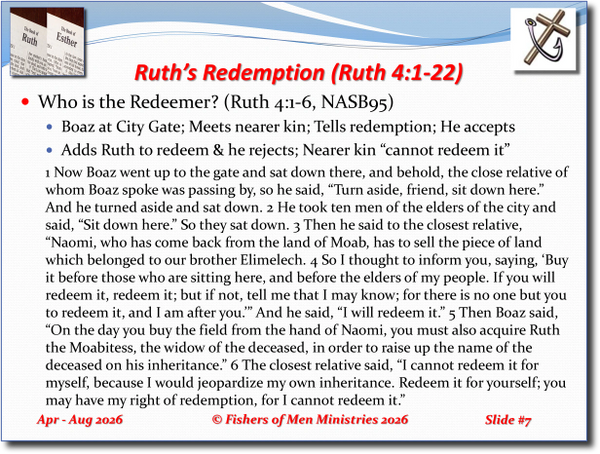
Who is the Redeemer (Ruth 4:1-6)
In Chapter 3, Boaz told Ruth that he had discovered there was a kinsman closer than he. He promised her that, if that nearer kinsman did not redeem her, he would. So, Ruth enters this day feeling the security of knowing her redemption is near, but she was unsure of by whom that redemption would take place. Just as a reminder, the redemption being discussed is the fulfillment of Israeli law to preserve the ownership of the land in the Promised Land for its original owners and their descendants. Naomi, Ruth and Orpah each lost their husbands who owned an inheritance in Judah, in or near Bethlehem. As Naomi returned to Bethlehem, she learned of the near kinsman, Boaz and has been establishing her need to redeem her husband’s property through him. We are now very near to closing on that issue.
Naomi was correct when she told Ruth that Boaz would not rest until he had settled the matter with the nearer kin (vs. 3:18). Boaz went to the city gate that next morning and saw the nearer kin passing by and said, “Turn aside, friend, sit down here” (vs. 1). As the man sat down, Boaz collected ten men of the community’s elders and had them sit down as well (vs. 2). In the next verse, Boaz gets right down to the business at hand saying to the nearer relative, “3 Naomi, who has come back from the land of Moab, has to sell the piece of land which belonged to our brother Elimelech. 4 So I thought to inform you, saying, ‘Buy it before those who are sitting here, and before the elders of my people. If you will redeem it, redeem it; but if not, tell me that I may know; for there is no one but you to redeem it, and I am after you.”
Initially, the nearer kin said he would redeem the land, but when Boaz told him he would have to redeem Ruth, the Moabitess and widow of their brother, he refused saying he feared jeopardizing his own inheritance. He told Boaz to go ahead of him and redeem the property and Ruth, taking his right of redemption, for he could not exercise that right. Speaking as the nearer kinsman did in the presence of ten of the city’s elders established the intent to refuse the right, but it required a formal step we see listed in Deuteronomy 25:8-10 to refuse marrying a brother’s widow..
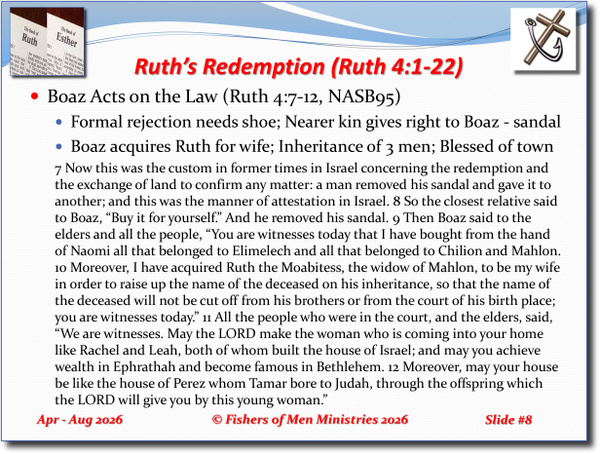
Boaz Acts on the Law (Ruth 4:7-12)
Verses 4:7-12 reviews the details of this transaction. Samuel writes of the former custom to confirm the redemption and exchange of the land involved, “a man removing his sandal and giving it to another to attest the transfer (vs. 7). So, the nearer kin of Boaz publicly said to him, “Buy it for yourself,” and he took re moved his sandal and gave it to Boaz. Boaz turned to the witnesses (elders) and all the others saying, “9 You are witnesses today that I have bought from the hand of Naomi all that belonged to Elimelech and all that belonged to Chilion and Mahlon. 10 Moreover, I have acquired Ruth the Moabitess, the widow of Mahlon, to be my wife in order to raise up the name of the deceased on his inheritance, so that the name of the deceased will not be cut off from his brothers or from the court of his birth place; you are witnesses today” (vss. 9-10).
All the people who were in the court and the elders agreed that they were witnesses to this transaction. But then they offered Boaz and Ruth formal blessings far beyond any they could have expected. They said, “11 May the LORD make the woman who is coming into your home like Rachel and Leah, both of whom built the house of Israel; and may you achieve wealth in Ephrathah and become famous in Bethlehem. 12 Moreover, may your house be like the house of Perez whom Tamar bore to Judah, through the offspring which the LORD will give you by this young woman” (vss. 11-12).
The blessing of Ruth being like Rachel and Leah was reference to the wives of Jacob (Israel) as they (and their handmaids) gave Jacob the twelve sons who would become the Twelve Tribes of Israel (Gen 35:22c-26). So, the blessing the people placed on Boaz and Ruth were blessings of plenty of children and the fame of the twelve sons of Israel. They added even beyond that wishes for great wealth and power in Ephrathah and fame in Bethlehem (vs. 11). Bethlehem was in the region of Ephrathah and is associated with death and burial Rachael, the wife Israel loved.
The final blessing the court gave them was that their house would be like that of Perez of whom Tamar bore Judah, the father of all in this land. A strong blessing of inclusion for Ruth.
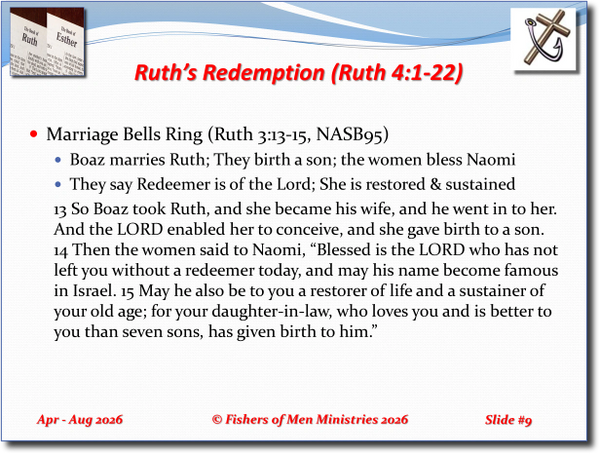
Marriage Bells Ring (Ruth 4:13-15)
So, the legalities of Boaz replacing the nearest kin as the Kinsman Redeemer is officially completed and properly noted at the tribal level as witnessed by the townspeople and elders of Bethlehem. Verses 4:13-15 document the actual marital ceremony between Boaz and Ruth. Verse 13 summarizes all that took place in a very few, short words: “Boaz took Ruth, and she became his wife, and he went into her, and the Lord (Jehovah) enabled her to conceive, and she gave birth to a son.” The action of taking Ruth means that he took her away from where she was and went to be with him (Boaz). This may not seem important but recall that the action that is taking place is a legal responsibility for a near kin to take his brother’s wife and produce a male child with her. This can be done formally or informally. The words suggest that Boaz and Ruth are starting a formal husband/wife relationship where the wife will go to live with the husband. In other words, this couple see the relationship as wedding for life, not just a response to a requirement to produce a male child to redeem the inheritance of Elimelech, Mahlon and Chilion through Ruth. This seems consistent with the blessings offered by the many witnesses at the wedding. It was certainly more than responding to a legal requirement.
The responses of “the women” of the community to Naomi are in verses 14 and 15. They said, “14 Blessed is the LORD who has not left you without a redeemer today, and may his name become famous in Israel. 15 May he also be to you a restorer of life and a sustainer of your old age; for your daughter-in-law, who loves you and is better to you than seven sons, has given birth to him.” The women are congratulating Naomi in that God (the Lord Jehovah) has provided a Kinsman Redeemer for her. They wish for her that the child’s name becomes famous in Israel and become a restorer and sustainer of life in her old age. Separately, they want to recognize that Ruth, her daughter-in-law, has proven her love for her and is better to her than seven sons could have been. All of these words further cement the idea that this wedding was more than just a response to a legal requirement. This woman, Ruth, who is better to her than seven sons, also provided this child to become the sustainer of Naomi’s life; she is once again full and no longer empty!
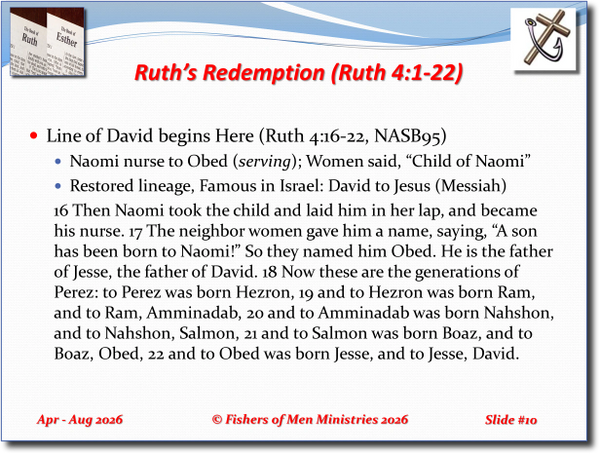
Line of David Begins Here (Ruth 4:16-22)
Verse 16 presents a picture of the child’s grandmother laying him to rest on her lap. The action looks like the action of accepting the child as a son to her as he certainly redeemed the inheritance of her two dead sons, Mahlon and Chilian. However, he was also the son of her daughter-in-law, which makes her the child’s grandmother. In fact, the child replaces Naomi’s husband and her two sons. He was the inheritance of two generations of ownership inside Israel. Verse 16 finishes by saying that Naomi became a nurse to the child. The Hebrew word for “nurse” here is aman and means serving or one who serves. So, Naomi will be instrumental in “bringing up” the boy to serve. It seems the neighboring ladies are active in naming the child, Obed which matches the idea of serving as introduced by Naomi and the women in verse 16.
At this point, Verse 17b, Samuel wants to switch to discussing the heritage of Ruth through Obed. He says that Obed was the father of Jesse who is the father of David. That sets up this widowed Moabitess woman as the great grandmother of the greatest king in all of Israeli history, King David, about whom the Apostle Paul says, “And when he had removed him, he raised up unto them David to be their king; to whom also he gave testimony, and said, I have found David the son of Jesse, a man after mine own heart, which shall fulfil all my will” (Acts 13:22).
Verses 18-22 give the rundown of the ancestry in more detail saying, “Now these are the generations of Perez: to Perez was born Hezron, to Hezron was born Ram, to Ram was born Amminadab, to Amminadab was born Nahchon, to Nahshon was born Salmon, to Salmon was born Boaz, to Boaz (and Ruth) was born Obed, to Obed was born Jesse and the Jesse was born David. And the prophecy continues from there that the “Root of David,” the “Lion of Judah,” the Mesiah of the Old Testament and the Christ of the New Testament, Jesus of Nazareth would be a descendant of King David. This ancestry is consistent with that detailed in the Gospel according to Matthew and the Gospel according to Luke (Matt 1:1-16 & Luke 3:23-38). Matthew, a tax collector, would have given Joseph’s ancestry while Luke, a physician, would have given Mary’s.
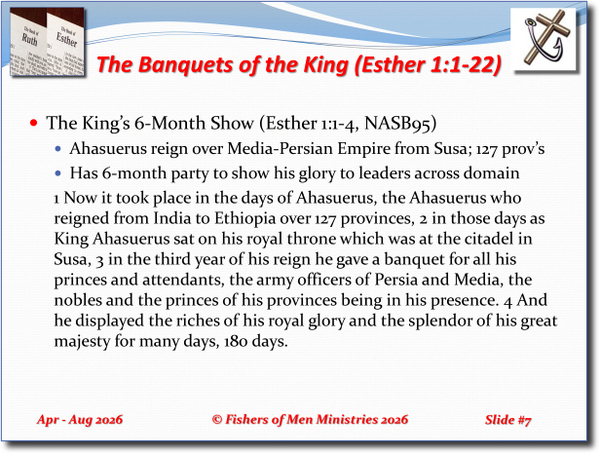
The King’s 6-Month Show (Esther 1:1-4)
The Book of Esther begins by exposing the extravagances of King Ahasuerus (Xerxes I) who ruled the Media-Persian Empire from 486 to 465 BC (Ahasuerus is Hebrew while Xerxes is Persian). He reigned over the 127 provinces (states or countries) between India and Ethiopia. The king reigned from the citadel in the city of Susa. The Citadel was a strong, raised fortress inside the larger city. Xerxes decided to throw a royal ball early in his reign to display his power, wealth and glory. His party included all the dignitaries from all 127 provinces and lasted for 180 days or 6 months. He invited all his military officers in addition to the civilian dignitaries. This was a typical move for all dignitaries who wanted to remain in power because the command of the military provided the internal power to maintain control over the nation and its vast provinces.
Just a few words of historic context, the Jews were taken into captivity, Israel by Asyria in 722 BC and Judah by Babylonia in 586 BC. Jerimiah 25:11 tells us the captivity in Babylonia was to last 70 years. Cyrus, the Persian king who defeated Babylonia, released them in 539 BC. Zerubbabel, a descendent of King David, was appointed King of Israel by Cyrus and led 42,360 Jewish exiles back to Israel about 516 BC (Ezra 6:14). A second group went back to restablish spiritual and religious life of the community under Xerxes I. A third return was under Xerxes (with his Queen at his side – Esther?) where Nehemiah rebuilt the wall around Jerusalem in 445 BC. This is the return which fulfilled Daniel’s Prophesy that it would be 69 weeks of years (173,880 days) from the commandment to rebuild (Neh 2:6) until the coming of the Messiah at the Trumphant Entry. The accuracy of the picking that date thousands of years before it happened is one of the great delights of serving a God Who knows the events of the end from the very beginning.
So here, we have a secular king who believes the world is at his personal beckoning. Little does he know that God set up the events of when Israel would fall and when they would be released from captivity long before they were even thoughts.
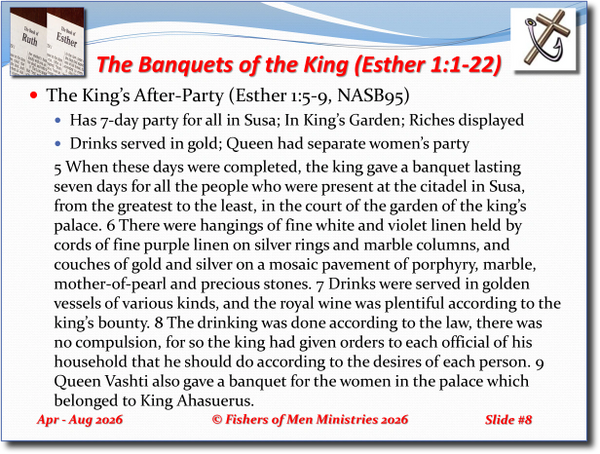
The King’s After Party (Esther 1:5-9)
So, the six-month party was wild and Ahasuerus did all he could to demonstrate his complete authority over everyone and everything in the empire. There was no real purpose for all this expense other than for Xerxes to show he could do it. After the party was over, Xerxes threw another party. This one was for seven days and was for all the people of Susa, the place of Xerxes’ headquarters. He had the city decked out with the finest linen money could buy (vs. 6). The list of fine cloth, precious gems and exquisite stones were beyond number and value. Again, Xerxes only wanted to demonstrate there was no limit to the king’s resources. The people invited to this party were everyone from the lowest to the highest if they called Susa their home (vs. 5).
The drinks were all served in golden challises of many different kinds. They were stored in the great, fine wood display cabinets for just these kinds of state celebrations. The wine that poured so easily throughout the banquet in every direction was, of course, the very best the kingdom had available. It was interesting that Verse 8 specified that the drinking was to be done in accordance with the law. There was to be no compulsion, and every man was to do that which was according to his own desires. I am sure that everyone reading this paper has been in those situations where one would feel pressure to “go along with” the desires of the host(s) of the party. There would be toasts for this and toasts for that and with each new toast, someone would put drinks that we would rather not have in front of our dinner plates. But for the seven-day Xerxes party, there would be none of that. Each person was allowed by law to do that which was in his own desires.
Verse 9 stands has a bit of information standing totally alone, or so it would seem. The information was that Queen Vashti was leading her own party elsewhere in the palace which belonged to King Ahasuerus. While the facts that the place of the Queen’s party belonged to the King and that all the women were in that separate space did not seem important then. But in a few lines, we will learn that the Queen had prior knowledge that the King might ask her to display her abundance of beauty in the gentlemen’s party when the King’s heart was merry with the wine.
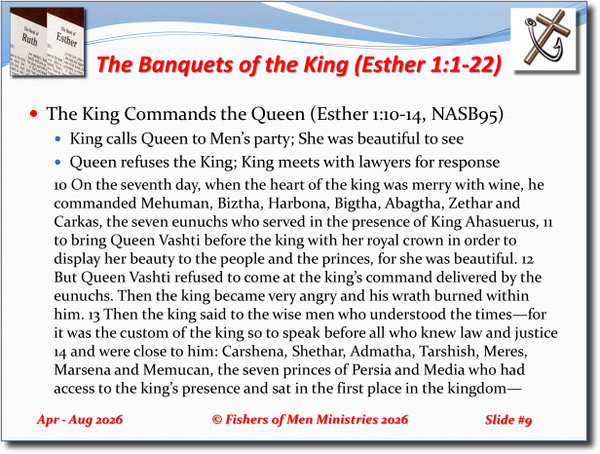
The King Commands the Queen (Esther 1:10-14)
It was now the seventh day of Xerxes’ Seven-Day Feast, and the king was merry with wine (i.e., the king was drunk!). He called the seven eunuchs who served him to come into his presence (vs. 10). (Anyone wishing to see the king had to be called into his presence or risk capital punishment.) He commanded the eunuchs to bring Queen Vashti before him with her royal crown, in order to display her beauty for the people and the princes (vs. 11). King Ahasuerus obviously thought his queen was very beautiful. Recall, there were no women in the king’s party; nor were there any men in Queen Vashti’s party. Vashti would be the only women in the king’s party.
Queen Vashti chose to refuse the king’s invitation to return to the king’s party with the eunuchs (vs. 12a). The response of the king was predictable, and he became very angry to the point of wrath burning within him (vs. 12b). Verse 13 says the king called his advisors, who were experts on such protocol, before him to discuss what had happened legally in the queen’s refusal to obey the king’s direction. It was a standard custom for the king to speak with (get advice from) the experts in the associated laws and customs, and their applications in such situations. Verse 14 names the seven experts who were called before him for such advice.
Now, we have quite an interruption in the joy and celebration of the king’s feasts in that we have an abrupt display of deliberate disobedience against the highest form of power in the entire realm of 127 provinces between India and Ethiopia. Regardless of the level of abuse the command was to Vashti, and the fact that the Persian law required that women did not show themselves in public, disobeying the king was a gross offense. After all, the king had just completed six months and one week of celebrating his greatness and honor and was now being openly humiliated by his wife. We can sit in judgement about whose error was the greatest, but only one truth will be considered by the king, whose opinion is the only one which will be considered in this environment. To the king, Vashti has committed a grave error and has humiliated the highest authority (no pun intended) in the land. What will the lawyers advise the king?
The Queen Refuses the King (Esther 1:15-22)
Notice first that despite the unlimited and unrestricted power and authority of the king, and his high level of anger and wrath at Vashti, he still took time to seek the advice and wisdom of his counselors. Further, he specifically asked “according to the law, what is to be done with Queen Vashti, because she did not obey the command of King Ahasuerus as delivered by the eunuchs?” (vs. 15).
The first to speak was Memucan. He said, “16 Queen Vashti has wronged not only the king but also all the princes and all the peoples who are in all the provinces of King Ahasuerus. 17 For the queen’s conduct will become known to all the women causing them to look with contempt on their husbands by saying, ‘King Ahasuerus commanded Queen Vashti to be brought into his presence, but she did not come’” (vss. 16-17). Memucan was not only concerned with the queen’s disobedience but with the results it might have on the attitudes of all the women in Xerxes’ realm. He thought that level of disregard for the husband’s commands might be widely practiced using Vashti’s action as the standard. To remedy that end, Memucan suggested the king publish a royal edict banishing Queen Vashti from presents of King Ahasuerus forever and that her royal position be given to another who is more worthy of it. Further, he said, “When the king’s edict which he will make is heard throughout all his kingdom, great as it is, then all women will give honor to their husbands, great and small” (vs. 20).
Xerxes liked the full advice of Memucan and issued a royal edict to all 127 provinces in the language of that area (vss. 21-22). Note that the issue, from Memucan’s perspective was threefold: First, the disobedience of Vashti had to be punished and impossible to repeat. To that end, Vashti would be banished from Susa and from ever coming into the presence of Xerxes again. This was akin to immediate divorce. Second, Xerxes was to issue a decree that would replace Vashti with another who would be more worthy of that position. And third, Xerxes would issue a decree demanding that all women would honor their husbands. The penalty was clear: immediate divorce.
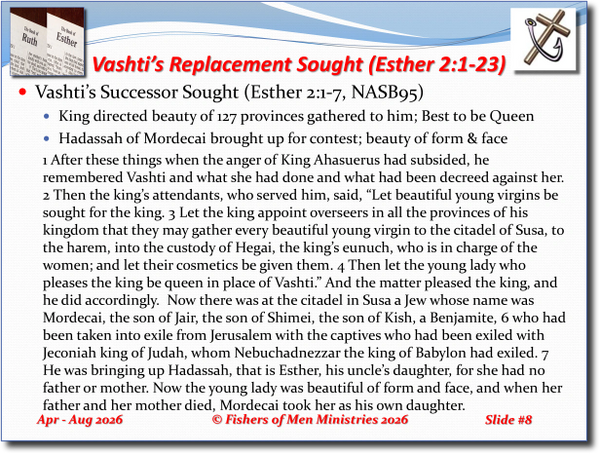
Vashti’s Successor Sought (Esther 2:1-7)
Chapter 1 showed how God used the arrogance, pride and vile human nature of King Ahasuerus to discharge his Queen Vashti to make room for “a woman who was more worthy than she” (1:19). So, when his anger subsided some, he recalled what she did and the decree he had written against her (vs. 1). His attendants suggested that beautiful young virgins be found for their king from across his entire domain and be brought to Susa for him to consider (vss. 2-3). Hegai was the senior eunuch of the king’s harem so, they would be placed under his care until the king could consider each one. The woman King Ahasuerus considered the best of them would then take Queen Vashti’s place. The king was pleased with the plan, and the process was begun to find the most beautiful young virgin in all the domain to take the place of Vashti, the king’s failed queen.
Our writer inserts an issue at this point introducing Esther’s uncle and guardian, Mordicai. Mordecai was a Jewish man whose pedegree made him a Benjiminite who had been taken into exile by the Babylonians through Nebuchadnezzar in 586 BC. As shown on the chart on the website (www.fishersinc.net/ruth-esther), the New Years festival and the rejection of Queen Vashti took place around the year 482 BC. Ezra would lead the earliest return to Israel in 458 BC. The historian Josephus reports that the king was also grieved at this point because the entire episode came to this point, and he would have preferred to reconcile with Vashti, but the empire’s constitution made the words of the king irrevocable.
Verse 7 adds that he was raising Hadassah (Esther) after her father and mother died. The report continues that Hadassah (Hebrew name) or Esther (Persian name) was “beautifil in both form and face.” Mordecai was raising her as his own daughter. Recall also that Mordecai and all his family were taken out of Judah into captivity. Israel was a dominated people under the Media-Persian Empire after they defeated the Babylonian Empire. They had no rights, no priveleges and their women (including Esther) could be taken at any moment as the victor’s possessions.
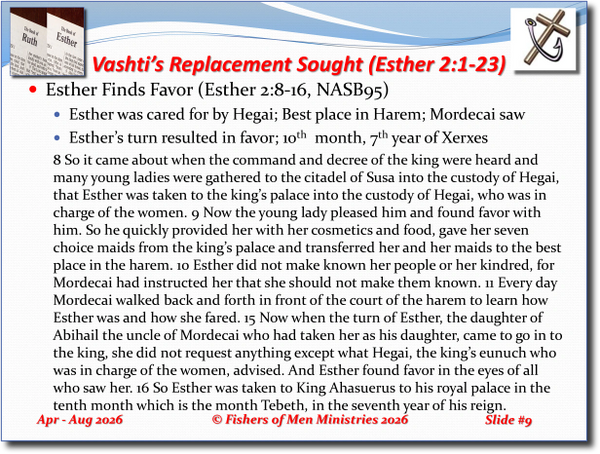
Esther Finds Favor (Esther 2:8-16)
Verse 8 picks up with the actual implementation of the plan for replacing Queen Vashti. As soon as the command and decree of Ahasuerus was published a great number of young women were gathered into the citadel in Susa and surrendered into the custody of Hegai, the eunuch responsible for their preparation to meet the king. Esther was one of the many taken to Hegai for purification before they met the king. But verse 9 seems to single out Esther as the one who found favor in the eyes of Hegai. The Scriptures say, “And the maiden pleased him, and she obtained kindness of him; and he speedily gave her her things for purification, with such things as belonged to her, and seven maidens, which were meet to be given her, out of the king's house: and he preferred her and her maids unto the best place of the house of the women.” So, she was given special treatment from the start of the contest. Esther was very careful not to reveal her people or her kindred in anything she did. This was at the advice of Mordecai, and he walked back and forth in front of the court of the harem to see how Esther was doing.
In general, “12 …when every maid's turn was come to go in to king Ahasuerus, after that she had been twelve months, according to the manner of the women, (for so were the days of their purifications accomplished, to wit, six months with oil of myrrh, and six months with sweet odours, and with other things for the purifying of the women;) 13 Then thus came every maiden unto the king; whatsoever she desired was given her to go with her out of the house of the women unto the king's house. 14 In the evening she went, and on the morrow she returned into the second house of the women, to the custody of Shaashgaz, the king's chamberlain, which kept the concubines: she came in unto the king no more, except the king delighted in her, and that she were called by name” (vss. 12-14). So, when it was Esther’s turn to go to the king, she asked only for the things that Hegai advised her. She found favor in the eyes of everyone who saw her on the way into the king’s quarters (vs. 15). It was the tenth month and seventh year of the reign of King Ahasuerus (478 BC). We are about to see the God of Israel bless Esther about hundreds of the most gifted women.
Esther Becomes Queen (Esther 2:17-20)
Verse 17 wastes no time in giving the results of Esther’s visit to King Ahasuerus. The writer declares that he loved her more than all the other virgins presented to him. I cannot help myself from wondering what happened with the hundreds of other virgins who were lined up to visit the king after Esther. Surely, they continued to come from all over the 127 provinces to have their opportunity to become the queen of the Media-Persian Empire. It was a real-life Cinderella story and an opportunity of a lifetime. Nothing but the providence of our living God could have caused Ahasuerus to fall head-over-heels in love with this young Jewish girl. Later, we will hear Mordecai ask her, “Who can tell whether you were chosen for the kingdom for such a time as this? (vs. 4:14b). This was truly a miracle of God to rescue His people. Esther found favor and kindness from the king more than any of the other women. He placed a crown on her head, made her queen and had her take the place previously held by Vashti. All of this in verse 17! Vashti was divorced from him in the third year of his reign, and he was married to Esther in his seventh year.
But the king, being the “party animal” he was, called for “Esther’s Banquet” for all his princes and servants and established a national holiday for all the provinces and gave gift to all (vs. 18). Notice that Esther made the public appearance at the banquet in stark contrast to Vashti who would not. Notice also that Esther had not forgotten who helped her get the crown. Regardless of her personal advancement to the second highest position in the empire, she remembered those benefactors who were responsible for getting her to that lofty position.
Esther continued to observe those things that Mordecai had commanded her, namely that she not share the knowledge of her heritage with anyone. She continued to hold fast to his instructions even though she was now the queen of the empire. It was just one more evidence of her personal humility, gratitude and grace. Esther obviously remembered that it was Mordecai who rescued her as a young orphan when her parents died. He provided the education and care that made her the kind of woman who a king could love at their first meeting. She proved willing to honor him.
Mordecai Saves the King (Esther 2:21-23)
Now, we find Mordecai sitting at the King’s Gate (vs. 21). There is no mention of whether he had this position before his “daughter” became queen or after, but either way, it was more of God’s grace that he was there when a dastardly plan to take the king’s life was caught in his hearing. The Scripture mentions the government servants by name as Bigthan and Teresh and says they were the king’s officials who guarded his door. They had become angry and decided to lay hands on the king. Whatever the issue was, these men decided the king ought to be denied his position among the living for doing it (vs. 21).
But God’s grace continued on Esther and would not allow the life of king to be taken. Mordecai got word of their treasonous plan, whether by overhearing their discussion or maybe being invited to join it, we know not, but he was able to use his relationship to Esther to immediately pass the information to the king and his royal guard before the action could be taken upon him. When the matter was investigated, it was found to be true, and the two traitors were apprehended and terminated by hanging in the public square.
Of course, an act resulting in the saving of a king was not to be passed off as some empty event. The entire episode was written into the king’s chronicles including the naming of Mordecai as the one revealing the plan to Queen Esther. There was no documentation of the immediate reward for Mortdecai, but the information was written into the king’s personal chronicles from which he would read regularly, as time would permit.
For a man of character like Mordecai, the act of saving the king’s life was reward enough, but the historic documentation of the deed would soon have the king review the episode and seek ways to appropriately reward a man who would do such a thing. That man would be revealed as a true patriot and openly recognized as such. For now, however, Mordecai’s reward was he saved the life of his daughter’s new husband. Without the king, Esther might be returned to the life of a common captured woman of the exile. History would have been rewritten, but God had plans!
Mordecai Rejects Hama’s Ego (Esther 3:1-4)
There is no mention of this in the Scriptures or commentaries, but does it not seem strange that Mordecai saved the king’s life at the end of Chapter 2, but the beginning of Chapter 3 says, “After these events King Ahasuerus promoted Haman, … and advanced him and established his authority over all the princes who were with him” (vs. 1). Is it possible that Xerxes thought Haman was the one who saved his life and not Mordecai? Worse miscarriages of justice have happened in life and will continue to happen. At any rate, we are all aware that there are at least three opinions of us that exist in this world and there is nothing we can do to reconcile them. There is the man (or woman) that we think we are, the one other people think we are and the one God knows we are. You cannot correct how other people see you no matter how wrong you might believe them to be. The Master and Maker of the Universe is aways right and can never be wrong. Further, He is all powerful and can cause others to see us in anyway that best suits His plans for our lives.
Haman receives this recognition and is elevated to the second highest office in the empire. Is his terribly warped mind, he believed he deserved it and was so filled with pride, he had the king sign a decree saying that everyone must bow and pay homage as he walked by. This included even the princes of the 127 provinces across the empire (vss. 1-2). His pride was far out of reason, but he convinced the king to sign and publish the writ. So, everyone complied with the king’s decree except Mordecai who would not bow nor pay homage, and Haman was totally enraged (vs. 3).
The king’s servants were so concerned about what Haman might do that they talked with Mordeca daily reasoning with him to change his behavior (vs. 4). The Scriptures do not document Mordecai’s response but simply state that he was a Jew. Exodus 20 tells us that we must never bow or worship anyone or thing other than the Lord our God (Ex 20:1-3). Mordecai was simply being faithful to the commands made of him by no less than the Creator of the entire universe. Haman might have been placed above the princes of the Empire, bur he was certainly not God.
Haman Warns King about Jews (Esther 3:5-8)
Verse 5 seems to say thin that Haman had not noticed the clear disobedience and disrespect of him by Mordecai. And, at this point, that bowing and homage was required at the hands of the king of the empire. When the king’s previous wife was disobedient, she was divorced and cast out of the castle. Why would we think less punishment would be dispensed to a mere captive from Israel, that is, a lowly slave. Here is a man in the second highest position in the empire; one who is the commander of the 127 princes across those provinces. It is like the mightiest being challenged by the lowest. In any other time, it might be considered absurd! But it is no less absurd than Haman deciding to annihilate all jews because of the rejection of this one man. Nevertheless, verse 6 tells us that Haman chose to take no action against Mordecai, the man, but rather, decided to avenge his rage on the entire race of Jews in the Media-Persian Empire.
Verse 7 transitions to Xerxes determining at what date the decree to annihilate all the Jews in Persia becomes operative. Pur is a Hebrew word meaning lot or Purim meaning the cast lots. The humiliation and terror of having your entire race annihilated on a date determined by the likes of casting dice, reduced the mass murder to a mere game. Lots were cast in the first month (Nisson) of the twelfth year of King Ahasuerus. Lots were cast before Haman to determine the day and month of the massacre. The lot fell on the month of Adar (vs. 7).
Now, in verse 8, Haman completes the revelation of his plan to the king. He starts that there is a people scattered throughout the empire who have laws that they live by that transcend the laws of the empire, the laws of this king. Haman says to the king that it is not fitting for the king to be king for some parts and people of but not all parts and peoples. Therefore, these specific people of the empire choose whom they might honor and pay homage and whom they will not. Of course, Haman was taking about the behavior of one man (Mordecai) but wishing to annihilate his whole race rather than punish the guilty one. This information will not surface for the king at this meeting but will be revealed by Esther soon.
Haman Seals Annihilation of Jews (Esther 3:9-12)
If King Ahasuerus had any doubt about how evil and corrupt Haman was, his attempt to pay him a bribe equal to nearly two-thirds of the empire’s annual budget should have eliminated that doubt. Haman had briefed the king on an unspecified group people in the kingdom who were supposedly disobedient to the king’s laws because it was contrary to their law (vs. 3:8). Here, Haman reveals his proposal for the best way to dispose of that disagreement. Recall that Haman did not tell the king that while the Jewish Law applied to all Jews, that there was only one Jew who openly opposed the king’s law. Namely, Mordecai refused to bow and pay homage to Haman as he passed by in the city square. So, Haman wanted to eliminate the entire Jewish race across all 127 provinces of the Media-Persian Empire because Mordecai, only one Jew, would not bow and pay homage to him. He felt so strongly about this proposal that he was offering the king 10,000 talents of silver or about $226 million to let him destroy all the Jews.
Evidently, the mere mention of that much money for the king’s treasury overwhelmed the king and he simply handed his signet ring to Haman telling him “the silver remined his and the people as well, to do with as he pleased” (vs. 11). The combined corruption of these two men goes far beyond my understanding.
Verse 12 reveals that this was no dream or nightmare, rather, King Ahasuerus tasked his scribes on the thirteenth day of the first month to capture Haman’s commands and put them in the form of a decree for execution exactly as Haman spoke it to the king’s satraps, to the governors over each province and the princes of all the people in their own language. The decree was written in the name of King Ahasuerus and sealed with the king’s signet ring. So, Haman was using an earlier version of the auto-pen!!
Think for a second about the kind of mind that would rather pay over $200 million to kill a whole nation or race of people than confront a lone perpetrator of a law for the sole purpose of feeding a man’s ego.
Haman’s Law sent to All Provinces (Esther 3:13-15)
Verse 13 shows how very serious Haman’s idea to murder all the Jews in Persia really was. “Letters were sent by couriers to all the king’s provinces to destroy, to kill and to annihilate all the Jews, both young and old, women and children, in one day, the thirteenth day of the twelfth month, which is the month of Adar, and to seize their possessions as plunder” (vs. 13). They were to kill the people and take their possessions to eliminate the memory of the people to whom those possessions once belonged. Students of the Bible and of history recognize this gross antisemitism as still another attempt to elimination the people of God’s chosen ones. There are many voices today speaking of hate for these people. Most of the people making these noises no longer recall the rich history involved with these people. They no longer recall the rich histories of Abraham, Isaac and Jacob and the associated covenants God made with them or what they mean for us. They all focused on a future Saviour who would come to make things right and right all wrongs. Yes, there is a day coming when the mention of His name will cause all people to fall to their knees and bless them who told them about His grace.
Copies of the edict were issued as law in every province. The people were warned to be ready for that day. The people looked the same as those we see every day, but these were to be eliminated and those reading this paper would never be born into life.
The couriers were dispatched and the peoples were told that not only would their lives be taken along with the lives of their children, but all their possessions would be taken and given to others. All they worked for; all they built for their children would be taken and disposed of to be remembered no more. While these couriers delivered the decree to the distance subjects of the king, the local people felt out of place in that they had not yet heard the bad news that they were losing everything they built. While they read, the same decree was being read throughout the empire including the citadel at Susa. Ironically, as the decree was being read all over the empire Xerxes I and Haman sat down for the refreshment of an afternoon drink as lives were destroyed.
Mordecai Hears Plot (Esther 4:1-3)
Haman, the new Prime Minister, proved his cowardice by refusing to face Mordecai for his failure to bow and pay homage to him as required by the king’s new decree. The two men may have been able to work out some mutually acceptable compromise to prevent loss of anyone’s life. The fact that Haman made no attempt at compromise shows that he was driven to eliminate the Jewish race regardless of what Mordecai did.
When Mordecai learned of the official decree of the king, he ripped his clothes as if he had heard the worst kind of blasphemous teaching possible. The practice of dressing in sackcloth and tossing ashes over one’s head was intended to show how low the person experiencing that humiliation felt. Mordecai continued his demonstration by wailing and yelling loudly about the grave misjustice he felt. He went out toward the king’s gate to the city where he would certainly be noticed by the king’s court (vss. 1-2). He felt it gravely necessary to express the grief and pain that decree caused.
Verse 3 documents that the response of Mordecai was not limited to himself alone. The Scriptures report that wherever the edict was read across the 127 provinces, the same response from the people was repeated. No one in the Persian domain denied the injustice of killing the entire Jewish population. Many in Susa knew the murders of hundreds of thousands of people were being done because Mordecai’s response to Haman’s gross injustice. Many of them reacted the same way Mordecai did with fasting, wailing and dressing in sackcloth and ashes.
The first record of this kind of demonstration was at the announcement to Jacob (Israel) that his first son by Rachal, the love of his life, was killed and devoured by a wild animal. Joseph was wearing the coat of many colors given to him by his father and mother showing the great love they had for that sone (Gen 37). Joseph’s 10 brothers were angered by the coat and jealous of the love their father had for this one brother. They decided to murder the brother and sprinkle the blood of an animal on his coat to support their story of the animal attack. On second thought, they decided to sell Joseph into slavery. He was taken to Egypt where he eventually became the Prime Minister.
Eunuchs Report to Esther (Esther 4:4-8)
The personal servants of Esther knew how important Mordecai was to her. When they learned of the great anguish of Mordecai, they had to tell Esther, and she was bent over in pain at their words. Her first thought was to provide proper clothes for the man who served as her father when she was orphaned; the man who had advised her in the competition for becoming queen. Everything she had was at least partially due to Mordecai’s wisdom and advice to her. When the clothes were rejected, she sent for Hathach, one of the king’s personal eunuchs who had been assigned to care for her (vss. 4-5). She ordered him to go to Mordecai and find out what was causing his great grief. Hathach learned that Mordecai was grieving at the King’s Gate and went to see him there. Mordecai detailed all he knew for Hathach including the exact amount of money Haman promised Artaxerxes if he would allow him to destroy the Jews.
Verse 8 documents that Mordecai also gave Hathach a copy of the decree the king and Haman published notifying all the Jews of the kingdom of their coming demise. He gave him the copy released in Susa but knew the same decree was published in every language and tongue in all 127 provinces of the Media-Persian Empire. Mordecai delivered these items to Hathach to show Queen Esther all that was happening and by whose hand they were happening. He was asking her to approach the king to acquire his favor and plead with him for her people.
Mordecai’s specific instructions to Esther before she became queen were to keep her nationality secret for the time. He had lived as a Jew among the Babylonians and the Persians enough years to know that they always saw the Jews as the captive people. It was wise to keep one’s nationality off the table as long as possible. That may have been part of the reason Esther never confessed her name as Hadassah and became queen rather than a common slave and/or concubine. But it may be that living as queen to Artaxerxes for more than five years might have placed her in a position of endearment sufficient to have earned the king’s trust and allegiance. Somehow, Esther finds herself in the position of being the only person who might influence withdrawal of the law.
Mordecai/Esther Exchanges (Esther 4:9-14)
Verses 9-14 document the exchanges between Esther and Hathach after he coordinates with Mordecai in sackcloth and ashes at the King’s Gate to Susa. This is the report Esther requested to find out why her Uncle Mordecai rejected her offer of fresh clothing for himself. Verse 9 assures us that Hathach has returned safely to Esther and is providing details of what he learned from Mordecai. Once Esther receives the briefing, she immediately sends the eunuch back to Mordecai (vs. 10). First, in response to Mordecai’s suggestion that she initiate a discussion with the king regarding this matter, that no spontaneous meeting with the king is possible under the threat of death. Second, that even she has not been called to see the king for the last 30 days. The only exception for meeting with the king is that he extends his golden scepter showing that he will accept the meeting, otherwise, the penalty for showing up without an invitation is death (vs. 11).
Upon hearing these words from Esther, Mordecai responds again in verses 13-14. He warns Esther that being faced with certain death, someone will reveal het secret that she is a Jewiss, and therefore, no more safe from Haman’s death decree than any other Jew. Mordecai extends that threat of the death penalty to her father’s house just as any other Jewish family. Then Mordecai asks the infamous question of the entire Book of Esther, “And who knows whether you have not attained royalty for such a time as this?” (vs. 14c). This sentence has been quoted throughout history to claim God’s infinite provision for His people and their houses under whatever circumstances He has called them.
Recall the context of this secret discussion between Mordecai and Esther. Both of them are Jews in a situation where they are included under a blanket decree from the king that they must die. Esther is using her royal office, royal servants of the king and a deception of not being a Jew to serve in their power to stop a grave injustice issued by a madman serving the king as Prome Minister. There are prohibitions forbidding Esther from even entering her husband’s office, yet the process for making an appointment would certainly see them all dead before completion.
Esther Plans to Intercede (Esther 4:15-17)
So, now is the moment for a life-or-death decision by Esther that will determine her fate along with the fate of the millions of her countrymen across the empire. What will she do? Her first move is to appeal to the powers of God through fasting and prayer (vs. 16). She tells Hathach to tell Mordecai to assemble all the Jews found in Susa. He is to tell them to fast and pray for three days and nights. They are not to eat or drink for three days, whether day or night. She pledges to them that she and all her maidens will fast and pray along with them in the same way. Esther finishes her instructions to Mordecai by telling him she has decided that she must go in to see the king about this issue without the required appointment. She says, “And thus I will go in to the king, which is not according to the law; and if I perish, I perish.
Esther is not sugar-coating the seriousness of her mission. Remember this is a man who divorced and exiled his Queen for disobeying one order from him. Here, Esther is doing no less than conspiring to have a decree from the king abolished. She faces death for going to see the king without his call for her, she faces death because she is a Jewess condemned to death along with all her countrymen and she faces death for conspiring to change the king’s law.
Verse 17 documents Mordecai’s response to het request for prayers. Mordecai took Esther’s instructions and did exactly as he was commanded by Esther. Consider the gravity of this sentence. Esther was an orphan taken in by Mordecai after her mother and father died. According to Jewish tradition, he could have taken her to wife to keep that bloodline active with its inheritance. But instead, the Scriptures say he took her to raise as a daughter. When the opportunity to compete for Queen Vashti’s position came up, he kept Hadassah’s Jewish heritage secret so she could keep prejudices out of the way. Once she succeeded, he did all he could to stand in support. Now, they were prepared to die together under the edict of a madman.
Notice also the evolution of the command structure. Early in the story, it was Mordecai commanding his daughter. Now, it is the Queen commanding her subject
Esther Plans a Banquet (Esther 5:1-4)
Our previous study left Esther with a request that Mordecai recruit local Jews and join her in a three-day fast with prayer for her as she risks her life by entering the king’s court uninvited. She reminded us that the penalty for doing so was death (vs. 4:16). Here, verse 5:1 points out that the fast is over and she is dressing for her visit to the king’s court. She describes the setting she sees as the king being present. She saw him on his royal throne in the throne room opposite the entrance to the palace. The queen was noticed by the king immediately upon her appearance at the inner court and was summoned by him. He held out his golden scepter to her in compliance with the law, allowing her to move into the throne room to meet with him without an appointment (vs. 2).
Then the king made an astonishing comment to her regarding why she wanted to see him. He said, “What is troubling you, Queen Esther? And what is your request? Even to half of the kingdom it shall be given to you” (vs. 3). So, despite how he may have interacted with Vashti, he was very gracious to Esther. Not only did the king extend his scepter to her, saving her from death, he promised her anything she wanted up to one-half the kingdom. Yes, I would say Esther found a secure place in the heart of the king. Now, the silence is deafening as we wait to hear what was so important that the queen risked her life to get an audience with the king.
Not much of a wait was required; Esther responded with her request right away. She said, “If it pleases the king, may the king and Haman come this day to the banquet that I have prepared for him today?” (vs, 4). So, Esther was using this uninvited audience with the king to ask him and Haman to a banquet she prepared for the later that day. Esther seems very wise on the egos of men. The king, of course, was willing to give her anything she asked up one half his kingdom, so believing he might agree to simply having a meal with his wife, the queen, would be easy to imagine. Now Haman was so full of himself that he was ordering the death of the entire Jewish race because one man, Mordecai, refused to render proper courtesy to him. If the king issues the call to Haman, this banquet is on!
Esther Plans 2nd Banquet (Esther 5:5-8)
Specifically, the king directed his aides in the throne room to “bring Haman quickly that we may do as Esther desires” (vs, 5:5). Recall that the king was given to parties, and this one was being called by the queen for just him and Haman. We can anticipate some level of excitement about being invited to the queen’s party. “So the king and Haman same to the banquet which Esther had prepared.” As verse 6 begins with “as they drank their wine at the banquet,” could very well imply that they were drinking the wine as they had finished their meal and were now reclining on the couches near the banquet tables. The king has had his full of anxiety regarding Esther purpose for the banquet and asks her again, “What is troubling you, Queen Esther? And what is your request? Even to half of the kingdom it shall be given to you.”
Esther replies in verses 7 and 8 by requesting still another banquet with the king and Haman at which time, she will gladly reveal her requests. Of course, she places the request in all the proper formats by saying, “My petition and my request is: if I have found favor in the sight of the king, and if it pleases the king to grant my petition and do what I request, may the king and Haman come to the banquet which I will prepare for them, and tomorrow I will do as the king says.”
So, the two men leave Esther’s banquet with an invitation to come for another banquet the next evening (vs. 8). The reaction of the king was predictable for Esther. They have been married for at lease five years at this point and Esther was well aware of the king’s anxiety in waiting for anything. He will be trying all night to have Esther give him a preview of what she will be asking that following evening with him and Haman in attendance.
Esther also knew Haman. She believed he would run to his wife and his friends to let them know that he had just returned from a banquet at the queen’s invitation and was full of the greatest food and fruit of the vine he had ever had. But further, he would say, the invitation was only for him and the king. But even further he would say, the queen has invited the king and me for just one more banquet tomorrow night. He would talk of how no one in the kingdom is greater than he.
Haman’s Invitation Pride (Esther 5:9-11)
Oh, how very correct Esther’s expectations of Haman were. He went out from the banquet glad and pleased with himself (vs. 9a). Haman was at the top of his professional career in executive management of the Media-Persian Empire. The king had made him second only to himself. He could hardly wait to get to his home where he would gather his wife and all their friends together to tell them where he had been and where he was returning to the very next day. When they were gathered, he recounted for them his glory, riches, number of sons and every instance where he was lifted, exalted or magnified by the king (vss. 10-11). He added that the king had promoted him above all the princes and servants of Persia. This same day the Queen of Persia had prepared a banquet and invited only Haman and the king. While in their presence she invited only the king and he to return for another banquet the next day. Haman told them how fulfilled he was.
But earlier, as he walked toward his home, he passed by the king’s gate, and it happened that Mordecai was there. Once again, Mordecai would refuse to acknowledge Haman by standing and paying homage to him. Haman could not comprehend how this lowly Jew could ignore his personal greatness or worse, how he could blatantly disobey the command of the king that all people must stand as Haman passed by and pay homage to him. Even as Mordecai humbled himself to dress in sackcloth and heap ashes upon himself, he still withstood the king’s command and Haman’s presence by refusing to stand or bow and pay homage to him.
So, despite all Haman’s personal joy, he was enraged at Mordecai (vs.9d). It was like there was no level of achievement and greatness that could make this one person show the honor and respect Haman had so obviously earned. Haman saw every person in the empire do as the king commanded and he had earned but this one man. Even knowing that his action had brought condemnation upon his entire race and that hundreds of thousands of them would die because of his personal vindictiveness made no difference. Nevertheless, verses 9-10 say that Haman controlled himself, went to his home and summoned his friends to tell them of his blessings.
Haman’s 50-Foot Gallows (Esther 5:12-14)
Haman also said, “Even Esther, the queen, let no one but me come with the king to the banquet she prepared, and tomorrow also I am invited by her with the king” (vs. 12). So, the setting of this slide picks up somewhat inside the previous slide. Haman continues with his head in his personal greatness in being invited by the queen to this second banquet she personally prepared (probably directed her servants to prepare). The key thing is that the queen specifically invited Haman to join her and the king to her banquet. That would be quite the honor for anyone. The empire is comprised of 127 provinces or states or countries where several different languages were spoke and the dominant cultures would be quite diverse. Nevertheless, out of all these very important leaders of the empire, only Haman sits alone with the king and queen of Persia.
But then, Haman takes another sidestep to remember Mordecai, the Jew, sitting at the king’s gate (vs. 13). It’s like having a splitting headache in the middle of your daughter’s wedding. Such a joyous occasion, yet the reality of the headache is relentless and will not yield to even the sincerest efforts to ignore it. Such was the mental picture Haman has of Mordecai opposing the commands of the king and he, that he stand or bow and pay homage to him. Try as he might, the strongest efforts to focus away from the pain of it fail.
So here, his wife and his friends yield to join Haman in his trouble (vs. 14). They say, “Have a gallows fifty cubits high made and, in the morning, ask the king to have Mordecai hanged on it; then go joyfully with the king to the banquet” (vs. 14). They were saying that Haman should make Mordecai’s future more obvious to him. Let him see that while he is special to the king and queen, as he describes it, he is special to you and is represented by the highest gallows in the entire empire. These gallows must be 50 cubits high. A cubit is the distance between the tip of the middle finger and the tip of the elbow. Most references acquiesce to about 18 inches or a foot and a half. So, Haman’s friends suggest he erect 75 foot-gallows for Mordecai to meditate on while sitting at the king’s gate. This would allow Haman to enjoy the banquet. Haman liked the sound of it.
How Shall the King Honor (Esther 6:1-5)
King Ahasuerus is probably a bit confused with Queen Esther requesting that he and Haman attend two banquets she had prepared. The first one was completed just before the king retired and the queen asked for the second one for the next day. He must have been wondering what Esther wanted of him that was so important and why it also involved his prime minister, Haman. Failing to calm his mind and get to sleep, the king asked to have his official chronicles of recent events read to him for any actions left unresolved (vs 1). To his surprise, he found an entry recorded which detailed a report from Mordecai involving two of his eunuchs plotting to assassinate the king. The names of the eunuchs were Bigthana and Teresh, and they were serving the king as doorkeepers. Mordecai reported the threat to Esther, and the king’s guard had executed the two perpetrators.
The king asked his reader what had been done to honor or dignify Mordecai for this deed of saving the kings life (vs. 3). The king’s servants replied that nothing had been recorded as being done to reward or dignify Mordecai for saving the king’s life. So, King Ahasuerus asked who was in the court right now? The servants advised him that Haman had just entered the inner court to see the king. The king ordered them to allow him to see the king right away (vs. 4).
The irony of Haman’s visit was that he was there to ask the king’s permission to hang Mordecai on the 75-foot gallows he had just built specifically for this man; the same man the king was going to ask him about to see how he might reward, dignify or publicly recognize.
The good news is that the chronicle system of recording important events was working. This man who did a great deed for the king would have remained anonymous and unrecognized had it not been for this tool. Now the king has the reminder, and he is seeking advice on exactly how that man should be recognized by the grateful monarch. The king’s opportunity to recognize this man in a special way might have been lost except for the chronicles of important events for future action. It was a monumental time for the king to recognize Mordecai.
Haman Recommends (Esther 6:6-9)
So, Haman is allowed audience with the king who immediately ask him, “What is to be done for the man whom the king desires to honor?” (vs. 6a). Haman’s mind temporarily leaves the important question of getting permission to hang Mordecai and considers whom the king might want to honor more than himself (vs 6b). But the idea of a very public recognition stays with him as he suggests to the king that he dresses the man in the king’s royal robes and parades him around Susa on the king’s personal horse as he wears a golden crown given him by the king (vs 8).
And to top all that, the privilege of presenting the robe, the horse and the crown to the man should be given to one of the king’s most noble princes (vs. 9). As that noble prince finishes dressing the man in his attire and placing him on his horse, he will lead him on horseback to the city square where he would proclaim before the whole city, “Thus it shall be done to the man whom the king desires to honor” (vs. 9).
Recall that Haman’s original plan was to see the king for permission to hang Modecai on the special 75-foot gallows Haman had built overnight to recognize him in a totally different way. But the king had interrupted Haman’s plan. Neither the king nor Haman knew they were talking of recognizing the same man in very different ways. For now, the king has preempted Haman’s plan in favor of his own.
But the plot thickens even more when we consider the king has already approved a second banquet by Queen Esther which includes Haman. Esther’s subject will be Haman’s plan to execute all the Jews in all 127 provinces of his empire including Mordecai and, completely unknown to both of them, Queen Esther, who is also a Jew. Recall that Esther is also in the dark about Haman’s plan to hang Mordecai and the king’s plan to honor him. One thing seems to be certain; when the king orders Haman to be the one who places Mordecai on the king’s horse, wearing the king’s robes and the king’s golden crown, and Haman is ordered to lead him to the city square, he will rethink asking the king to hang him. How agile will Haman be when Mordecai is exalted, not executed?
Haman’s Idea Accepted (Esther 6:10-11)
But the king had a much quicker timeline than anyone thought. He fully accepted Haman’s plan immediately and ordered Haman to execute that plan exactly as he proposed it. The shocker for Haman was that instead of being the subject of the plan as he once thought; it is a plan executed by him for his arch nemesis, Mordecai the Jew (vs. 10). The king’s order must have felt like a dagger in Haman’s heart. He had come to seek an audience with the king for the purpose of getting permission to do an immediate execution of Mordecai, and now, he has been ordered to personally honor the same man he wanted to kill. The king added, “Do it completely and quickly” (vs. 10).
So, Haman took the king’s robe and dresses Mordecai with it (vs. 11). He fetched the king’s horse and the golden crown just as he had suggested to the king. Then he led Mordecai on horseback through the city square for all to see. As he led him on the horse, he proclaimed loudly, “Thus it shall be done to the man whom the king desires to honor” (vs. 11). Every step adding to the pain of knowing he suggested this plan to the king and the king liked it. Further, Haman probably thought of the fool he was to think the honor was being considered for him. The king clearly demonstrated that he thought more highly of that renegade Jew than he thought of him.
Worse, he had his family and friends waiting for him at home. They knew of his plan to execute Mordecai. They were the ones who recommended Haman build the 75-foot gallows for that purpose. He liked the idea and had the gallows built quickly. But Mordecai would not swing from that rope, but rather, he would be lauded for saving the king’s life from two would-be assassins. And the greatest and most visible parts of the king’s honor for him would be at the hands of Haman, himself. It may have been “poetic justice,” but it felt like the end of a very promising career. He had started that day with a plan to have Mordecai hanging from a rope, but the day starts to close with Mordecai higher than he ever was and Haman as the instrument of the king’s honor. But recall, the day is not yet completed. Haman still has to face his wife and his friends, and last but certainly not least, Haman has a banquet with the king and queen. He had to pretend all was well.
Haman’s Humiliation (Esther 6:12-14)
Verse 12 says it as sorrowfully and succinctly as it could be said: “Then Mordecai returned to the king’s gate. But Haman hurried home, mourning, with his head covered.” One can only imagine the congratulatory handshakes and backslaps Mordecai faced as he returned to the king’s gate. All of the most important people of the city gathered there. They all remembered the hateful looks Haman had for Mordecai as he refused to bow or honor him. Today saw Mordecai vindicated and Haman brought down in shame. As Haman headed home with a cover over his head, he read the scene exactly right; Haman had been openly shamed that day.
Verse 13 begins with even more suffering. “Haman recounted to Zeresh his wife and all his friends everything that had happened to him.” Retelling the story must have caused Haman to understand that not only did something go entirely wrong, but there were career implications which will not likely go away. But notice the way verse 13 is stated. It is as if everything that had happened to him.” It seemed he thought he was external to it; that he might have been some innocent party who watched it happen but was not implicated in it. While that might soften the initial shock, it will not alter the consequences.
After Haman told the story of his encounter with the king and Mordecai, we learn that those with his wife were considered “his wise men.” After reading what they had for advice, they may have been wise, but they were certainly not gentle. The foundational statement: “If Mordecai, before whom you have begun to fall, is of Jewish origin, you will not overcome him, but will surely fall before him” (vs. 13). First, notice that while they already know the Jews are to be assassinated, they still believe the Jews would overcome Haman. This statement turns out to be prophetic truth, as we will see. The question is how these advisors knew. Further, they see Mordecai as being a part of that victory. Another prophetic truth. Now for the most near-term painful truth. Haman has begun to fall before him, and he will continue to fall before the Jews, in general.
But even worse, now the king’s eunuchs were waiting to take Haman to the Queen’s banquet.
Esther’s Plea (Esther 7:1-6)
We left our previous study as King Ahasuerus (Xerxes I) sent his eunuchs to pick up Haman for Queen Esther’s banquet. Haman was in a very disturbed state of mind as he learned earlier that he was to honor Esther’s Uncle Mordecai for the King’s recognition of him as the man who saved his life earlier that year, but nothing had been done to recognize him for that deed (vs. 6:3). Haman returned home to meet with his wife and team of wise men he had called together. They had summarized their recommendations for him by saying, “If Mordecai be of the seed of the Jews, before whom thou hast begun to fall, thou shalt not prevail against him, but shalt surely fall before him” (vs. 6:13). Immediately after this, the eunuchs arrived to take him to Esther’s second banquet.
At the banquet, the king once again asked Esther what her request was and committed that she could ask for as much as half the kingdom and it would be granted to her (vs. 7:2). Esther responded that she was requesting her life and the lives of her people who had been sold, appointed to death and empire-wide destruction be saved from their enemy. She continued that, had the edict stated that she and her people were to be sold into slavery, she would have quietly acquiesced to that destiny, but to have the entire race annihilated was more than she could bear (vss. 3-4).
The king responded to his queen by asking her to identify the person who would dare in his heart to do such a thing and tell him where he could find that person (vs. 5). It appears clear that the king was not aware of what was taking place in his kingdom under his name. The level of surprise he voiced proves he did not know about the decree that was published with the authority of his ring nor did he know the impact of that writ. Esther accurately and briefly summarized both its existence and its impact for the king. He demanded to know who that person was and where he could find him.
And now we know why Esther requested the presence of the king and Haman at her banquet, for her next statement will identify “the adversary and enemy” as the wicked Haman” and the fact that he was immediately present would answer the king’s question of where he could be found (vs. 6).
Haman is Hanged (Esther 7:7-10)
Esther 7:7-10 reveal to us the wisdom and constraint of a true king and the lack of both displayed by the second in command of the Media-Persian Empire. The king has just been told that the man he trusted with the signet ring of the empire, the very symbol of the full authority of its king, has failed him in the very worse way. Haman had used the king’s ring to authorize the murder of an entire race. “Who is he and where can I find him?” indeed! But when Esther answers “He is this wicked Haman and he is here in my banquet,” the king must remove himself to regain composure to prevent a response seated in rage, fury, anger and disappointment. Only true leaders know and properly respond with this level of constraint.
Instead, for just a second, look at the response of a man who was an unworthy leader. Haman displays the errors of total fear and a lost sense of judgement. The queen’s husband has left the room, and Haman quickly approaches his wife to beg for her intercession. He so inappropriately and uncontrollably approached her that he fell upon her couch just before the king returned and saw him on the couch with the queen. This error multiplies his most recent errors. What could this grossly insufficient man be doing by approaching the queen in this way?
The king revealed his impression by asking, “Will he force the queen also before me in the house?” (vs. 8). As the king’s question hung in the room for just a few seconds, the attendants covered Haman’s face. One of the chamberlains suggested, “Behold also, the gallows fifty cubits high, which Haman had made for Mordecai, who had spoken good for the king, standeth in the house of Haman” (vs. 9). The king responded, “Hang him thereon.” So, they hanged Haman on the gallows that he had prepared for Mordecai. Then the king’s wrath was pacified.
This is the story of a successful man’s complete undoing in the face of unlimited power and success. Haman had everything a man could desire; power, prestige, recognition at the highest levels and access to the king of 127 provinces. But small men remain small people regardless of the size of their jobs. He was simply not up to the work required of him.
Mordecai Promoted (Esther 8:1-7)
It was not long ago that we saw Mordecai and Esther in sackcloth and ashes. Mordecai was in a hopeless situation facing the death penalty simply because he was a Jew. He reached out to the orphaned lady he had raised as his own daughter, and who had become the Queen of the Media-Persian Empire. Esther risked her life by appearing in the inner court of the king without an appointment. The king told her to ask anything she wanted up to half the whole kingdom, and it would be granted. She requested the attendance of the king and the prime minister, Haman, at a second banquet. God had so ordered the events of the empire that Haman was ordered to parade Mordecai around the city to honor him for saving the king’s life earlier that year. Haman was publicly discredited and personally humiliated in doing so. His personal advisors said that Hamn would not succeed against Mordecai. Further, they said that Haman, who had begun to fall before this man, would be brought down by him (vs. 6:13). Worse, it was at that moment that the king’s eunuchs came for Haman to attend the previously planned queen’s banquet. While drinking the wine after the banquet meal, Esther revealed her request of the king as a pardon for her and all her people under the threat of extinction by a decree of the king. He reacted violently and demanded Esther reveal the name and location of the person who would dare in his heart to create such a decree. Haman was hanged on the fifty-cubit gallows he had built for hanging Mordecai.
So, Mordecai was promoted to take Haman’s place as prime minister. The king agreed with Esther that the Jews should be permitted to ready themselves for battle against those who would attempt their destruction before the king’s decree could be reversed. He had the lawyers write decrees to reverse the earlier decree condemning the Jews, but he realized the word could not reach all arms of enforcement immediately.
The king also gave the entire house of Haman over to Esther to do with as she desired. He also issued proclamations stating that Haman was hanged and Esther was in charge of all remaining assets of his house because of those who reached out to harm the Jews in any way.
King Avenges Jews (Esther 8:8-17)
Verses 8 through 17 deal with the realities of righting the wrongs that were done under the hands of Prime Minister, Haman. The realists of our world would rejoice to hear that regardless of the changes in attitude and law expressed above, their intensions could not reach the 127 provinces and all branches of law enforcement quickly enough to save the threatened lives of countless numbers of Jews. The king was aware and here are the steps he took to make the wrongs right.
The constitution of the Persian government did not allow revocation of a previous edict by the king. Recall that the first action of the king was to issue a decree permitting Jews to defend themselves against any army attacking them. The decree included that the Jews were permitted to take enrich themselves through their defensive actions (vs. 11). Verse 14 also states that the Jews would be issued protective vests and other armament. The intent was to protect the people against those overly aggressive in executing the Jews before the new laws could be distributed among the distant provinces. None of the steps take any action to provide offense weaponry, rather it was defensive in nature.
Mordecai also took personal action to get the word out and dressed himself in royal garments and colors. His dressing in blue and white with a golden crown did much to bring joy to the Jews in terror of the earlier writ that permitted state and local government authorities to take action against the Jews. They were glad and encouraged that the king was actively taking part in creating harm for Jews everywhere. Mordecai, however, was traveling far and wide across the empire to get word out that the decree was published to neutralize the earlier document while the laws of the constitution would not permit direct action to abolish it.
The beauty and value of this study is the direct touch of God’s hand in caring for His people even inside an unholy government such as the Medea-Persian Empire. God had Hadassah, an orphaned Jewish girl, compete in a king’s beauty contest to replace his wife. She won and began influencing all events during Ahasuerus and Xerxes II reigns as kings.
Antisemites Slain (Esther 9:1-10)
The writer, whether it was Mordecai or Nehamiah, wanted to be very specific with the dates associated with this segment of history. The reason seems obvious; the empire was in the last steps of establishing a new holiday which will last throughout all history. But it must begin with solving the immediate, most threatening and significantly disastrous situation at hand. There is an edict in existence which is the current law on the books that has fixed a date for the assassination of all Jews in the Persian Empire. It was put in place under the authority of the king’s signet ring in the hands of the “evil Hamman” as Esther calls him. So, on Adar 13, the king’s edict was about to be executed, and all the Jews of the empire were to be executed (vs. 9:1a). The writer appropriately states at the end of verse 1 that the enemies of the Jews had hoped to “gain mastery over them.” But he continues, “it was turned to the contrary so that the Jews themselves gained the mastery over those who hated them” (vs. 1b). To that end, the Jews of the various cities across the empire banded together and struck fear in the hearts of those who hated them (vs. 2). As the Jews gathered together, they seemed to form a formidable force, against which their enemies could gain no advantage. As a matter of fact, verse 3 says, even the princes, satraps and governors of the various provinces assisted the Jews because they feared having Mordecai turn against them.
The people of Persia perceived that Mordecai was great in the king’s palace and was growing greater over time (vs. 4). The Jews struck down all their enemies with the sword; as they were permitted to do whatever they wished to those demonstrating their hate against them. Verses 6 and 10 document that the Jews killed and destroyed 500 men and the 10 sons of Haman in the citadel, the city of Susa.
So, the wisdom of King Ahasuerus shines forth in this effort. With the law of Persia forbidding the repulsion of a king-sign law, there was no way to undo the law Haman put in place to kill all the Jews in Persia. The king’s new law stated that the Jews could arm themselves and stand against those operating under the earlier law. The Jews protected themselves.
Purging Susa & Haman’s Line (Esther 9:11-15)
King Ahasuerus reported the numbers of deaths in Susa at the hands of the united and empowered Jews and asked Queen Esther what they had done in the other 126 provinces of the Empire. But the king does not seem to wait for an answer from Esther before he asks the next question. He wats to know what the next request from his queen would be.
Notice that the king’s first priority for reporting was the dead of his citadel city. Those he knew and could likely name the first hundred. He had connected with all of them at the one-week banquet described in the first chapter of our book. Is it possible that the king was still in grief over his trust of a man who was grossly untrustworthy? Had the king not handed Haman that signet ring, none of those people; the leaders, the military, the politicians, the common folks would have been dead that day. It was the small-minded man given the big position who proved it was far beyond him.
The king’s question of Esther still hung in the thick atmosphere surrounding the throne room that day. It was not that the queen had trouble responding. She has been the queen for more than five years now. She was fully aware of how things worked. The king had already told her that her wish would be granted even if it was for half the kingdom (vs. 12). What she asks for here almost seems out of character for her, but she asks, “If it pleases the king, let tomorrow also be granted to the Jews who are in Susa to do according to the edict of today; and let Haman’s ten sons be hanged on the gallows” he built for Mordecai (vs. 13). Verse 14 provides the assurance that the king decreed her wishes and the ten sons of Haman were, in fact, hanged on the gallows built by their father for Mordecai, the new prime minister of the Empire.
Verse 15 serves as a summary verse for what had taken place in Susa. As in all the 127 provinces of the Empire, all the Jews were drawn together and formed an awesome show of defensive mass to stand against all those who hated the Jews and were fully intending to assassinate all of them in accordance with the original decree of the king. The ensuing battle would be brief.
Jews Slaughter 75,000 (Esther 9:16-18)
Recall the king had asked Esther what she wanted to accomplish in the rest of her plan, that is, in the other 126 provinces. Esther had not responded directly. Mordecai had already been made the prime minister, a position second only to the king. In verse 16, we find that there were 75,000 killed in the other 126 provinces of the Empire since that appointment. Ahasuerus, Esther and Mordecai had developed a methodology to reverse the king’s original decree to murder the Jews. The report of the men killed in battle included the fact that the Jews did not take any of the plunder of the victory as was typical in those days.
Verse 17 fixes the day that these events took place on the thirteenth day of Adar. The Jews rested on the fourteenth day and declared it to be a day of feasting and rejoicing. On the other hand, the Jews who were gathered in Susa on the thirteenth and fourteenth of Adar. They used the fifteenth as the day of rest (vs. 18).
Our writer seems to use verse 19 to select a national date for the future holiday on the fourteen of Adar so that the empire could celebrate together. He tells the readers that the Holiday of Purim would be one of rejoicing and feasting, and includes sending food to one another and especially to the poor. The reason for the celebration was for the Jews, who came so very close to being assassinated across all the Media-Persian Empire, to celebrate their salvation from that fate.
Recall that Mordecai was the one who discovered the king’s writ (published under the king’s signet ring in Haman’s possession). Mordecai, dressed in sackcloth and ashes, and mourned loudly to get Esther’s attention. She immediately sent her people to find out what was troubling him. He told her what was in the writ and how there seemed no escape from the annihilation of their race in Persia. He asked her to go to the king and implore him to change the law Haman vindictively established for him. Esther told him that could be punishable by her death. He insisted, and Esther established a three-day fast with prayer and went in to see the king. He received her and that resulted in the plan described above.
The New Holiday (Esther 9:20-10:3)
Now, Mordecai is ready to send letters to all the Jews within the Medio-Persian Empire to record these events and coordinate with all the Jews in the Empire, whether near or far (vs. 20). He was advising them that the national holiday of Purim was established and would be honored on Adar fourteenth and fifteenth (vs. 20). The king sent all the people they had identified obliging them to celebrate its first enactment on Adar (February-March) fourteenth and fifteenth that year, and on those same days perpetually. They were celebrating because on those days, the Jews were able to rid themselves of their enemies and turn themselves from sorrow to gladness and from mourning to holidays that they could make days of feasting, and rejoicing and sending gifts of food to one another and gifts to the poor.
Queen Esther and Mordecai wrote with full authority to confirm this second letter to the king concerning this important holiday of Purim. King Ahasuerus sent this letter to all the Jews in all the 127 provinces of the Persian Empire. These were words of peace and truth in a time when both were seldom heard of. Verse 31 establishes the three days of Purim at the appropriate times in the same way it was delivered to the king by Esther, the queen and Mordecai, the Jew.
We can see the establishment of the holiday above, but the days of Purim have come to represent the hidden miracles of God in everyday routine living. Recall that Haman had used the authority given him to establish a day that all of the Jews in the Medio-Persian Empire would be annihilated. The laws of Persia forbade even the king to change a law established over the king’s ring. It seemed inevitable that the law would be upheld and the Jews who had not returned to Israel would be terminated. But God had miraculously placed an orphaned Jewess in the position of Queen to influence the thinking of the king to establish a second edict stating that all Jews had the right to arm themselves and fight back against all threats to them. The Jews of Persia were saved, and full vengeance was exacted upon the perpetrators along with their families. The Jews of Persia killed 75,000 people who hated them and the Jews were once again recognized as a people of God.