Signed in as:
filler@godaddy.com

As the temperatures change from the blistering heat of Summer 2026 to the cold, lonely and freezing temperatures of Winter, the Lakeland Sunday Night Bible Blog (Lakeland SNBB) is going to stay warm and cozy studying the "Nine Little Letters" of the New Testament. Those letters are 1, 2 & 3 John, Jude & Philemon (Part 1, below). If yoy would like to go directly Part 1 studies, click Here. If you would like to go directly to 1 & 2 Peter , click Here. If you would like to go directly to James & Titus, click Here. Part 1 continues below.
Shortly after his meeting with John the Baptist, Andrew talked with Jesus and was convinced that He was the promised Messiah of God. He sought his brother, Simon Peter and brought him to meet Jesus as well. The two of them saw the two sons of Zebedee, James and John in their fishing boats and invited them to follow them to meet Jesus (Matt 4:18-22). That was how John became one of the first four apostles selected by Jesus after Andrew, Peter and James. John became famous through his Gospel as "the disciple Jesus loved" (John 13:33). John was exiled to the Island of Patmos where he received the visions which have become the Book of the Revelation of Jesus Christ. Many scholars believe that he was confined on Patmos until the Roman Emperor Domitian died, about 98 AD, when he was released and reviewed the earlier three Gospels of Matthew, Mark and Luke. John then wrote his Gospel including many places where he provided supplementary material which greatly enhanced the value of his writings and our knowledge of Jesus Christ.
The most noteworthy additions were Chapters 14-16, between the time the Apostles finished the Last Supper with Jesus and the time He was taken prisoner at Gethsemane. The tenderness of the words John wrote about Jesus in those chapters included statements like "13 Greater love has no one than this, that one lay down his life for his friends. 14 You are My friends if you do what I command you. 15 No longer do I call you slaves, for the slave does not know what his master is doing; but I have called you friends, for all things that I have heard from My Father I have made known to you" (John 15:13-15).

First John, Second John, Third John, Jude and Philemon were chosen as the first five of the "Nine Little Letters" for our studies from July to December 2026. While their sizes are small, their importance to the Gospel message is very large. John called himself "The disciple Jesus loved" throughout his Gospel. In Leonardo da Vinci's infamous painting on the ceiling of Rome's Sistine Chapel, "The Last Supper," John is seen as the young one without a beard next to Jesus' right side.
The three letters of John dealt very specifically with false teachers, walking in the light of truth and church discipline/unity, respectively. First John deals with the primary themes of the nature of God as light and love, the importance of living in truth, and the assurance of eternal life. Click Here for more on 1 John. Second John addresses warning against false teachers departing from the truth of Christ. Click Here for more of 2 John. Third John encourages hospitality and support of missionaries. Click Here for more on 3 John.
Jude packs a lot into a Bible Book of only one chapter with 25 verses. He had an objective to tell us of a real salvation and describe several challenges to that common salvation. He describes the attacks and how to recognize their errors. He finishes by telling us what the real Gospels looks and sounds like. He intends that we never let another false prophet or teacher corrupt our faith in Jesus Christ, his beloved half-brother Click Here for more on Jude's Letter.
Philemon provides a glimpse into the heart of Paul as he writes to Philemon regarding his run-away slave, Onisemus. Onisemus attended Paul as he was in prison in Rome. During that time, he gave his heart to Jesus Christ. Paul writes to the owner of Onisemus pleading for his freedom and forgiveness as his son in Jesus Christ. It is in this letter we see a side of Paul, the beaten, abused, shipwrecked, snake-bitten and imprisoned veteran showing himself as father and guardian over the newly born disciple of Jesus Christ. He asks Philemon for the freedom, forgiveness and pardon of his runaway slave. Click Here for more on Paul's Letter to Philemon.
Author, Title, Date
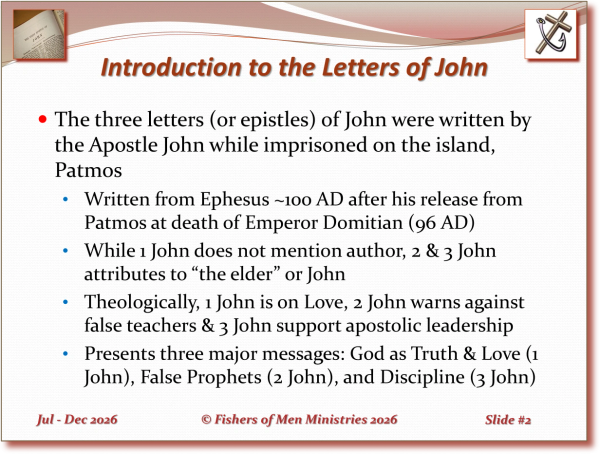
The books of 1 , 2 & 3 John are historically and traditionally attributed to the Apostle John, the Disciple Jesus loved. The title “1 John” (read as "First John" reflects its position as the first of three epistles attributed to John in the New Testament. First John does not specifically mention an author while 2 & 3 John attribute the writing to "the Elder." From that the authorship is determined and assigned as all three letters to the Apostle John.. First John was written late in the first century AD, probably 96 AD..
Purpose
First John is a strong sermon on the doctrines of God being the light and the Word of God and the epitome of love. That is, Jesus is the light (enlightener, revealer, explanation) and Word (authority, statement, establishment) of God. God so loved, with which He loved the entire world (cosmos or universal set of all humankind) that He gave His only begotten Son (Jesus the Messiah.and Christ) so that whosoever (all, anyone, everyone) who believes on Him (accepts His teachings) shall not perish (be condemned, be found guilty) but have eternal (everlasting, never ending, permanent) life.
Audience
All three letters were written to the dispersed believers, sometimes refered to as the Lady. These were likely the people chosen as leaders of the church and encourages them in the light and love of the Lord. Letters 2 & 3 John add encourages members to take a strong stance against false doctrine. The two issues being dealt with were specifically Gnosticism and Hospitality. Gnosticism was in 2 John as locals were trying to add the :Knowledge" doctrines to the Christian doctrine. Hospitality was in 3 John and was to be directed to support missionaries and other workers.
Importance of This Letter
Chuck Swindoll writes, " The parallelisms in 1 John are striking for their simplicity: Christ vs. antichrists, light vs. darkness, truth vs. falsehood, righteousness vs. sin, love of the Father vs. love of the world, and the Spirit of God vs. the spirit of the Antichrist. While this is not a complete list, it reveals a letter that presents the world in an uncomplicated way—there is right and there is wrong, period. This emphasis by John, while striking, is not without love. It’s quite the opposite, in fact. John recognized that love comes from God, and he encouraged the believers to love one another (1 John 4:7). John’s first epistle teaches that while it is important to recognize the lines between truth and error, it must always be done in a spirit of love."
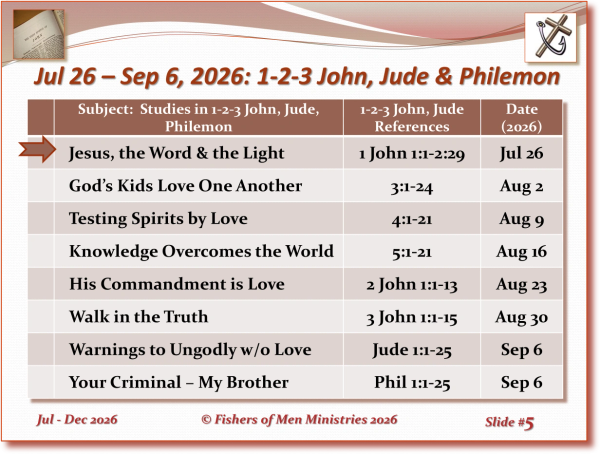
Schedule for John's First Letter
First John is written by by one of the four earliest of the Apostles of Jesus Christ. Andrew sought Jesus after John the Baptizer's sermon, and Adrew ran to Simon (called Peter) as the second Apostle. Then Jesus approached the Sons of Zebedee, James and John, making John the four selected Apostle of Jesus.
There are five chapters in the first letter John wrote calling the recipients of the letter "My Little Children." He is not talking to them a children born to him through physical birth, but rather, by spiritual birth. John had been exiled and imprisoned on the island of Patmos for refusing to stop preaching the word of the Gospel. At Roman Emepor Domitian's death (95-96 AD), John was released from Patos, hence the date for 1 John.
1 John, ( read as "First John") 2 John, 3 John, Jude and Philemon were chosen as the first five of the "Nine Little Letters" for our studies from July to December 2026. While their sizes are small, their importance to the Gospel message is very large . John called himself "The Disciple Jesus loved" through out his Gospel. At the Last Supper, John is seen as the young one without a beard next to Jesus' right side (Leonardo Vinci's great Painting). Jude was the half-brother of Jesus and Philemon was a great friend to the great Apostle, Paul.
First John is the longest of the three Johnine letters. While the title of the letter implies John wrote it, his name does not appear inside. Its emphases are love, fellowship, and correct belief about Jesus.
Christ the Advocate (1 John 2:1-14)
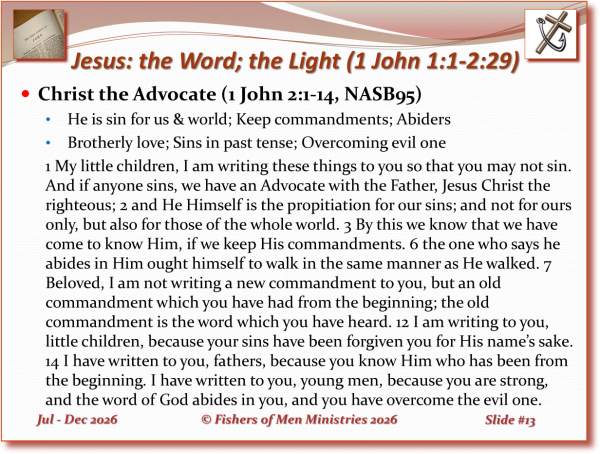
Here, John switches to a more personal approach to addressing the audience. Now he calls us his little children, this is, we are part of the family – we are together in this situation with John. He says he is writing these things to us that we may not sin, but if anyone does sin, we have an advocate (vs. 2:1). He has already proven that we are not only all sinners but that we are guilty of a sinful status and a sinful performance so, there is no one without sin (Ron 3:23) nor is there anyone who does not sin (Rom 3:10). The fact that we have an Advocate in Jesus Christ is good news because we are guilty and need Him every day, maybe even every hour. Notice also that John says Jesus is fully righteous. That is important because another sinner cannot serve as an advocate. Verse 2 strengthens that stand by saying that Jesus is the propitiation for all our sins. The word propitiation is the Greek word hilasmos meaning expiator or atonement. Atonement can be seen in its syllables as “at one ment” or the curing of any separation between us and our Savior. He heals the breach caused by sin and causes us to be one with the Savior again. And here is the rest of that great news; He is the atonement for the sins of everyone in the entire world (vs. 2). A person can acknowledge that He is their Savior and received that truth, or one can deny He is their Savior and suffer the condemnation of paying for their own sin (Acts 4:12, Rev 20:15). A person can tell if he is one of His because they act (walk) the same way He acted (vs.6). The drives in your mind and heart make you want to do what He did, and you are uncomfortable doing anything else.
John realizes that this kind of talk might seem new or novel to us so, he says “Beloved, I am not writing a new commandment to you, but an old commandment you have had from the beginning” (vs. 7). He reassures us of his truth by saying, “I am writing to you, little children because your sins have been forgiven you for His name’s sake” (vs. 12). He writes to the fathers because they know Him, and to the young men because they are strong and know the Word of God abides in them. In every case, John addresses the abiding of God as a requirement for everyone; not church or clothes or uniform or memberships but God within us. Jesus told one of the most noted Israeli scholars of His day, “You must be born-again to see the kingdom of God” (John 3:3).
The Incarnate Word (1 John 1:1-4)
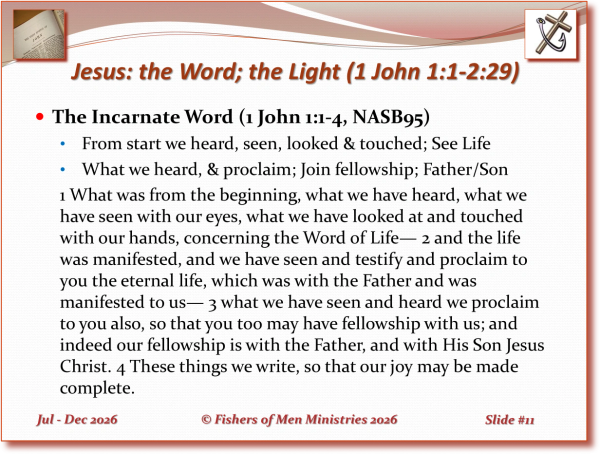
As with all letters, our first duty is to determine who wrote the letter and to whom the letter was intended. The way John begins his letter, might be better understood if we recall the experience of the Apostle Thomas after the resurrection of Jesus (John 20:24-29). When Jesus appeared to ten of the apostles, Thomas was not there. When the other apostles told him about seeing Jesus alive after His resurrection, Thomas rejected their story and told them he would not believe unless “he could see the nail prints in His hands, put his finger in the nail prints and thrust his hand into his side,” he would not believe (John 20:25). Eight days later, Jesus appeared again, but this time, Thomas was with them (vs. 26). Jesus invited him to put his finger in the nail prints and his hand in His side. While the Scripture does not say that Thomas accepted the invitation, Verse 28 says, “And Thomas answered and said unto him, My Lord and my God” (KJV). Verse 29 has Jesus’ response as, “Thomas, because thou hast seen me, thou hast believed: blessed are they that have not seen, and yethave believed.”
Now, 1 John 1:1 can be more fully understood in the context of what the disciples saw after Jesus’ resurrection. Here, John is reliving the experience of Thomas; that is, he saw and looked with his eyes, he touched the Word of Life with his hands. In Verse 2, John says he experienced the life of Christ, and he is testifying or recounting those experiences of seeing that eternal life to us.
John says in verse 3 that his purpose in sharing his experiences with us is so that we can join him and the millions of others in fellowship, and that that fellowship is with “the Father, and His Son Jesus Christ. It is like John is welcoming us to a club, of sorts, that’s members have this common experience, like Thomas did, of knowing the Word of Life, first hand, by seeing, and hearing, and touching, and feeling the resurrected Christ for ourselves. He realizes that we cannot have the same joy he and the other apostles had of actually living in the presence of Jesus for three years, but he hopes our joy can be completed by reading the words of his account of those many experiences (vs. 4).

Jesus: The Light (1 John 1:5-10)
John begins his message by recounting what he heard from Jesus directly. First, Jesus told them that “God is Light, and in Him there is no darkness at all” (vs. 1). His illustration is like walking into a room with no lights and having someone turn the lights on. The light reveals the details of everything in the room. There are no secrets remaining. Before the light came, one could only guess what might be in the room. But with the light, every secret thing in the room is revealed and there is no darkness left once the shining of God’s light begins. It is all-revealing light. In verse 6, John says if one can say there is still darkness after His light shines, he is lying and the is no truth in him. Verse 7 is a transitional verse: it starts by setting a conditional idea that if we walk in that all-revealing light, just as God Himself is that light, we have fellowship with one another. The end of verse 7, after the transition to the new topic or condition, John says the “blood of Jesus, His Son cleanes us from all sin.” So, in this statement, John reveals that the light of God establishes unity among the believers and establishes a complete cleansing from all our sin. So, The light of God brings its believers together in solid unity and provide a full and complete cleansing from all sin - righteousness.
So, John wants to set up two realities with the believers in Christ. First, the blood of Christ cleanses us from all sin and if we say we have no sin, we are misguided or simply lying. Second, if we confess (acknowledge) our sin, Jesus is faithful to remove those sins and cleanse us from all unrighteous (vs. 9).
In the first case, the subject is the “wearing of sin.” In the second case, the subject is the personal commission of sin. The first establishes our condition as sinners, while the second establishes that even if we could be excluded by living in the condition of sin, our personal commission of sin establishes our status as sinners. Whether we are talking about sin because of our humankind or because of our personal unholiness, we are guilty of being sinners. But also, in either case, the blood of Christ is fully capable of forgiving sin and cleaning us from either and all sin.
The World vs. Eternal Life (1 John 2:15-29)
In that same sense of walking the way Jesus walked, John says “Do not love the world nor the things of the world. If anyone loves the world, the love of the Father is not in him” (vs. 15). This is another measuring stick to understand where our hearts are. Write a list of the things you like and the things you do not like. If your “likes” are godly things and your “dislikes” are worldly things, there is something in you driving you toward being like Jesus. If not, you might be heading the other way! You must also measure whether doing these things is natural or forced. If God is your guide, you do these things naturally because of Him.
Verse 16 is a universal truth, “For the world offers only a craving for physical pleasure, a craving for everything we see, and pride in our achievements and possessions. These are not from the Father, but are from this world” (vs. 15). Look at what Satan has used to temp Jesus? What has led to the failure of priests, pastors and political leaders? Sometimes it is not as easy as it looks. What are the things God has created us to need? Example: When Satan tempted Jesus to turn the rocks into bread, how long had it been since Jesus had eaten?
Verse 18 opens the discussion of the promised Antichrist. (The capital “A” is the person; the small “a” is the behavior.) Second Thessalonians 2:3-12 gives a short background of him. Revelation 13 shows him as the first beast and the false prophet as the second beast. This person, the Antichrist, will be the key leader during the Tribulation Period. He will be worshipped on the Temple Mound in Jerusalem. He will kill all who will not worship Him. The False Prophet will be the “Preacher” who exalts him. Satan, the Antichrist and the False Prophet are the unholy trinity of the seven-year Tribulation Period.
John finishes with a warning that we abide in Him and He abides in us. He warns us that when He appears and takes His Church away from the earth before the Tribulation Period that we make sure we can be certain of our stand and approach Him in confidence. We certainly do not want to have to back away in shame because we refused to be called one of His.
How Great A Love (1 John 3:1-3)
Unlike the Apostle Paul, John does not use the standard “From, To, Purpose” format in his letters. For some, this hinders a full understanding of the letter for the sake of proper interpretation. Most of the commentaries and Christian scholars agree that this first letter is written to a sizable group of churches experiencing a common problem of false doctrine finding its way into their churches. The teachers of such doctrine are sometimes labeled as “antichrists” because their false doctrines stand against the deity of Christ and church leader’s overall authority to make policy on holy living because of Christ’s holiness. Personally, I see no greater authority than the letters of those who physically walked with Jesus and were called upon to surrender their own lives for doing so.
Here, John tells us of the greatness of the Father’s message giving us the title of Children of God (vs. 1). John sternly applied the same term to us even more strongly in his Gospel at verses 1:10-13. There he says specifically, “10 He was in the world, and the world was made by him, and the world knew him not. 11 He came unto his own, and his own received him not. 12 But as many as received him, to them gave he power to become the sons of God, even to them that believe on his name: 13 Which were born, not of blood, nor of the will of the flesh, nor of the will of man, but of God.” There is no stronger stand for us being God’s children than these statements.
And John is certainly correct in saying that the world does not know us (or certainly does not understand us) in the culture of the world today. They ask, “Why, what kind of people would prefer being eaten by wild beasts, drawn and quartered in an arena or burned alive at a Caesar’s party instead of simply renouncing their stand for Jesus Christ?” Nevertheless, He calls us His children, and we openly claim the title even though we have little idea what that means. Verse 2 says that we do not know what that means nor what we shall be when He returns for us, but we do know we should not let our hearts be troubled because He is certainly coming back for us and we shall be like Him. We hold and keep ourselves pure for Him because He said He is making a place for us and will return, we will become like Him and He will take us to where He is (John 14:1-6).
Sin & Lawlessness (1 John 3:4-12)
In these verses, John addresses the relationship between sin and lawlessness. He starts with the statement that everyone who practices sin also practices lawlessness (vs. 4). Most of us would agree that goes without saying. Any members of these churches with Jewish backgrounds have spent their entire lives knowing that violating the Ten Commandments or the hundreds of derivative laws, defined sin and at the same time defined lawlessness.
Now, he tells us we ought to know and understand the mission the Father gave to the Son. John says, “You know that He appeared in order to take away sins; and in Him there is no sin” (vs. 5). It probably surprises no one that in Christ there is no sin, but read John’s application of that knowledge, “No one who abides in Him sins. Ho one who sins has seen Him or knows Him” (vs. 6). Initially, it appears he is making a very legalistic statement saying that if you ever sin after you claim Christ, you clearly have no part in Him. It is not a statement of absolute truth as much as it is a measuring stick for us to determining where we stand with Christ. Before we were born again, sin was nearly automatic, and it had little impact on us. But once we became a part of Christ, once we became a child of the King, all things were made new (2 Cor 5:17). Now, we have the Holy Spirit in us Who communicates the dangers of sin and influences us away from it.
t
In Verse 6, John introduces the term “abides in Him.” This depicts a coexistence between God and man. The Holy Spirit is the downpayment for our salvation (2 Cor 5:5). In other words, God gives us the indwelling Holy Spirit until He calls us to Himself. God indwells us, communicates with us, keeps from “practicing sin.” We can still be tempted, we will even sin, but “practicing sin” is repeating sin over and over and being able to live in it. Anyone who can practice sin has not had an experience with God. This is what “measuring stick” means. You can measure your relationship with God by measuring how you feel about even the slightest sin. If you can shrug it off and not have to deal with it, you need to reassess that rebirth experience and make it right.
World Hates the Brethren (1 John 3:13-22)
Here, John writes to advise Christians of the fact that people who do not know Jesus Christ as Savior and Lord, people who get their values for living life from what they see around them are not going to be happy associating with you. He says the people of the world will hate you. All Christians know the struggles of living without Christ and the great relief they felt when they finally surrendered to Him. It is simple: Jesus designed us to have eternal life with Him. If we are not inside that life, we feel uncomfortable and do things to take our minds off the constant pain we feel. People who have not experienced the rebirth continue to live in that uncomfortable, dissatisfying life as their daily routine. When they see us and the joy we have in knowing we will live forever with Jesus, they are angry because we found “that peace that passes all understanding” Paul talks about in Philippians 4:7. No one likes to admit they are wrong and to admit error in something so important is devastating for the lost person.
But we can get joy and belief reinforcement out of the anger of this world. If the world hates us, we are obviously showing Christ in our daily walk. The life nonbelievers live is only available in the present. We have already left that world spiritually, and when the Lord comes for us, we will leave it physically. The people who do not have Christ have to survive in this world for the rest of life and are doomed to a far worse life in the punishments of Hell. The enemy prevents them from understanding that truth, so they will always be angry if you bring it up.
But John tells us the truth in verse 16. Those who abide in Jesus know His love for us in that He laid down His life for us even while we were still sinning (Rom 5:8). Satan has given nothing to the lost person except the lack of satisfaction of this life and the promise of eternity in Hell for the next life. Verse 17 tells us one way we can approach the lost person to get his attention without hate. We can share some of the things God has given us to help them make their lives more tolerable. By doing this, they will eventually ask us what makes life so much better for us. Then we can share Christ, and they can experience that life too.
New Commandment (1 John 3:23-24)
All of us have heard and know that the mission or assignment God gave to Jesus Christ on Earth was to “seek and save that which was lost” (Luke 19:10). 1 John 3:23 reiterates that same commandment for us. John says, “His commandment is that we believe in the name of His Son Jesus Christ, and love one another, just as He commanded us.” This is how Jesus answered that question when He was asked which commandment is the greatest. He said, “37 Thou shalt love the Lord thy God with all thy heart, and with all thy soul, and with all thy mind. 38 This is the first and great commandment. 39 And the second is like unto it, Thou shalt love thy neighbour as thyself” (Matt 22:37-40). Loving the Lord with all your heart, mind and soul certainly sounds like “believing the Lord died and was raised from the grave and confessing the Lord with your mouth” to be saved (Rom 10:9-10, KJV). We love those around us because we love Him. Jesus told Nicodemus, one of the most dedicated and learned pharisees of His time that you must be born again in order to enter Heaven (John 3:3 & 7). Now this was a man who had risen to the top levels in the Jerusalem Sanhedrin, the highest religious counsel in all of Judaism. He was highly educated and led Jewish religious people all over the world. But Jesus said to him, “If you are not Born Again, you cannot see the Kingdom of God.” Most people would ask, “Well, if a man like Nicodemus cannot make to Heaven, what hope do I have?” The answer is easy, “10 For with the heart man believeth unto righteousness; and with the mouth confession is made unto salvation.” Just like I said in the earlier quote, that sentence is from Romans 10:10. Jesus knew that Nicodemus had done many great works, but Jesus also knew that salvation does not come from what we do, it comes from where our hearts are. Paul puts it like this, “For by grace are ye saved through faith; and that not of yourselves: it is the gift of God:” (Eph 2:8, KJV).
Last, John gives us a way we can tell if we are abiding in Jesus. He says, “The one who keeps His commandments abides in Him, and He in him” (vs. 24). The only way we can keep His commandments is to live in Him as He lives in us. That motivation come from the heart, not the mind. That is, we do what we ought because He lives in us, not because we determine so.
Are Spirits from God? (1 John 4:1-3)
John drills right in on a potential danger on teaching the depth of God ‘s love for us and our responses. Namely, it is the danger that our love might influence the attitude we have toward trusting the sources for teaching those around us. That is, we tend to trust more as we love more. The danger is that there is hateful evil lurking around the perimeter of trust-worthy love who is “walking about, seeking whom he may devour” (1 Peter 5:8). It appears that John is describing such an issue behind the scenes of this letter. So, he starts with a strong caution against quickly believing any spirit who approaches us. He offers a simple test to apply before trusting such a spirit. He says, “2 By this you know the Spirit of God: every spirit that confesses that Jesus Christ has come in the flesh is from God; 3 and every spirit that does not confess Jesus is not from God; this is the spirit of the antichrist, of which you have heard that it is coming, and now it is already in the world” (vss. 2-3).
The test seems quite straight forward, especially when we recall that inside us already dwells the Holy Spirit of God from the instant of our conversion (2 Cor 1:22). So, the first indication we will have to warn us of pending danger is the uneasiness of that Spirit within us. Our response has to be to take a close look at the source of the teaching we are receiving to see where they stand on Jesus Christ coming in the flesh from God. If they will not accept that basic concept, we cannot receive their teaching on any topic. If they can commit to that doctrine, John says they we can hear their teaching.
Consider for a second what John is saying here. To eliminate the danger of accepting the teaching of a false teacher, we must determine where the person’s heart stands on the doctrine of the origin of Jesus Christ. If they can confess that Jesus was with and came from the Creator, he is worthy to present data to us. If he is unable to express that belief, we are to refuse information or teaching from him nor allow him to spread his false teaching to others around us. John associates these false teachers with the antichrists we have been warned to allude (2 Thess 2:3-12).
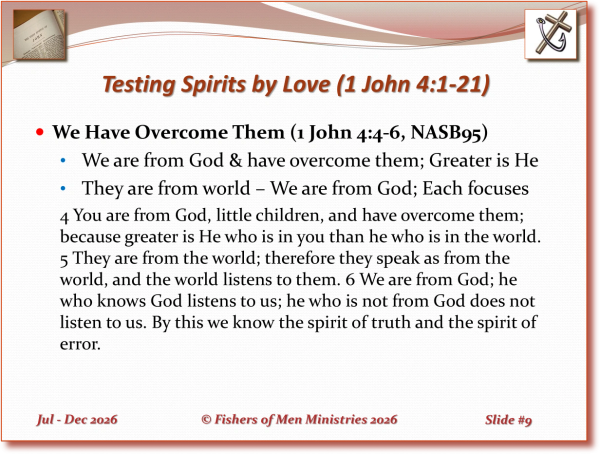
We Have Overcome Them (1 John 4:4-6)
Here John speaks of the unlimited power of the Spirit-Filled Christian (“those who are from God”), to stand up against the power of those evil spirits. He calls on us to simply know and acknowledge that the Spirit of God within us is greater than the spirit of Satan standing against us. This fact is not something to be trivialized or used for testing, rather, this fact is to be known and used with high confidence when we, or those we love, are confronted by the evil armies of Satan.
He continues that these evil spirits are from “the world” and therefore have great influence over those who are also from the world. In other words, the false teachers (and antichrists) have great influence over those who come from the same place from which they came. And many of these people are in positions of leadership within the world. It is reasonable to understand that when unholy teachers address unholy students, that the results will be unholy as well.
To the contrary, Verse 6 summarizes that we are from God, and Satan knows God listens to us, and he knows that those who are not from God will not listen to us. This makes it easy for Satan to determine whom he can use to accomplish his objectives. But it also provides a great measure for us to know whom we can trust and whom we cannot trust to move our objectives forward. Many of the rules that govern how we do business and whom we can hire, were made by unenlightened people. Frequently, unenlightened people with hiring authority will hire the unenlightened because of the general truth of personal interaction, namely, “people like people who are like them.” So, the unenlightened will seldom cause the enlightened to be hired. And to farther frustrate that situation, not all enlightened people will perform at the level at which they are equipped to perform. You have heard it said, “Some are so heavenly minded, they are of no earthly good.”
John ends his discussion observing that this is also how we can determine the spirit of truth versus the spirit error. From time to time, we have to judge whom we will call friends and who we will not. Judging the spirits, whether holy or earthly, is extremely important to personal success.
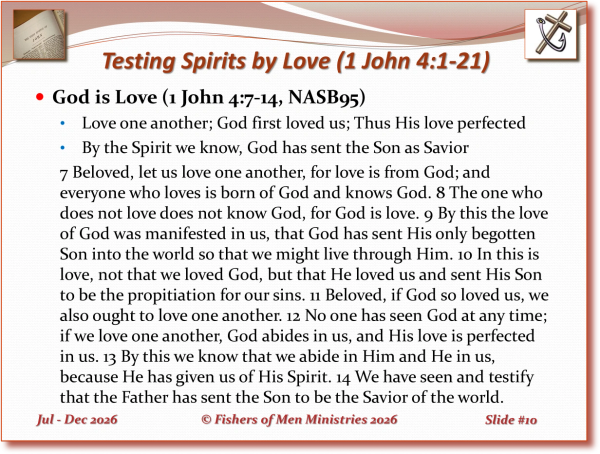
God is Love (1 John 4:7-14)
In John 4:7-14, John wants to begin by defining this word we have been using for the previous two slides. The verse states, “Beloved, let us love one another, for love is from God; and everyone who loves is born of God and knows God.” First, there are three primary Greek words for love in the New Testament: agape, eros and phileo. Phileo is a brotherly love, like Philadelphia, called the city of brotherly love. Eros is the erotic form of love, like desire and passion. Agape is the affectionate, benevolent, charitable love described in 1 Corinthians 12:4-8, “4 Love is patient, love is kind and is not jealous; love does not brag and is not arrogant, 5 does not act unbecomingly; it does not seek its own, is not provoked, does not take into account a wrong suffered, 6 does not rejoice in unrighteousness, but rejoices with the truth; 7 bears all things, believes all things, hopes all things, endures all things. 8 Love never fails.” This is the kind of love used in these paragraphs from 1 John 4. It certainly sets lofty goals for the child of God to maintain.
With that background of the meaning of the word, imagine John’s admonition that we be like that for one another because that is the way God is. Further, if we can love in those ways, it shows that we know Him and are like Him. If we cannot love like that, we do not know Him (vs. 8). But look at verse 9: This was the way God demonstrated His love to us: He sent His only Son into the world that we might live through Him. Not life as we know it, but the sinless life that He purchased for us with His blood (vs. 10). John made the statement in verse 11, “Beloved, if God so loved us, we also ought to love one another.”
Verse 12 takes that life and love and says that no one has seen God at any time, but if we can love others with that agape love, we can show the world that He lives in us and through us, His love can be completed or fulfilled. And here is how we can know we abide in Him just as described here, that He has given us His Spirit and through that Spirit we have seen and can testify that the Father has sent the Son to be the Savior of the world (vss. 13-14). The challenge of how we can love with that same intensity is answered next. Briefly, we let His love shine through us.
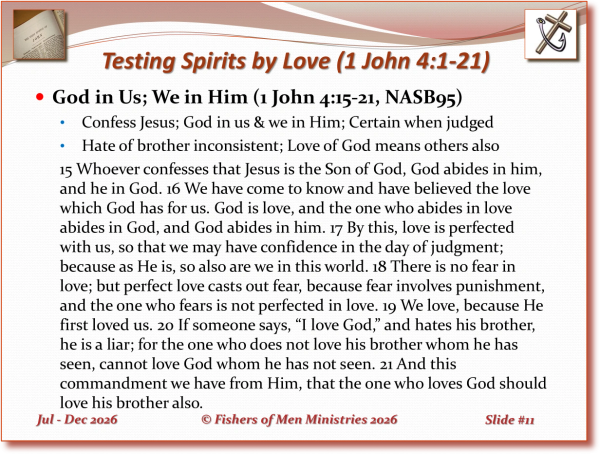
God in Us; We in Him (1 John 4:15-21)
This part of 1 John 4 reveals the secret of how we can love with the same love Jesus did. In the simplest, most straight forward way possible, we can love like Jesus did by letting Jesus do the work. The concept of being possessed by a Being who has the power to do things through us is somewhat foreign to most of us. But it is in the idea of God’s living in us that solves the equation of how we can do the impossible as Christians. Let us read more about the idea of “abiding.”
The Greek word for abide is meno. It means to take up permanent residency somewhere but not just living there. It means occupying every corner of that place. It is like being possessed by an evil being only the Spirit is a benevolent possessor rather than a dominant one. For example, when Satan possesses a person, he destroys that person. When the Holy Spirit possesses someone, He empowers and multiplies that person. As far as being changed by His possession of us, consider Paul’s statement in 2 Corinthians 5:17, “Therefore if anyone is in Christ, he is a new creature; the old things passed away; behold, new things have come.” Or like that old song, “Thanks to Calvary.” Recall the converted man returned to the place where they used to live, and his little boy ran and hid behind the door. The singer would than sing, “Son, no need to hide, you’ve got a new daddy, now. Thanks to Calvary, we don’t live here anymore.” The changes were pervasive. I was so obviously different that people could not believe I was the same person. I remember in March of 1974, I no longer wanted to go to some of the places I used to go, drink the same things I used to drink, say some of the words I used to say. I had become a new creation, and astonishingly enough, I did not do the changing. Rather, it was done by something that changed in me.
It was God taking up residence in me and some of me had to change to make that dwelling place home for my Lord. Notice in verse 16 that the abiding or indwelling is mutual, that is, “I abide in Him as He abides in me.” Just like God said He could not see the gross sins of Israel through the blood of the innocent lamb on the Day of Atonement, God cannot see my sin through the blood of His Son dwelling in me. That is why we can no longer be the way we were. It just is not there!
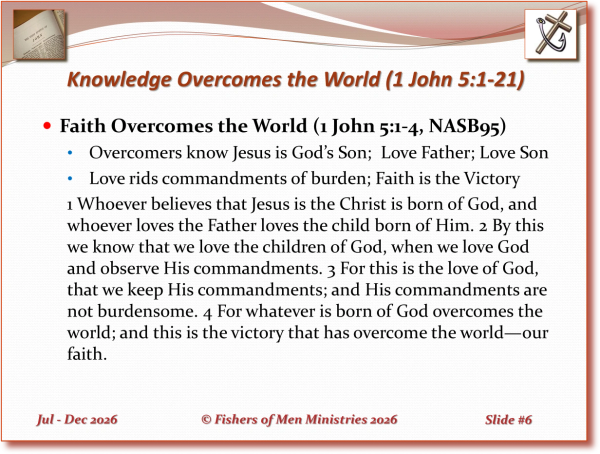
Faith Overcomes the World (1 John 5:1-4)
Theologically speaking, it is not difficult to see that John wants to drive home the point that a person’s relationship with God is the determining factor in where that person will spend eternity. John documented this fact in the early chapters of his Gospel at John 3. There Jesus is visited by Nicodemus, an extremely well-educated Jewish leader. Nicodemus intended to learn from Jesus and determine why mostly all Jewish and Roman leaders were upset and angry with Jesus to the point of planning His death. He opens saying that he knew Jesus must have been a teacher sent from God because no one could do the things Jesus was doing unless he were sent from God.
Jesus, on the other hand, was commissioned by the Father to come to seek and to save that which was lost (Luke 19;10). So, Jesus said, “Verily, verily, I say unto thee, Except a man be born again, he cannot see the kingdom of God (John 3:3). Nicodemus was a man who had given his entire life to the study of the Jewish Scriptures and explaining them to other learners. Now, he is being told by this new rabbi (teacher) that he had to do something more to enter Heaven. Men of his stature were not used to being told they needed more to be close with God. Nicodemus challenged Jesus’ knowledge of the birth experience and especially how impossible it was for a man his size to reenter his mother to be born again. It is clear that the two men were not speaking in the same context. Jesus was speaking spiritually and Nicodemus was speaking physically. Similar conversations take place every minute of every day in every city of the world, but how the conversation ends holds the eternal life of the inquirer in its balance.
Verse 5:1, simply says that anyone who believes that “Jesus is the Christ is born of God; the promised Messiah, has experienced the rebirth Jesus was explaining earlier. John’s Gospel does not document the second birth of Nicodemus here, but the fact he and Joseph of Arimathea asked for the body of Jesus after His crucifixion provides that evidence. In verses 2-4, John talks of the results of this rebirth experience. A reborn person keeps God’s commandments; not because he must, but because the Spirit inside leads him. Note also, the reborn find no burden in doing it.
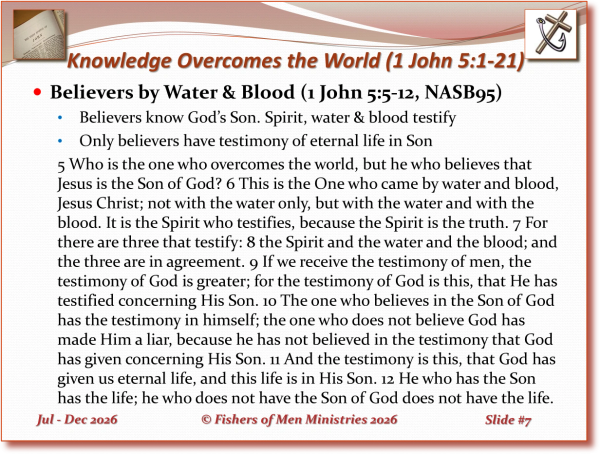
Believers by Water & Blood (1 John 5:5-12)
John asks the question, “Who is the one who overcomes the world, but he who believes that Jesus is the Son of God?” (1 John 5:5). He seems to be returning to that explanation He was giving to Nicodemus so many years earlier. Once again, John emphasizes that the rebirth in Jesus Christ provides the power to overcome the trails and tribulations of this world. Notice he mentions that Jesus was One who came by water and blood. He reemphasizes even again by saying, “This is the One who came by water and blood, Jesus Christ; not with the water only, but with the water and with the blood” (vs. 6). If we identify the water with the water of the placenta and the blood with the blood of the cross, the messages of Jesus and John are very easily understood. The water of the placenta is the first birth and causes a physical human to be born. But the blood is the blood of Jesus’ cross which allowed the second birth, or rebirth, to take place. In the evangelistic context, if a person is born once, they will die twice: once in the physical death and a second in a spiritual – separation from God for all eternity. But if a person is born twice, they will only die once. Jesus asked Martha at her brother’s death, “I am the resurrection and the life; he who believes in Me will live even if he dies, and everyone who lives and believes in Me will never die. Do you believe this?” (John 11:25). Jesus was explaining to Martha that there is no such thing as death for those who are born-again. He finishes verse 6 assuring us that the Spirit Himself provides the testimony of this fact. And that truth causes the testimonies of the Spirit, the water and the blood to coincide regarding the future for all believers.
God continues that while we might be reassured by humans concerning these facts, the reassurance from God is even more certain. He says, “If we receive the testimony of men, the testimony of God is greater; for the testimony of God is this, that He has testified concerning His Son. The one who believes in the Son of God has the testimony in himself; the one who does not believe God has made Him a liar, because he has not believed in the testimony that God has given concerning His Son” (vss. 9-10). Then John summarizes this doctrine clearly this way, “He who has the Son has the life; he who does not have the Son of God does not have life.” The rebirth delivers life!
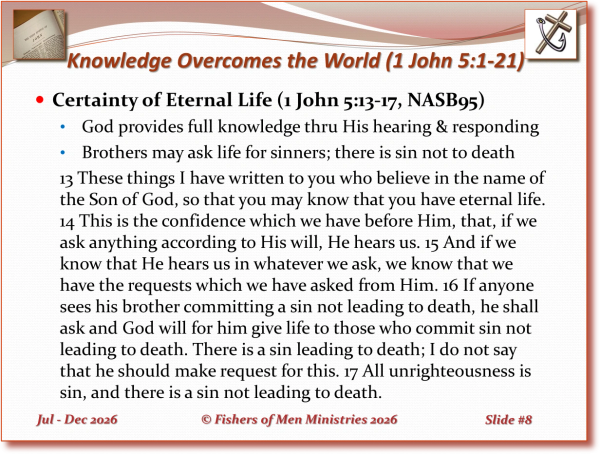
Certainty of Eternal Life (1 John 5:13-17)
Verses 13-15 are three of the most encouraging verses regarding our lives in Christ. The beginning of the verse is obvious as he says, “These things I have written to you who believe in the name of the Son of God.” So, he penned these words to fellow believers, so they might know beyond any doubt that they have eternal life through their belief that Jesus Christ is God’s Son and that He died, was buried and was resurrected (see Rom 10:9-10). Eternal life in Jesus Christ, then, is a settled issue. John said it was the reason he wrote this area of 1 John.
Now verses 14-15 picks up on a separate topic, and that has to do with prayer. John says that we can be confident in the presence of God that if we ask anything which is in His will, He hears our prayer and will honor that request for us. And that is the primary rub in the statement, that is, we will have it if it is in His will. Each of us is on this earth to complete a set of purposes God requires of us. And, like all the saints of God who have gone before us, God will not allow us to transition from here to Heaven before we have finished those things. If our prayer prevents or hinders the purposes God assigned to us for this life, He simply will not honor the request. That does not mean, however, that God cannot work an alternative response to your prayer which accomplishes what you prayed while still honoring God’s will.
Verses 16 and 17 speak to one of those difficult passages of the Bible. He starts by saying that we should pray for every fellow believer we find practicing a sin which is not unto death. John says the request you make of the Lord will be honored if it is not against His will for anyone. That prayer will be answered even to the point of giving life to that person. First question is what is “a sin unto death.” This is difficult because the same Greek word is used for physical and spiritual death (Thanatos). The only sin to spiritual death is refusing the Gospel of Christ. Only Hell awaits the person who dies without Christ. For life, the Greek zoe is for spiritual life and bios for physical life. The Greek word in verse 16 is zoe. Does “sin unto death” mean we can lose our physical or spiritual life? Ask Ananias and Sapphira (Acts 5:1-11) or see what Jesus said in Mark 3:28-29.
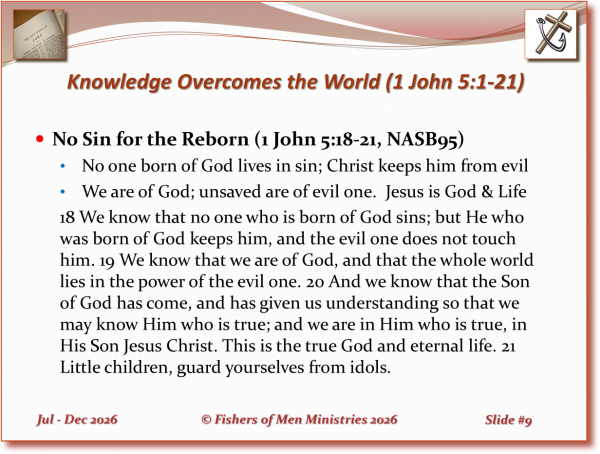
No Sin for the Reborn (1 John 5:18-21)
The lead sentence in verse 18 is questionable for most (It just doesn’t feel right!). We know there is literally no one who can live a sinless life. The question of how the perfection of “no one who is born of God sins” could pass the test of common sense for anyone who lives a minute as a child of God. The answer is in the meaning of the verb, “sins” (Greek hamartanei versus hamartánō). The first word is the actual verb used in the Greek text. The second is the commonly used verb as in Strong’s number 264. Strongs lists the root Greek word rather than the actual word used. In this case, the difference is in the verb ending “ei.” This forces the difference between committing sin and having a regular habit or dedication of committing the sin. The English Standard Version (ESV) and New Living Translation (NLT) chang the KJV word from “sinneth not” to “does not keep on sinning” or “do not make a practice of sinning,” respectively. In application, this meaning that while a born-again person may sin (in fact, 1 John 1:8 says, “If we say that we have no sin, we deceive ourselves, and the truth is not in us”). The born-again person cannot tolerate living inside, having a habit or repetitively committing that sin. ESV says, “We know that everyone who has been born of God does not keep on sinning, but he who was born of God protects him, and the evil one does not touch him” and captures the full meaning of the change the indwelling Spirit of God makes.
Verse 19 shows another contrast. John says that we are of God, but the whole world lies in the power of the evil one. We have been changed. Our “want to’s” have been changed. The born-again is not trying to play “holier than thou,” he or she is just a different person than before and it shows (2 Cor 5:17). John knows that as he lived the fisherman’s life out on the water with Andrew, Peter and James. You can only imagine the language they used out there in their two boats. Those of us who have lived the unregenerate life as adults have experience. But God came into us and we are different than before. Verse 5:20 captures a lot of the change of the “before” and “after” associated with John’s experience and that same experience he saw in the Apostles around him. Somehow, I started getting more joy out of “The King is Coming” than “In-A-Gadda-Da-Vida.”
Author, Title, Date
The books of 1 , 2 & 3 John are historically and traditionally attributed to the Apostle John, the Disciple Jesus loved. The title “1 John” reflects its position as the first of three epistles attributed to John in the New Testament. First John does not specifically mention an author while 2 & 3 John attribute the writing to "the Elder." From that the authorship is determined and assigned as all three letters to the Apostle John.. First John was written late in the first century AD.
Purpose
1 John is a strong sermon on the doctrines of God being the light of the world and the epitome of love. That is, Jesus is the light and love of the world. 2 John centers on the teaching against Gnosticism and 3 John is written on church disciple and unity.
Audience
All three letters were written to the dispersed believers, sometimes refered to as the Lady. These were likely the people chosen as leaders of the church and encourages them in the light and love of the Lord. Letters 2 & 3 John add encourages members to take a strong stance against false doctrine. The two issues being dealt with were specifically Gnosticism and Hospitality. Gnosticism was in 2 John as locals were trying to add the :Knowledge" doctrines to the Christian doctrine. Hospitality was in 3 John and was to be directed to support missionaries and other workers.
Importance of This Letter (From Matthew Henry commentary)
Here we find a canonical epistle inscribed, principally, not only to a single person, but to one also of the softer sex. And why not to one of that sex? In gospel redemption, privilege, and dignity, there is neither male nor female; they are both one in Christ Jesus. Our Lord himself neglected his own repast, to commune with the woman of Samaria, in order to show her the fountain of life; and, when almost expiring upon the cross, he would with his dying lips bequeath his blessed mother to the care of his beloved disciple, and thereby instruct him to respect female disciples for the future. It was to one of the same sex that our Lord chose to appear first after his return from the grave, and to send by her the news of his resurrection to this as well as to the other apostles; and we find afterwards a zealous Priscilla so well acquitting herself in her Christian race, and particularly in some hazardous service towards the apostle Paul, that she is not only often mentioned before her husband, but to her as well as to him, not only the apostle himself, but also all the Gentile churches, were ready to return their thankful acknowledgments. No wonder then that a heroine in the Christian religion, honoured by divine providence, and distinguished by divine grace, should be dignified also by an apostolical epistle.
Schedule for Jude's Letter
Jude is written by one of Jesus' four half brothers and at least two half sisters. They are listed as James, Joseph (also called Joses), Simon, and Judas (Jude), along with at least two unnamed sisters (Matthew 13:55-56; Mark 6:3) . The Letter of Jude is written to warn believers about false teachers and divine judgement.
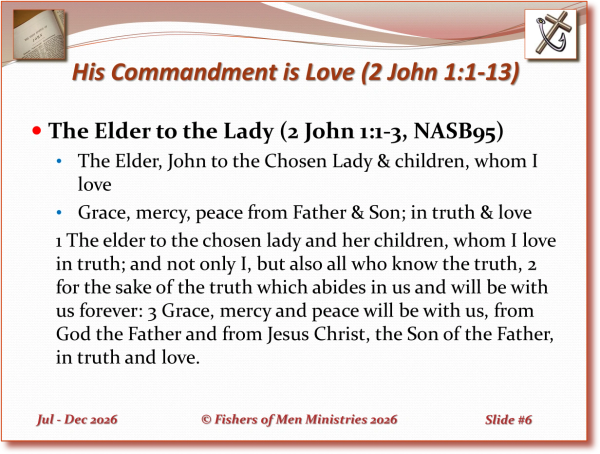
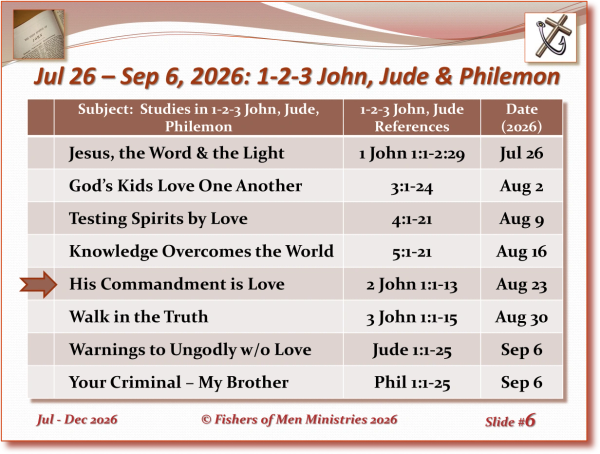
The Elder to the Lady (2 John 1:1-3)
As with most letters, Second John begins with the “From, To and Greetings” of the art form. Here we have the Elder as the From and the Chosen Lady and her children as the addressees. The Elder is, of course, the Apostle John just as with First John and Third John. He is clearly the oldest living of all the Apostles of Christ. He was the only one to have died of natural causes. Matthew Henry addresses the “Chosen Lady” as a female person of eminent quality, in birth, education and estate. Your reviewer takes the Chosen Lady more generally as in the Bride of Christ and “Her Children” as the members of the church. Recall how Paul frequently referred to those he had led to Christ as his children in the faith, like Timothy and Onesimus. John states that he loves this Lady in truth and that she is loved by all those who know that truth; that truth being the Gospel of Christ. Notice how John adds to the fact of that love by all who know the truth, that that truth abides within us and that it will never depart from us, that is, it abides with us forever.
He wishes the Lady and her children grace, mercy and peace to be with them as it has come from God the Father and from Jesus Christ, the Son of the Father, in truth and love. The good wishes are wide enough to include all those who are in the way of the truth and love.
It is in this kind of grace, mercy and peace with a net wide enough to continuously grow the influence and the attractiveness of such a movement as started so many centuries ago. It is interesting that John spells out the involvement of the Father and the Son but leaves off the focus on the Holy Spirit. Especially since it is that Holy Spirit Who provides the power to hold together the church through its commonality of teaching and movement. A church or better, a fellowship of believers, becomes interesting to the many others who are seeking a place where they can find such an environment to enjoy for themselves. The Holy Spirit within us has a natural propensity for this kind of fellowship, and it is closely related to that peace that passes all understanding of Philippians 4:7 fame also characteristic of the Christian fellowship of the new church across all its realms. These fellowships grow because they offer a very positive choice against Roman pain.
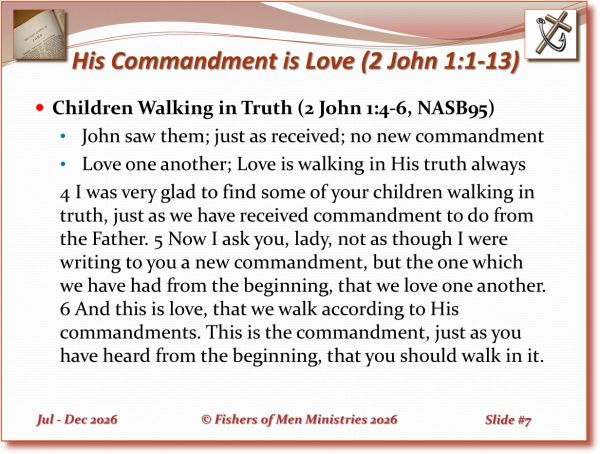
Children Walking in Truth (2 John 1:4-6)
John shares that he is pleased that the children of the Elect Lady are still walking in honor of that truth they received just as they had received God’s commandment to do so from the Father from the beginning (vs. 4). Verse 5 gets into the reason for John’s letter. John asks the Lady (the church), not something which should be seen as a new commandment, rather, that same commandment which we have had from the beginning, that we love one another. John emphasizes that this is not a new commandment, but a restatement of the one they already knew so very well. Whether he is stating this in a way of being pleased for past performance, an emphasis to continue in the same way or a demand that they reestablish the practice of that love is not know at this point.
But in Verse 6 John reestablishes the basic of God’s commandment; that this love demonstrated in our keeping of the commandments Jesus left for us to define our faith. He restates the intent again saying that the commandment means the very same thing it has meant in the beginning and we had heard from that beginning, that we should walk in that commandment, that is, we must love one another. It is within this love that the objective of walking like He walked, places our eyes on Jesus rather than any or all the leaders now in place. John first stated this goal in 1 John 2:6, “he who says he abides in him ought to walk in the same way in which he walked” (RSV). The effort is both noble and simple, the people who call themselves Christians, should copy Christ. It returns to the idea of that wristband so many of our young people wore dozens of years ago that stated “WWJD” or spelled out, “What would Jesus do?”
It removes one of the dangers of new leadership to interpret what Christianity means to them and lead the people to copy them rather than copying the Christ Who defines what Christianity is all about. Is this not where the dangers of denominationalism came from. We need a little less of the versions of Christianity as defined by Baptists, Methodists, Catholics and Presbyterians, and more of the Christianity of Jesus Christ. From my perspective, the most reasonable way to accomplish this is to return to faithfulness to God’s Word, the Bible. Christianity is copying Jesus.
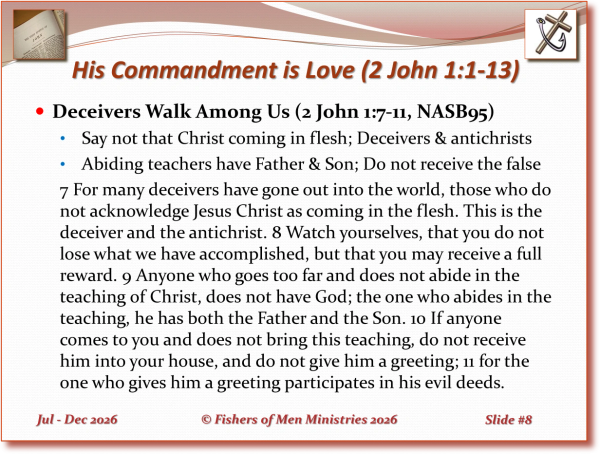
Deceivers Walk Among Us (2 John 1:7-11)
Now that John has documented how the ministry should function, he documents that there are people who have gone out into the world and picked up false doctrine. These people do not acknowledge that Jesus Christ came in the flesh (vs. 7). Notice John has not yet said they are inside the churches, but rather, they have gone out into the world. Their refusal to accept that sound doctrine that Jesus Christ came in the flesh is deceptive and antichristian according to John. A person or people who teach this doctrine are deceivers and antichrists.
The deception of this doctrine is that fulfillment of hundreds of prophesies of the birth of Christ necessitates that Jesus Christ did, in fact, come here in the flesh. For example, He was born of a virgin, He was in the linage of King David, He was born in Bethlehem, He was the suffering servant of Isaiah 53, and many more prophesies. Teaching that He did not come this way is teaching that Jesus of Nazareth was not the Christ, not the Messiah. “Watch yourselves” indeed! (vs. 8). It is easy to see how John could give the warning that following false doctrines would be antichristian. Simply put, any man who does not fulfill ALL the prophecies about the Christ is not the Christ. Anyone who teaches that Jesus did not fulfill these prophecies is rejecting Jesus as the Christ. He is antichrist or antichristian. John was concerned that they might lose what they had gained so far, or that they might not receive their full reward under God.
Verse 9 designates this kind of response to Christian teaching as going too far. It is simply the opposite of abiding in the Lord. People who live in the true doctrines of Christ have both the Father and the Son. John warns that if anyone comes to us with teaching other than true doctrines of Christ, we are not to receive them nor their teachings. Further, we should not even receive one of them into our homes nor offer them greetings. Anything that could be seen as encouraging or aiding these people is partaking in their false doctrines; participating in their evil work. In some communities, the people banned together and shunned people like these as soon as they were known. They would not be permitted any form of comfort from the community. They would be shut out and forbidden from participating in the community in any way.
Not by Pen; Face to Face (2 John 1:12-13)
As John bids his farewells to these saints, he realizes that he has shared a great6 deal of very strong teaching. He has more to say to them but feels he should do it face-to-face rather than with even more writing. John understands that everyone has limits for how much new information they can process and absorb at any given time. He is concerned that some of the information he shared was so very important and hard to hear that the listeners might be saturated at this point in time. He clearly had a previous plan to come see them so that their joy might be fulfilled. He judges that continuing to share his important message at this time might be expecting a little too much from these saints of the Lord. If the information is worth sharing with the goal of creating memories, he had better stop and let the natural absorption process place the information already shared into their memories.
I recall a college course I took in an accelerated program. The class was on business history, so it was already a sure cure for insomnia. But add to that it was a course designed for Friday night and all day Saturday. About lunchtime on Saturday, there was no information being learned; it was all a test to stay awake and last until suppertime. It was this level of information overload that John feared he might have reached. “Surely, if these people are going to use this information, I had better stop and try at another time. Even better,” he thought, “he might visit them and share the information during the visit rather than adding more to the end of this writing.” John was obviously a wise teacher.
John shared some very heavy material in his second letter, and he drilled it home with strong examples of possible harm to the community. He had the attention of the crowd, but he refused to abuse it and demand more at this time. He probably thought back to his use of words like deceivers and antichrists and knew a lot more explanation needed to be shared before the impact of those words could be fully appreciated. Certainly, he would have to explain the difference between antichristian behavior and the Antichrist, that Beast of the first half of Revelation chapter 13.
Author, Title, Date
The books of 1 , 2 & 3 John are historically and traditionally attributed to the Apostle John, the Disciple Jesus loved. The title “3 John” reflects its position as the third of three epistles attributed to John in the New Testament. First John does not specifically mention an author whil 2 & 3 John attribute the writing to "the Elder." From that the authorship is determined and assigned as all three letters to the Apostle John.. Third John was written in 96-99 AD.
Purpose
First John is a strong sermon on the doctrines of God being the light of the world and the epitome of love. That is, Jesus is the light and love of the world. Second John centers on the teaching against Gnosticism and Third John is written on church disciple and unity. John adds to that a admonistion to support the needs of missionairies in terms of fellowship and housing.
Audience
First John is a strong sermon on the doctrines of God being the light of the world and the epitome of love. That is, Jesus is the light and love of the world. 2 John centers on the teaching against Gnosticism and 3 John is written on church disciple and unity.
Importance of This Letter
The Christian movement was believed by the Jewish religious leaders to be doomed to failure as soon as they murdered Jesus of Nazareth. Acts 9 tells us that Saul of Tarsus was permitted by the Sanhedrin to expand his geographical area for persecuting Christians outside Judea and into Asia. Saul was converted on the way to Damascus of Syria and became known as Paul, an Apostle of Jesus Christ. The hope that Christianity offered was far superior to the persecution of the Jews and Romans, and provided for strong belief for the thousands who faced death for their beliefs.
Schedule for Jude's Letter
Jude is written by one of Jesus' four half brothers and at least two half sisters. They are listed as James, Joseph (also called Joses), Simon, and Judas (Jude), along with at least two unnamed sisters (Matthew 13:55-56; Mark 6:3) . The Letter of Jude is written to warn believers about false teachers and divine judgement.
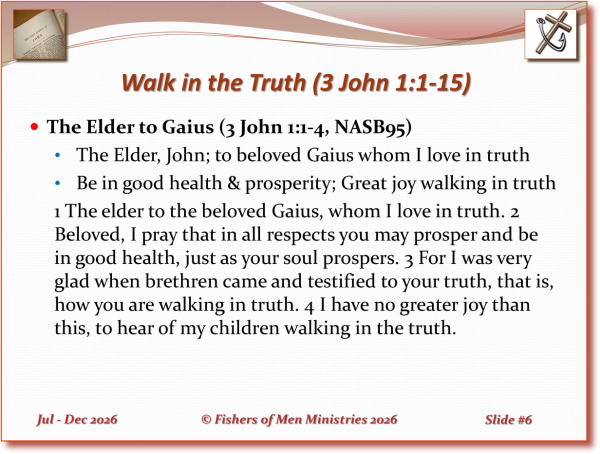
The Elder to Gaius (3 John 1:1-4)
In First John, we picked up the ideas that Jesus is the Word and the Light unto the entire world. Through Him we must love one another and test the spirits of this world through that love. We learned that the knowledge gained through studying the Word and the Light can teach us how that knowledge can overcome the spirits of this world and its secular influence. Second John followed up on the idea of love and its powerful influence despite the world’s counter influence of deception within our churches. In Third John, we get the same emphasis on the power of a loving attitude especially among the brethren, but John adds to his warning against deceivers among us to include false accusers among us, as well. John has lived long enough to understand that wherever God is successful in spreading the Good News of the Gospel of Jesus Christ, there will be a counterculture of effort to eliminate or reduce that influence through hate, deception and false accusations.
Here we find John, as the Elder, writing a serious letter to his beloved Gaius; thanking and encouraging him to pray, prosper and watch out for his good health while maintaining prosperity of his soul. It takes a lot less time to make statements like these than it does to make all four of them happen in the environment Gaius was forced to live.
In verse 3, John reveals that he has received some of the brethren coming to him and testifying of Gaius’ truthfulness and how he maintained his strong walk for the Lord in the truth. Indeed, John can congratulate Gaius knowing that those loved and adored by Christ will certainly be loved and adored by the disciples of Christ he led. The indwelling Holy Spirit common to both would nearly demand it to be so. Or maybe his title as elder hints of his knowledge that all of the Apostles of Jesus Christ have pasted on with the exception of himself, making himself, therefore deserving of the badge of the Elder (or maybe eldest or only).
His message in this greeting is to report the great joy Gaius has kindled in his heart with the reporting that one of his children was walking in truth. We know that the “truth” here is the truth of the Gospel and the life it kindles inside the heart of its teachers and practitioners. Gaius is real!
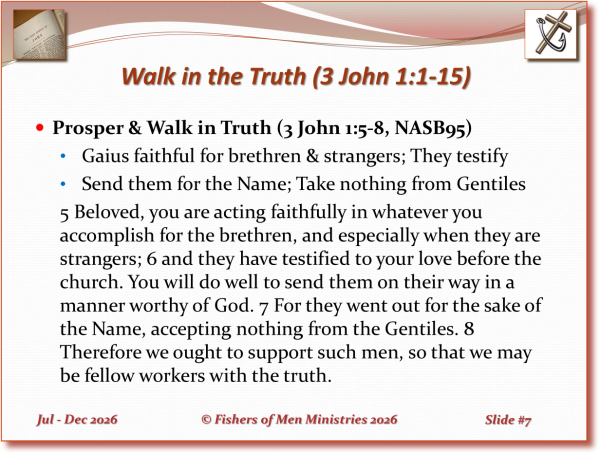
Prosper & Walk in Truth (3 John 1:5-8)
As we consider this man. Gaius, recall that there was one of that name Baptized by Paul in Corinth who might well be the one John is now addressing (Rom 16:23). Even if it is not he, it is a fellow brother in name, estate and disposition as Gaius. As all the writings of John emphasize the need for strong and sincere love, it is true that one giving that kind of love finds himself in receipt of that love naturally returned to him. John reenforces his feelings toward Gaius with words like “the well-beloved” and “whom I love in the truth.” But notice also that while John recognizes Gaius’ faithfulness in whatever he does for the brethren, Gaius does especially for the strangers. The words “brethren” and “strangers” here generally point to whether the ones talked about are also in the Jewish faith. “Strangers” is used throughout the Old Testament as those who are Gentiles. Certainly, Paul went first to the Jews when founding his churches but to the Gentiles as well. The fact that John followed the same path should not be surprising. (Recall that Paul was martyred in Rome about 67 AD and John was released from Patmos in 98 AD.)
In Verse 6, John says that the testimony given by others for the sake of Gaius’ love was given before the churches. He suggests that Gaius might do well send them forward in a way which is worthy of the God they serve. It would seem appropriate that one who is so richly lauded for his practice of love would not hold back from those who returned that love in favor of the one who first gave it, none other than Gaius, himself.
Verse 7 adds a double blessing for those who were being sent out from Gaius. First, they were going out for the sake of the Name. This name could be no other than the Name of Jesus. But second, they were going out accepting nothing in return from the Gentiles. This was a modus operandi championed by Paul some 30-40 years earlier as he and his cohorts like Priscilla and Aquila who made and mended tents while on the ministry field to keep from charging for their ministries (Acts 18:1-3, see also my book, Bivocationallisted on this webpage). John says in verse 8 that Gaius should certainly support these ministers in anyway they can so they could join them.
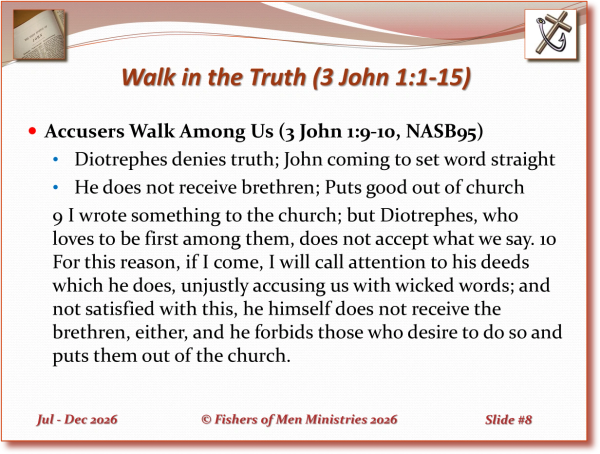
Accusers Walk Among (3 John 1:9-10)
John now comes to one of the primary reasons for writing this letter. It seems that John “wrote something to the church” which a certain Diotrephes openly rejected (vs. 9). This is a problem of highest order! John was the last remaining of those who walked with Jesus Christ. If there was a though Jesus uttered, John would have heard it. Acceptance of the validated writings of the Apostles was established as a primary source of Scriptures for the New Testament decades before this part of John’s ministry.
But secondly, this Diotrephes is a self-proclaimed and puffed-up leader who desires to be first among the dissenters (vs. 9). John says he will openly confront him when he comes for his upcoming visit (vs. 10). John reports that Diotrephes is a man who does not accept the writings of the disciples (recall that John never used the word “Apostles” in his writings). We always try to chose between those words because the word “Apostle” usually applies to only the twelve who walked with Jesus, Matthias who was selected by the Eleven to replace Judas (Acts 1:23-26), and Saul of Tarsus (renamed Paul). Matthias was never again heard of, but Paul wrote much of the New Testament and established the majority of New Testament churches on his three missionary journeys. Paul met the three requirements for an Apostle: he was directly selected by Jesus Christ (Acts 9), taught by Him directly for several years (as Paul would be), and saw Him alive after his resurrection (Acts 1:17, 22, 25). I don not know of many scholars who reject the teachings of Paul. A Disciple, on the other hand, is any believer in Jesus Christ – there are billions of those.
So, John goes on to describe the shortcomings of Diotrephes that he plans to address when he arrives to meet with Gaius and other leaders of the church. It is not the specifics of his case that should trouble today’s Church leadership. This issue could come under the heading of Pastoral Leadership or Deaconate Leadership to handle. The Deacons have the responsibility for handling issues of church unity while the Pastorate would deal with open sin within the congregation. Either would fit here. The most important part is in addressing the issue before it continued open and thought to be true because of lack of action. Just as the US Constitution addresses a “speedy trial,” church discipline requires speedy trials for false doctrine or causing disunity.
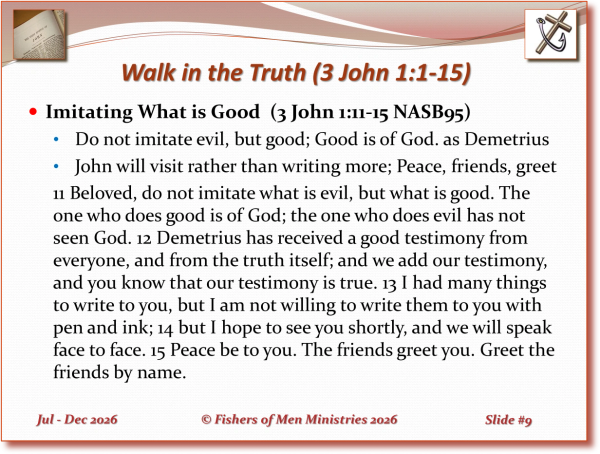
Imitating What is Good (3 John 1:11-15)
Notice the timing of the issue on imitating that which is good. The issue with Diotrephes might be something thought to follow for others who like to be noticed for being outrageous. Recall that the church is the place where Christians gather to build each other up and encourage one another. Taking action on a member or group in the church is always a sad distraction.
John is trying to encourage church members to imitate the great examples of Christianity who God chose to place in our churches just for the sake of being examples. He says that we should never imitate that which is evil or bad, but that which is good (vs. 11). He follows up that the one who does good is of God but the one who does evil has not seen God. For example, Demetrius has received a good testimony from everyone, and from the truth itself. John adds that we (him and others) could add their testimonies and the church knows that their testimonies are true. This kind of testimony is that which builds up a church rather than tearing one down. My hope for Diotrephes is that he resigned and departed before John arrived so that the issue would not have to be opened to the entire membership of the church. Sometimes if these kinds of issues can cause those not involved to take sides and lead to something called a “church split.” In those cases, there would end up with the two sides dividing and unable to come back together as a combined congregation again. A church split is not a very Christ-like way of handling disagreement, but they do happen. There are many better ways to handle disagreement, but when tempers get out of hand, that is the end point. Of course, passing an unruly church member to another church is bad.
Verse 13 begins John’s ending for this correspondence. He wants Gaius and the others to know that there are several other topics he would like to discuss but either time or subject matter might be such that are better handle in a meeting rather than in a letter. John mentions specifically that he was unwilling to write in the letter (vs. 13). He does, however, hope to meet with them very soon and cover the remaining topics face-to-face. He wishes the people of this church peace and passes on personal greetings from the friends of the other church or organization (vs. 15).
Author, Title, Date
Jude self identifies as author of this book, along with 2 Peter, he wrote sometime between 65 & 80 AD. 2 Peter's potential writing period finished about 12 years earlier than Jude's potential writing period. Like 1 & 2 Peter, "Jude" identifies the title of the letter and the author of the letter.
Purpose
Jude, like 2 Peter provides serious warnings against false teachers, their deceptive practices and the moral decay taking place in the early church. These warnings of severe persecution by the Roman Empire against the Christian Church come along with the internal church issues facing Jude.
Audience
Jude's let ter was written to the dispersed believers just like 1 Peter. These were likely the people in the dozens of churches Paul had planted and many missionaries encouraged and trained through the years. These were mostly Gentile believers rather than Jewish believers. Jude tries to stay away from quoting Jewish traditions and ritual observance.
Importance of This Letter
Jude is written by one of Jesus' four half brothers and at least two half sisters. They are listed as James, Joseph (also called Joses), Simon, and Judas (Jude), along with at least two unnamed sisters (Matthew 13:55-56; Mark 6:3) . The Letter of Jude is written to warn believers about false teachers and divine judgement.
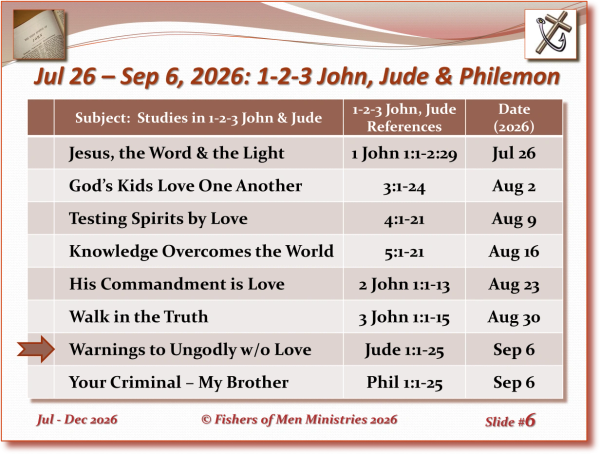
Schedule for Jude's Letter
Jude is written by one of Jesus' four half brothers and at least two half sisters. They are listed as James, Joseph (also called Joses), Simon, and Judas (Jude), along with at least two unnamed sisters (Matthew 13:55-56; Mark 6:3) . The Letter of Jude is written to warn believers about false teachers and divine judgement.
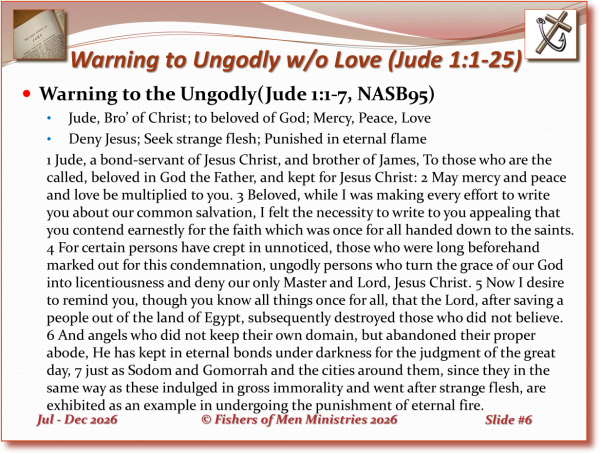
Warning to the Ungodly (Jude 1:1-7)
The penman of this letter introduces himself as Jude, a band-servant (slave) of Jesus Christ and a brother of James. Many authorities name James and Jude as brothers of Jesus as listed in Mark 6:3 and Matthew 13:55. Because a plural is named for his sisters but not listed, most believe Jesus had at least two sisters. Matthew Henry lists Jude as an Apostle of Christ and James as well. In verse 2, Jude extends to us and all other readers the mercy, peace and love through Jesus Christ. Jude wants it well understood that he is contending for “the faith which was once handed down to the saints.” Of late, the word “saint” has been used to designate a certain set of devout believers who have been found worthy and have been canonized through the ceremonies of one Christian denomination. Rather, a saint here, is one has received Jesus Christ as Lord and Savior. To us, then, Jude writes this volume of Scripture concerning our common salvation (vs.3). He felt it necessary to write to us appealing that we contend earnestly for that faith which was handed down to us by the Lord.
Jude notices that certain people have crept into our whelm unnoticed. They are people who were before marked out for condemnation. They were ungodly people who turned the grace of our God into lasciviousness and denied our only Master and Lord, Jesus Christ (vs. 4).
Now, Jude wishes to remind us that the Lord who saved us out of Egypt found it necessary to destroy many who did not believe. Just as God found it necessary to eliminate angels who did not keep their own domain but abandoned their proper place (vs. 6). Recall also that Sodom and Gomorrah and cities around them indulged in gross immorality, seeking after strange flesh and were abolished and destroyed as examples.
Jude is writing to remind us of these terrible truths because the God we serve today is the same holy, righteous and pure Being He was then. Jude wonders if the beastly pleasures of a moment make amends for our suffering God’s vengeance of eternal fire. He says stand and sin not!
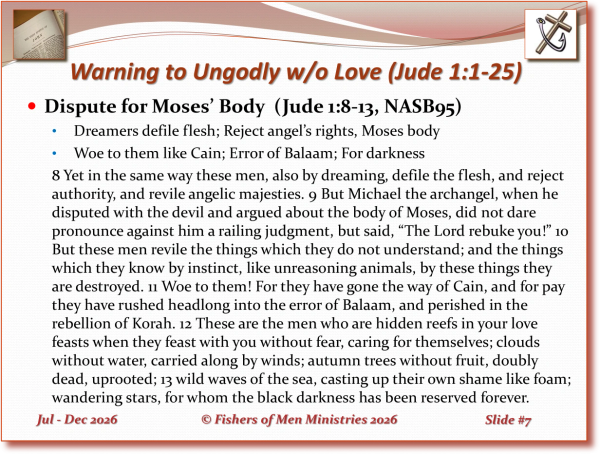
Dispute for Moses’ Body (Jude 1:8-13)
In Verse 8, Jude references back to those men and continues that they spend their time dreaming, they defile the flesh, they reject authority and revile angelic Majesties. However, Micheal the archangel disputed directly against the devil and argued with him regard the body of Moses. Notice, however, that he did not dare pronouncing charges against Satan a railing personal judgement, but rather said simply, “The Lord rebuke you!”
These foolish men revile the things they do not understand and the things they do not know by instinct (vs. 10). Like the animals who do not have reasoning powers, they are destroyed by what they do not understand. Jude says, “Woe unto them because they have gone the way if Cain, and for pay they have rushed headlong into the error of Balaam and perished in the rebellion of Korah (vs. 11).
These men are like the hidden reefs when they feast with you without fear. They care only for themselves. They are like clouds without water, carried alone by the winds, autumn trees without fruit, twice dead, uprooted, wild waves of the sea, casting up their own shame as the foam of the sea, casting up their own shame like feasts, wandering stars, for whom the black darkness has been reserved forever. (vss. 12-13).
So, Jude is finding dozens of ways to illustrate the worthlessness of the efforts of these people determined to bring down the faith in the only Saviour, Jesus Christ. Think about the foolish mariners who like to navigate in dangerous waters filled with reefs, anyone of which could destroy their boats. Nevertheless, instead of manning the ship’s controls, they are feasting or dining with the passengers. When they hit a reef, their ship will go down around them, and the great meal will do nothing except hasten the appearance of the sharks. Think of the clouds that have no water – clouds are made out of water vaper; they simply do not exist unless they have the evaporated waters to form the water vapor that makes them clouds. Jude is saying these rebellious people are less than the amount of time it takes to disagree with them.
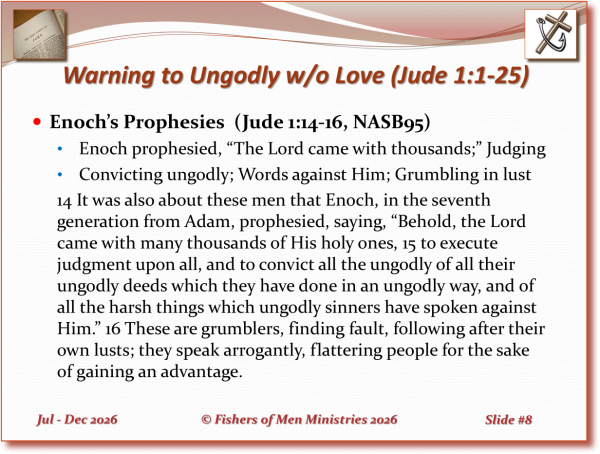
Enoch’s Prophesies (Jude 1:14-16)
There is no other mention of Enoch’s Prophesies in any other Book of the Bible, therefore, it must be another illustration like the two dozen we have already seen. Let’s look. First, Jude lets us know the timing of the illustration is seven generations after Noah (vs. 14). Enoch supposedly prophesied, “Behold, the Lord came with many thousands of His holy ones to execute judgement upon all, and to convict all the ungodly of all their ungodly deeds which they have done in an ungodly way, and of all the harsh things which the ungodly sinners have spoken against Him.”
In verse 16, they farther enlarge the group of the ungodly to include grumblers, finding fault, following after their own lusts; they speak arrogantly, flattering people for the sake of gaining an advantage (vs. 16).
As we read through the lists of people and their characteristics, one thing ought to come to the surface: This is all a trivial pursuit! Nothing can be gained by any of the groups or individuals mentioned. All you know at the end of the lists is that there is nothing accomplished of any value at all. We have seen all this before. We know that Satan is the master of applying three basic temptations against us that exploit the weaknesses of humankind. First John 2:16 says, “For all that is in the world, the lust of the flesh, and the lust of the eyes, and the pride of life, is not of the Father, but is of the world.” The lust of the flesh are all those things which are needed by the body but are subject to our control. They are hunger, thirst, temperature control, fellow, ship, affection, etc. Satan knew Jesus was hungry after 40 days of no food or water so he offered Jesus and easy test to solve His need. He said turn these rocks into bread. Jesus quoted the Scripture. Satan took Jesus to a high place so He could see all the wonders of the world. He said bow to me and all this could be yours. Jesus quoted the Scriptures. Satan took Jesus to another high place to see all the kingdoms of the world. Satan said worship me and all this could be yours. Jesus quoted Scripture. But every person who has fallen from greatness has fallen because of one or more of these temptations. Jude is warning us not to fall for any of this. God has the solution to all our needs.
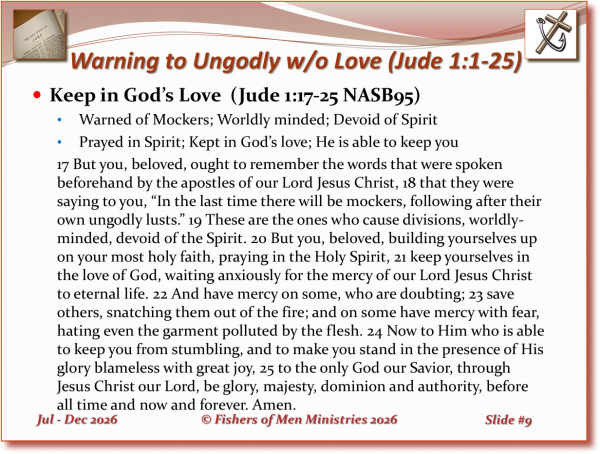
Keep in God’s Love (Jude 1:17-25)
Verse 17 begins this slide with a transitional word referring back to the previous page. Jude says, “But you, beloved, ought to remember the words that were spoken beforehand by the Apostles of our Lord Jesus Christ and what they were saying to you” (vss. 17-18a). Jude here references the warnings of things prophesied to take place in the last times. He says, “there will be mockers in those days, following after their own ungodly lusts” (vs. 18b). In verse 19, he explains who these are and what they are doing. Jude says, “these are the ones who cause divisions, worldly-minded, devoid of the Spirit.” When unity under Jesus Christ is most needed, these will divide us.
Jude returns to the use of contrasting words by again using the word “but” to announce a turn in the action. He was painting a horrible picture of the people in the latter times conducting life’s business in a spirit of rebellion; acting on their wills, without yielding to the spirit within them, exercising their own worldly lusts. “But you, beloved,” he says to start verses 20-21 in contrast, “building yourselves up upon your most holy faith, praying in the Holy Spirit, keeping yourselves in the love of God, waiting anxiously for the mercy of our Lord Jesus Christ to eternal life.” The difference is clear and striking. Those of the world are living out life in their own power without any holy guidance, while we are basing every step in the world on godly, spiritual motivations.
As we navigate the complexities of life in the latter days, we will “have mercy on some, who are doubting, save others, snatching them out of the fires; and on some have mercy with fear, hating even the garment polluted by the flesh” (vs. 22-23). We will be protecting ourselves by praying as the Holy Spirit leads, helping the lost find Jesus Christ for their own salvation and rescuing some out of extremely distasteful and repugnant situations.
Jude closes his thoughts at this point with still another directional transitioning set of words, “Now to Him who is able to keep you from stumbling, and to make you stand in the presence of His glory blameless with great joy, to the only God our Savior, through Jesus Christ our Lord, be glory, majesty, dominion and authority, before all time and now and forever, Amen..”
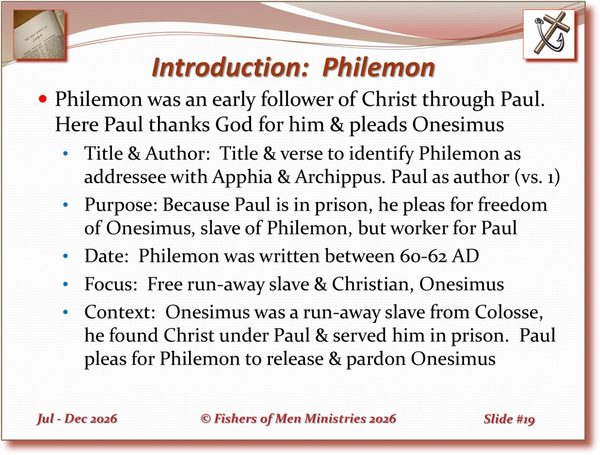
Author, Title, Date
The apostle Paul was the author of this personal letter to Philemon: Christ follower and slave owner of the runaway slave, Onisemus. The date of the letter was during Paul's imprisonment in Rome between 60 - 61 AD.
Purpose
The purpose of the letter to Philemon was clear and announced at Verses 10-14 as he explains "10 I appeal to you for my child Onesimus, whom I have begotten in my imprisonment, 11 who formerly was useless to you, but now is useful both to you and to me. 12 I have sent him back to you in person, that is, sending my very heart, 13 whom I wished to keep with me, so that on your behalf he might minister to me in my imprisonment for the gospel; 14 but without your consent I did not want to do anything, so that your goodness would not be, in effect, by compulsion but of your own free will (Phile 10-14, NASB95). .
Philemon is the name of the person to whom Paul wrote this letter. He was a great friend to Paul and had run-away slave named Onesimus. When Onesimus ran away from Philemon, he aligned with Paul and commited his life to Jesus Christ. When Paul wrote this letter to Philemon, he called Onsesimus his child and asked Philemon to forigive him, pardon him and restore him to continue working for Paul's ministry from prison.
Audience
The audience for the letter (epistle) to Philemon is Phileman. It contains a plea from Paul to the owner of a runaway slave named Onisemus. He had become very useful for supporting Paul while in prison, but Paul did not want to use him until he reconciled his staus as a criminal with his owner, Philemon
Importance of This Letter
Paul decided to send Onisemus back to Philemon to reconcil his criminal status as a runaway slave. The letter contains Paul's plea for Philemon to release Onesimus, forgive his offense against him, pardon his crime and return him to continue his very important service to Paul in the Roman prison.
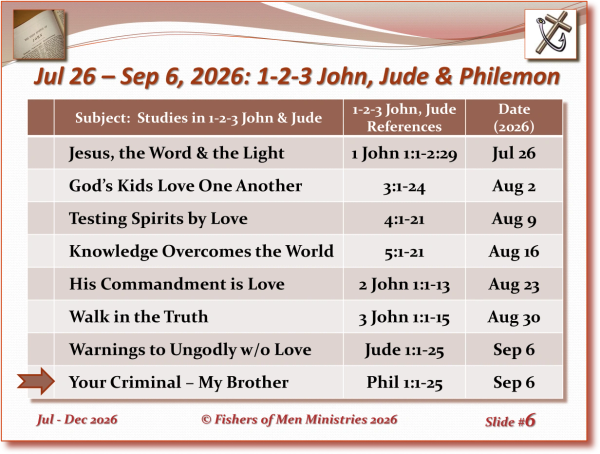
Schedule for Paul's Letter to Philemon
Philemon is the name of the person to whom Paul wrote this letter. He was a great friend to Paul and had run-away slave named Onesimus. When Onesimus ran away from Philemon, he aligned with Paul and commited his life to Jesus Christ. When Paul wrote this letter to Philemon, he called Onsesimus his child and asked Philemon to forigive him, pardon him and restore him to continue working for Paul's ministry from prison.

Paul’s Salutation (Philemon 1:1-3)
Philemon is one of those short but strong letters of the New Testament. There is little doubt about Paul being the author of the letter as he self-identifies himself as the person from whom the letter comes in Verse 1. He adds that their brother in the Lord, Timothy, was with him, as well. Paul referred to Timothy in earlier writings as his son in the faith, but that seems to have changed as both, Paul and Timothy grew in the years. From the start of Paul’s letter, it appears obvious that Paul wishes to take full advantage of any special treatment or privilege he might get by currently being “in chains” for the Lord, likely alluding to his house arrest in Rome between 61-62 AD. And being there with Timothy, one who has distinguished himself as Pastor at Ephesus was there with him. Paul
Paul mentions several people who he knows were in attendance and likely received the letter along with its primary recipient; Philemon. Philemon occupies the honor of the people addressed because he was the owner of the slave named Onesimus, about whom Paul’s letter was to deal. The others named were Apphia and Archippus. They were with Philemon at the church in his home, but not addressed for any business at this writing. The known information regarding the members of this house church provide assurance that Paul loved the leaders of this church and provided the leadership needed to cause them to be a flourishing church over the following decades. Philemon is identified as a brother and fellow worker in the faith, Apphia as their sister and Archippus as a fellow soldier.
Paul closes his opening comments for the letter by wishing all attending by wishing them grace upon them and peace from God the Father and the Lord Jesus Christ, the focus of their faith. What we can look for in the next several paragraphs on Philemon and his house church is Paul’s elaboration of his strong feelings for Philemon and his church. We will see the strong love Paul has for presenting the Gospel and helping those new under Christ, like Onesimus.
Philemon’s Love & Faith (Philemon 1:4-9)
Verse 4 presents another familiar set of thoughts as Paul assures Philemon that he thanks God always for him; making mention of him in his prayers. This is documentation of Paul’s personal feelings toward Philemon before any need on his part was apparent. But, Paul goes on to link their relationship under this time of asking a favor with their combined feelings and dedication, their love and faith toward Jesus Christ and all the saints of God in their church. In verse 6, Paul documents his constant prayer that the fellowship of their faith might become effective for the future through their knowledge of every good thing which is in Philemon because of his relationship to Christ and for Christ’s sake.
Paul says he has come into a great deal of joy and comfort in the love he sees in Philemon because of the hearts the saints have been refreshed through him (vs. 7). Paul feels like the good Philemon has done and continues to do provide great comfort to himself as well as the others. Because of this, they want him to continue and even add more to his work there. It is Paul’s hope that the good Philemon is doing will result in even more fruit to God’s honor and to the credit of their worship.
Now, Paul gets directly to the point. After all, it is the main reason why he is writing this letter. He is ready to boldly ask or even plea that Philemon grant him an extravagant favor. Paul believes he has several good reasons this and believes he could have directed the favor to be done but would rather ask Philemon for it rather than command it under Christ.
In verse 9, Paul says it is because of the mutual love they have for each other that he can ask this favor. Paul reminds Philemon that he is an old man and a prisoner for the sake of the Lord. This comes at a bit of a surprise after Paul had already documented his horrible circumstances, his lengthy service for the Lord and the personal homage he was due, that he would remind Philemon that he could have just directed the pardon of Onesimus without anyone’s permission. The investment Paul made in preparing Philemon for the question might well have been enough.
Plea to Free Onesimus (Philemon 1:10-16)
So, verse 10 contains the actual request. Paul appeals to Philemon to show kindness to his “son” or “child,” Onesimus. The words Paul uses to share this opening statement with Philemon reveals there has been a change in the circumstances surrounding the relationship between Philemon, Onesimus and himself. Because of this change, Paul can refer to Onesimus as “his child.” Before this time, Onesimus was a thief and runaway slave, but instead of referring to him as the criminal he once was, Paul refers to him as the son he had become. (I immediately thought of Paul’s words, “all things have become new” in 2 Corinthians 5:17.)
In verse 11, Paul acknowledges that Onesimus has been of very little value to Philemon or anyone else, for that matter, because of his attitude and his performance history. He adds that Onesimus’ new birth has given them a new person of far greater value to Philemon and to himself. Paul sacrifices his need to have Onesimus continue to work for him by returning him to his rightful owner, Philemon (vs. 12). Paul has to admit, however, that Onesimus is no longer an ordinary slave in his mind. In fact, as he returns Onesimus to Philemon, he is sending him at great peril to his own heart.
He continues that he would have preferred keeping Onesimus with him to continue his great support in these days of Roman imprisonment for the cause of the Gospel of Jesus Christ (vs. 13), but without the full consent of Philemon, he did not feel he was properly using Onesimus. Paul felt that the way things were, he was effectually demanding the use of Philemon’s property rather than properly requesting his service (vs. 14).
Paul interjects that it may well have been planned that Onesimus was separated for this time, that he might be returned to you at a much greater value than before. In fact, this man who is returning to you is no longer a slave, but much more so and beyond just being a better possession, he is now a beloved brother to you, and also to me. And this phenomenal change you will see in this man is not just skin deep, as in a better servant, but in the Lord as well. No longer a slave but a brother.
It is for Paul’s Sake (Philemon 1:17-25)
Paul continues by asking, if Philemon feels any value to the relationship he had with Paul, would he not welcome Onesimus back as a brother? That is, would you welcome him back as if you were welcoming me? (vs. 17). Further, Paul writes to Philemon, “If he has wronged you in any way or owes you anything, charge it to me” (vs. 18, NLT).
Now, verse 19 is a very interesting verse! In the New Living Translation, it comes out with the whole verse being uppercase; attesting to its intended power and emphasis. Paul repeats, “If Onesimus owes Philemon anything, he has written in his own hand that he will repay it.” But then Paul brings forward a reminder from the past. He says, “And, I won’t even mention that you owe me your very soul!” (vs. 19). With all that Paul has said, adding that “if the relationship had any value between them,” would seem a bit of an overkill.
Nevertheless, Paul makes the statement and changes his request of Philemon into an opportunity for Philemon to repay him for a past favor that may have involved Philemon’s own soul. Knowing the impact of these words, Paul assures Philemon that he heard him correctly, saying. “Yes, my brother, please do me this favor for the Lord’s sake. Give me this encouragement in Christ” (vs. 20). In doing this, Paul has denied Philemon an opportunity to receive a personal blessing from the Lord by granting this favor without Paul’s compulsory statement. If the opportunity failed, Paul could always return to the “heavy-handed-approach.”
In the closing verses, Paul assures Philemon of his every confidence as he writes to him that he will grant his request and even more. He begins setting up plans for the upcoming trip by asking Philemon to prepare lodging for him because of his certainty that God will grant Philemon’s prayer to be with him. Paul sends greetings from the group serving there from the prison. He lists Epaphras as a fellow prisoner and adds Mark (assumed as John Mark, writer of the Gospel of Mark), Aristarchus, Demas, Luke (as in Dr. Luke, writer of the Gospel of Luke and the Acts of the Apostles). Then Paul closes pronouncing the grace of Christ upon all.