Signed in as:
filler@godaddy.com

If you are starting the Lakeland Sunday Night Bible Blog (Lakeland SNBB) with First and Second Peter, you may not know this is Part 2 of a three-part study entiutled "The Nine Little Letters" of the New Testament. If you would prefer to do the entire study and want to start with Part 1 (1, 2 & 3 John, Jude & Philemon), click Here. If you would rather do Part 3 first, click Here for James and Titus. See the General Introduction for these studies immediately below.

The letters of 1 John and 1 Peter were two of the last additions to the Scripture Canaan prior to 367 AD at the agreements between the Church of the West and the East. After that time the Nine Little Letters of 1-2-3 John, Jude, Philemon, 1-2 Peter, James and Titus were all a part of the Scriptural Canon, Click Here to select studies in First Peter.
The penman of this epistle appears plainly to be the same who wrote the foregoing; and, whatever difference some learned men apprehend they discern in the style of this epistle from that of the former, this cannot be a sufficient argument to assert that it was written by Simon who succeeded the apostle James in the church at Jerusalem, inasmuch as he who wrote this epistle calls himself Simon Peter, and an apostle (v. 1), and says that he was one of the three apostles that were present at Christ's transfiguration (v. 18), and says expressly that he had written a former epistle to them, ch. 3:1. The design of this second epistle is the same with that of the former, as is evident from the first verse of the third chapter, whence observe that, in the things of God, we have need of precept upon precept, and line upon line, and all little enough to keep them in remembrance; and yet these are the things which should be most faithfully recorded and frequently remembered by us. Click Here for studies in Second Peter.
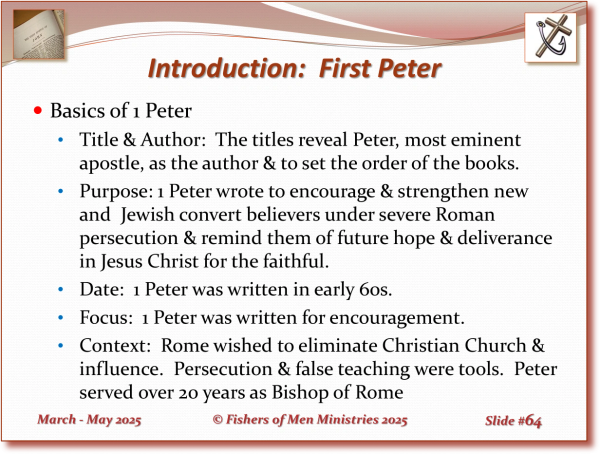
Author, Title, Date
The book of 1 Peter is historically and traditionally attributed to the Apostle Peter, the Great Fisherman and leader of the faith after Jesus ascended. . The title “1 Peter” reflects its position as the first of two epistles attributed to Peter in the New Testament. The opening verse affirms his authorship. The book of 1 Peter is historically and traditionally attributed to the Apostle Peter, the Great Fisherman and leader of the faith after Jesus ascended. . The title “1 Peter” reflects its position as the first of two epistles attributed to Peter in the New Testament. The opening verse affirms his authorship. Scholars uphold Peter’s authorship, emphasizing his firsthand experience with Christ and his leadership role in the early church. 1 Peter was written in the early 60s.
Purpose
Peter's first epistle was written to encourage and strengthen early Christians to remain faithful in the midst of Rome's severe persecution knowing that the redemption promised by Our Lord was certain to follow.
Audience
The two letters were written to the dispersed believers (1 Peter 1:1). These were likely the people in the dozens of churches Paul had planted encouraged. These were more likely Gentile believers rather than Jewish believers.
Importance of This Letter
The Christian movement was believed by the Jewish religious leaders to be doomed to failure as soon as they murdered Jesus of Nazareth. Acts 9 tells us that Saul of Tarsus was permitted by the Sanhedrin to expand his geographical area for persecuting Christians outside Judea and into Asia. Saul was converted on the way to Damascus of Syria and became known as Paul, an Apostle of Jesus Christ. The hope that Christianity offered was far superior to the persecution of the Jews and Romans, and provided for strong belief for the thousands who faced death for their belief.
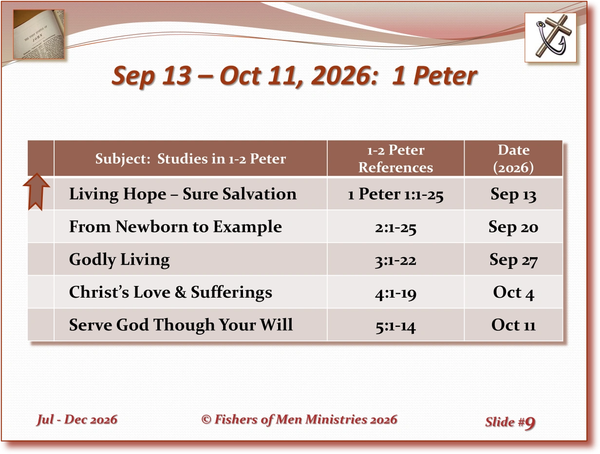
Part 2 of the Nine Little Letters is First Peter. These studies are scheduled to start on September 13 and run for five weeks to end on October 11.
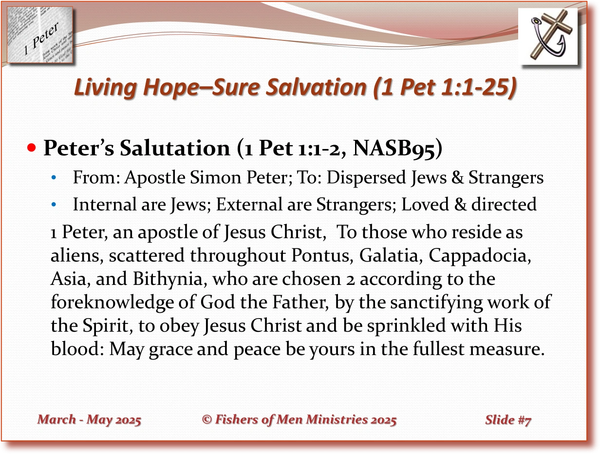
Peter’s Salutation (1 Peter 1:1-2, NASB95)
After the Gospels and the Acts of the Apostles are the numerous letters written by Paul and then seven, non-Pauline letters: James; 1, 2 & 3 John; 1 & 2 Peter; and Jude. Our study for this next thirteen sessions will be the latter three of these. First Peter was written about 46 AD with church tradition attributing its writing to the Apostle and Great Fisherman, Peter. The setting was Rome, and the environment was amid severe persecution of the Christian church. Recall when we were studying the Acts of the Apostle, that Paul was forbidden by the Holy Spirit to go into parts of Asia Minor (Acts 16:6). It was there that Peter had his ministry. The persecution was at a fever pitch. The Roman Emperor, Nero, was burning Christians along city streets, blaming them for a fire in Rome which Roman’s started and carrying the persecution into areas controlled by Rome.
As is the practice of most letters written to various people for a myriad of purposes, writers generally identified themselves and identified to whom the letter is written early in the document. Peter identifies himself as, “Peter, an apostle of Jesus Christ” (vs. 1). The identity of the writer for 1 & 2 Peter has not come into challenge over the centuries. Immediately after stating he was the author, Peter says this first letter is written “to those who reside as aliens, scattered throughout Pontus, Galatia, Cappadocia, Asia, and Bithynia, who are chosen” (vs. 2). In the KJV, verse 2 starts by saying the letter is written to the “elect according to the foreknowledge of God the Father.” Some try to take this beautiful truth and suggest that God predetermines who will be saved and who will be lost (condemned) before any were born, and we must maintain that destiny regardless of whether we accept the Gospel of Christ or not. Space does not permit a thorough proof of that fallacy here, but three verses should reveal God’s will on this subject, and He does not change. Read John 3:16 knowing that the word “world” there is the Greek Cosmos, which mean the universe of all people, 2 Peter 3:9 knowing He is not willing that any should perish and 1 Timothy 2:4 knowing that God our Savior will have all men to be saved. Romans 10:9-10 tells us that we get the gift by believing with our hearts and confessing with our mouths.
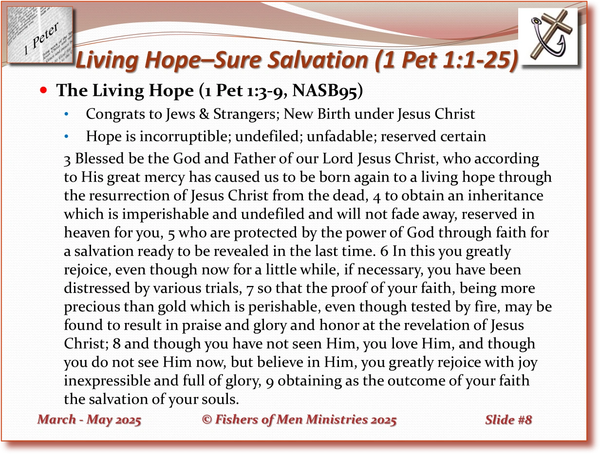
The Living Hope (1 Peter 1:3-9, NASB95)
Peter goes into the praise of God and the Father of our Lord, Jesus Christ (vs. 3). He talks of the Father’s great mercy (grace, or unmerited gift) in giving us the unmerited gift of the rebirth into a living hope through the resurrection of Jesus Christ from the dead. In verse 4 Peter says that this living hope includes “an inheritance which is imperishable, undefiled and will not fade away.” Further, this inheritance is “reserved in Heaven for us.” And even beyond that, “we are protected by the power of God through faith for a salvation ready to be revealed in the last time.” It is an inheritance which is perfect and fully guaranteed not to fade away. It is laid up for us in Heaven, which is greater than Fort Knox. Not only is it protected by the Creator of the Universe, but we are personally protected by the power of God. There is no power greater than the power of God and that level of power is the level of power by which this verse secures what God holds for us.
Many Christians have to make real choices between living or dying for their faith. Peter quantifies it this way in verse 6: we can rejoice greatly in what God has given us, but for a while, we have real reason for distress because of those various trials. All of us know of this problem even if at a much different level than the original addressees. They were facing loss of homes, loss of possessions, loss of family, loss of a lifetime of savings. The absolute power of Rome means that they could take anything from them with little or no explanation.
In verse 7, Peter tries to quantify the great value and source of personal peace and power that can be found in Christ regardless of the trials and tribulation of daily struggles. So, even while we are tested by fire, we can receive some relief knowing that no matter what level of power the enemy has, our God has greater. Therefore, no matter the hurt the enemy might inflict upon us in this life, we can have peace knowing the enemy cannot reach those things guaranteed by our God. And the enemy cannot have those things God guarantees us. Verses 8 and 9 acknowledge that while we cannot physically see God, we love Him, believe what He tells us and find great joy in knowing the day is coming when our faith will result in salvation from this world and victory over it.
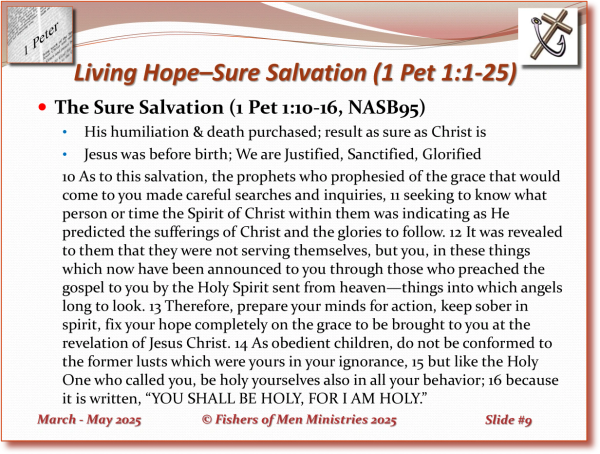
The Sure Salvation (1 Peter 1:10-16, NASB95))
Now, Peter wants to identify the great advantages of this salvation he is talking about. He starts out by pointing to the specific salvation they were discussing from the saying, “As to this salvation.” Peter identifies the prophets who had prophesied of grace, or unmerited gift, that would come to them. The ones who described that grace began to search and inquire as to what person or time the Spirit of Christ was revealing for the suffering of Christ, he mentioned and what would be the glories they mentioned as being ahead of them. So, verses 10 and 11 are asking when the prophecies for the coming sufferings of Christ and the glories to follow would occur. They wanted to know questioned who that coming Spirit of Christ might be, what are the glories that would follow and when would they occur. Verse 12 posts the answers to that inquiry. It says the prophecies referring to the “sufferings of the Spirit of Christ and the glories to follow” were not prophecies for their time. The prophecy of the suffering of Christ was for an earlier time and were fulfilled in the sufferings of Jesus of Nazareth some thirty years prior to the writing of this letter.
The “glories to follow” started with the fact of the resurrection of Jesus Christ from the dead. That resurrection proved that God had accepted the sacrifice Jesus offered for the penalty of the sin of all mankind, and that the debt had been paid in full (Greek tetelestai in John 19:30). That news was so great that even the angels in glory were seeking to be a part of it. Many glories would take place because of Jesus’ final payment for sin. Not just for leaders but for all the church’s saints!
Jesus would also leave gifts for mankind when He went to the Father 40 days after He was resurrected. Peter sets our sight on the actions required to deliver Jesus’ redemption to this world. First, Peter describes the holiness needed in terms of rejecting the lusts of the past which no longer have dominion over them. Jesus’ payment for sin was for all time. As Jesus submitted to death, the multi-layered veil separating the Holiest place in the Temple from the Holiest of Holies where the Arc of the Covenant was stored, was ripped in half signifying the removal of any barrier between God’s holiness and that of humankind under His Holy Spirit, Peter started at Holiness!.
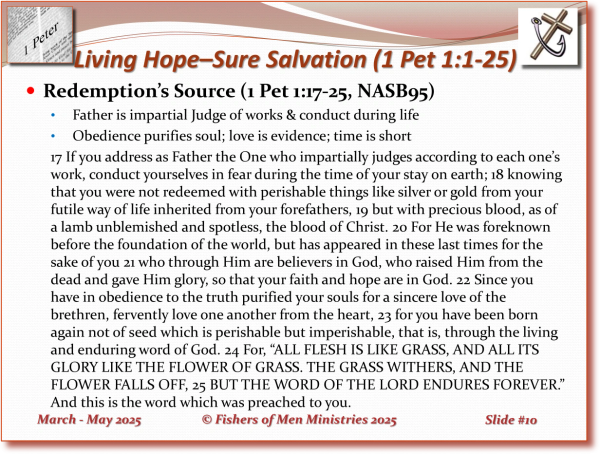
Redemption's Source (1 Peter 1:17-25, NASB95
Peter specifies in verse 17 for whom this message is for. He says, “And if ye call on the Father, who without respect of persons judgeth according to every man's work, pass the time of your sojourning here in fear.” Verses 18-21 provides the backup material for the strength to accomplish what Peter said. He starts by saying that He (Jesus) paid the ransom price to buy you back from the natural, empty life you were living (vs. 18). He adds that it was necessary to pay a ransom for you to buy you from your natural parents, and the price He paid was not paid with silver or gold. Rather, the ransom He paid was the precious blood of our Lord and Savior, Jesus the Christ (vs. 19). It was the sinless, spotless “Lamb of God” figure for Jesus. He is referred to as the Lamb of God 13 times in both Testaments. The figure goes back to the Hebrew sacrificial system where a spotless, blemish-free, one-year-old lamb is the desired offering. The Creator of the Universe selected His only Son as the sacrifice on the cross of Calvary (vs. 20). Further, He was “chosen by God long before the foundation of the Earth” (vs. 20).
But look at the second half of verse 20, “but He has now revealed Him to you in these last days” (vs. 20b). Paul says it this way in Romans 8:1, “There is now, therefore, no condemnation for those in Christ Jesus.” We have no remaining charges against us. And Jesus gave up His spirit and died. It is this fact that revealed Jesus to those who have been born again (vs. 20). It is through that faith, we were made righteous. We are joint heirs with Jesus (John 1:10-12). Paul says, “If we believe in our hearts the Lord Jesus and confess with our mouths that God raised Him from the dead, we shall be saved” (Rom 10:9). Paul continues, “For with the heart man believeth unto righteousness; and with the mouth confession is made unto salvation” (Rom 10:10). We who believed and confesses have been made righteous before God. The holiness Peter insisted on was provided by the death and resurrection of Jesus Christ! We are NOW ready to serve Him!
So, verse 21-24 announces that the born-again of Jesus Christ are purified for service and that purification endures forever under the propitiation of Christ’s death forever!!
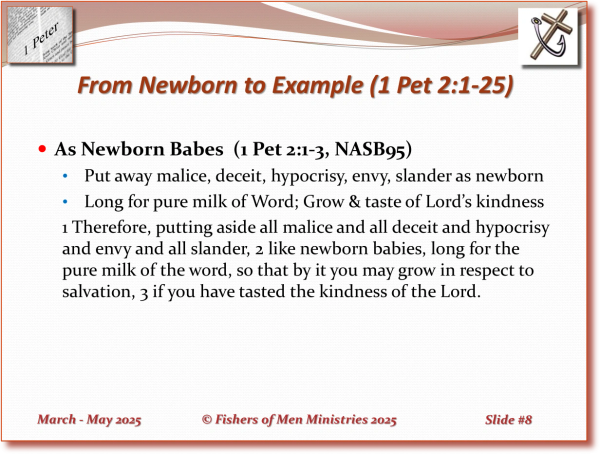
As Newborn Babes (1 Peter 2:1-3, NASB95)
Peter establishes his common understanding of the great need of these people by simply stating (in effect), “Let’s focus.” He recognized that they were feeling the great pressures from the Jewish leaders, the Greco-Roman culture, the Romans and even other Christians grow quickly. It came out looking like malice, deceit, hypocrisy, envy and all slander to Peter. He knew very well if the newborn Christian were to stand alone against these well organized and time-tested masters, they would individually fall away in frustration. He had to find a way to bring them together.
Below the surface, all of us who have had time to study the truth and to get that self-assurance and confidence of personal proof had the power to stand firm, but many of those in Asia Minor were just too new in the faith to do battle – they were still at the survival level. And, we also know that the enemy will exploit those weaknesses to mislead and confuse the newer Christians. That is why those of today’s Christian deviant faiths and cults send people to our homes when our family leadership is working. If they can plant the smallest seed of doubt in our faith, they can lead the newer Christians or maybe their weaker family members away. Verse 1 says we simply need to put those kinds of thoughts away for a later time.
Verse 2 says we need to recognize that responding to these tests requires deeper study, or we might be misled on those areas. The cult members are-trained to induce doubt or confusion into our Bible study or church practices. Peter says our very nature as new believers is to long for a better understanding and may open us to “a new word” to plant deceit or confusion. Our longing to study the Word and get its power and understanding is a very normal drive, just like a new baby wants to get more of that pure milk. Paul admonishes us as he does Timothy, the preacher he led to Jesus Christ, “Work hard so you can present yourself to God and receive his approval. Be a good worker, one who does not need to be ashamed and who correctly explains the word of truth” (2 Tim 2:15, NLT). Verse 3 simply says this ought to be true if you are in the faith.
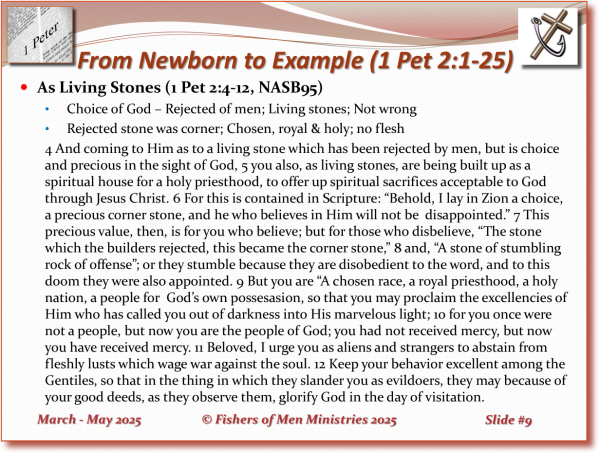
As Living Stones (1 Peter 2:4-12, NASB95)
1 Peter 2:4-8 sets up the vocabulary for integrating Scripture from both testaments regarding the topic of “living stones.” His starting place is to remind us that Jesus was the “living stone, rejected of men, but accepted as the cornerstone by God” (Psa 118:22, 1 Pet 2:4-5). The metaphor is fulfilled as Christians serve as living stones become the foundational cornerstones for spreading the Gospel of Christ, not as lifeless stones but as living stones. Then Peter tells us in verse 2:6 that we are about to look at a quotation from Isaiah 28:16 (KJV) saying, “Behold, I lay in Zion for a foundation a stone, a tried stone, a precious corner stone, a sure foundation: he that believeth shall not make haste.” Peter continues that this precious value, then, is for you who believe; but for those who disbelieve, “The stone which the builders refused is become the head stone of the corner” (Ps 118:22, KVJ) and, “A stone of stumbling and for a rock of offence”; for they stumble because they are disobedient to both the word, and to this doom they were appointed.
This discussion of the stone, foundation stone, corner stone, rock of offense are all references to the Lord Jesus Christ. Christ was rejected as “He came to His own, and his own received Him not. But as many as received Him, to them gave He power to become the sons of God, even to them that believe on his name” (John 1:11-12). So, to those who believed Christ, were granted the privilege of Sonship forever.
Peter continues in his message to the Christian communities of Asia Minor: “To those who reside as aliens, scattered throughout Pontus, Galatia, Cappadocia, Asia, and Bithynia, who are chosen according to the foreknowledge of God the Father, by the sanctifying work of the Spirit, to obey Jesus Christ and be sprinkled with His blood” (1 Pet 1:2). So, these are the born-again of Jesus Christ in this area, and Peter wants to encourage them to act in ways which would encourage new believers in the church or associated movement. Peter said they were, “a chosen race, a royal priesthood, a holy nation, a people for God’s own possession” (vs. 9). As Peter assisted the exiled Christians, leading them in study of God’s word, they were becoming those “living stones.”
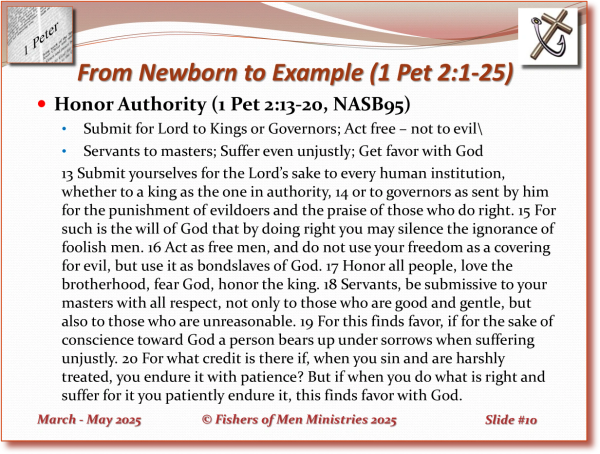
Honor Authority (1 Peter 2:13-20, NASB95),
Here is another opportunity for establishing a distinction for Christianity. Rather than an integration of labor and religion, Christianity holds the institutions separately but applies the Christian attitudes and approaches consistently across all endeavors. That means that Christians submit themselves to the leadership of the organization or agency because that is how Christianity works. Christians give allegiance to their secular and governmental leaders because being an outstanding employee or countryman brings glory to our God. “Submitting ourselves for the Lord’s sake to every human institution, whether to a king as the one in authority, or to governors as sent by him for the punishment of evildoers and the praise of those who do right” (vs. 13). The idea here is that performing one’s work in an extraordinary way is the objective of the Christian employee or worker. The kind of work, or the managers above that work, matters not. What matters is that the Christian can get glory for God out of the way they approach the work.
Verse 14 expands just a little to drive the point home. Peter says it is the unmitigated will of the Lord to silence ignorant and foolish people by doing the assignment correctly regardless of the surrounding circumstances. It matters not whether the work is governmental, commercial, scholastic, competitive or voluntary, the Christian will do the best work because they are Christian and the Christian goal is to have the one for whom the work is done, glorify God because of the level of labor the Christian provided. Further, while Christians are in the process of doing the work, they will act as free men and women (vs. 16). That simply means that they will not be watching the clock or wasting the time until the required hours are counted. They will do what it takes to get the work done to the full satisfaction of the person for whom the work was required. The verse means that Christians will not use the cloak of Christianity to excuse our performance or get false credit for the work. Christians will achieve excellence because God demands it; not because some manager asks for it. Peter sums the idea by saying, “Honor all people, love the brotherhood, fear God and honor the king” (vs.17). He sums in verse 20that there is little to gain in suffering when it is due; rut much to gain when suffering when it is not due.
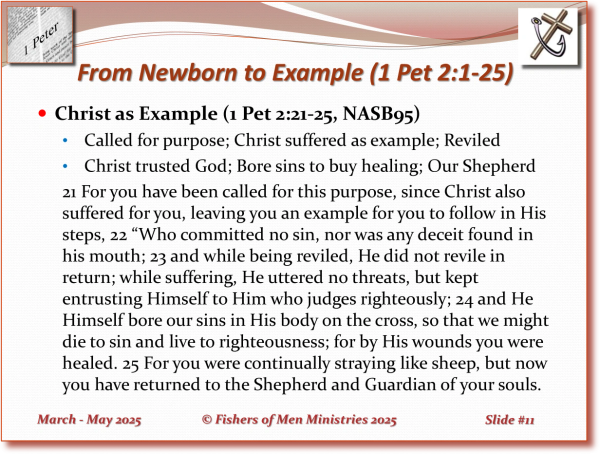
Christ as Example (1 Peter 2:21-25, NASB95)
In 1 Peter 2:21-25, Peter provides more evidence for why Christians should provide exceptional service for whatever is requested. Peter restates the purpose saying that “this is the purpose for which we were called, that Christ suffered for you, leaving you an example to following His steps.” So first, Christ suffered for us leaving this example (vs. 21). The example was left by a Person who had not committed any sin of His own, nor was He trying to deceive anyone who might be overseeing His sacrifice (vs. 22). So, Jesus had done nothing wrong for which He should be taken prisoner and executed. Further, that while He was reviled (verbally abused by angry, aggressive, hateful interrogation), He did not respond in kind (Isa 53:9). Even after suffering, He made no threats in return. Instead, Jesus continually submitted Himself to the One who judges rightfully and righteously, “by His wounds you were healed” (Isa 53:5).
Notice at verse 24, the discussion is taken from the history of Christ to the prophecies of those actions, and how they would be delivered. Verse 24 says, “He bore our sins in His body on the cross, so that we might die to sin, and live to righteousness (Isa 53:6, John 1:29). The reference to “by His wounds, we were healed” takes us to Isaiah 53:5, as above). Verse 25 says that all of us like sheep are straying away but will soon return to the Shepherd and Guardian for our souls (Psa 119:176).
The transition from the stated information to the prophetic listings by Isaiah shows that Peter recognized and identified the Hebrew Scriptures of the Suffering Servant in Isaiah 53, as well as the Greek of the New Testament making Peter’s letter a clear display of completed prophecy. The direct theological marriage between the description of the suffering Servant here and the several rare words used by Peter to reference that vision show that Peter’s grasp of this very deep, theological truth is well within the fisherman’s capabilities as driven by the filling of the Holy Spirit of God. So, having Jesus as our example of Godly living as a Christian follows centuries of prophecy and personal teaching of the Lord, Himself (John 13:15, Eph 5:1-2).
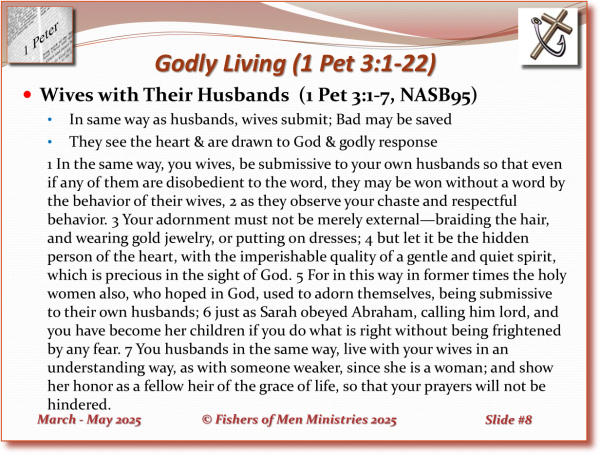
Wives with Their Husbands (1 Peter 3:1-7, NASB95)
Verse 1 of Chapter 3 forces a look back to find out what the wives are exhorted to do “in the same way as.” Peter had already talked about how subjects ought to submit to their sovereigns and servants to masters in Chapter 2:13-25, now he picks up with wives submission to their own husbands just as Paul did in Ephesians 5:22-6:9. The consistences in these lists almost liens toward some kind of master list to which both had access. Nevertheless, it is good that both apostles are leading in the same directions on interpersonal relationships. The “sumission to their own husbands” seems to have a dual meaning in that they are to submit to the husbands but only to their own husbands. That statement seems to stress behavior inside the marriage while also limiting behavior to inside the marriage. This statement also follows Paul admonitions for the behaviors in order to evangelize the mate. This is a common thought, and it is often the case that a converted mate can reach the spouse better than anyone else. The sinserity of the conversion experience would be most obvious to the spouse. Verse 3 admonishes the women to be modest in dress and adornment (jewery, hairstyle and such). The influencing of the mate should be through that medium only closely seen by the spouse; the behaviors of the heart and deeper feelings, “the imperrishable quality of a gentile and quiet spirit” (vs. 4).
Verse 5 lauds this way of influence and states that it has been working for years in the past. Verse six goes back as far as Abraham and Sarah as examples of such. Peter states that Sarah called Abraham lord. He suggested the reader might become very much like her (as children) if they can do such without fear or fright (vs. 6).
Then, again much like Paul’s Ephesian 5 model) the husband in the same way must live with their wives in an understanding way, as someone weaker since she is a woman (vs. 7). Further, the husband should honor her as a fellow heir of the grace of life. In this way, the prayers of the husband would not be hindered or withheld. The emphasis is in the positive influences of each.
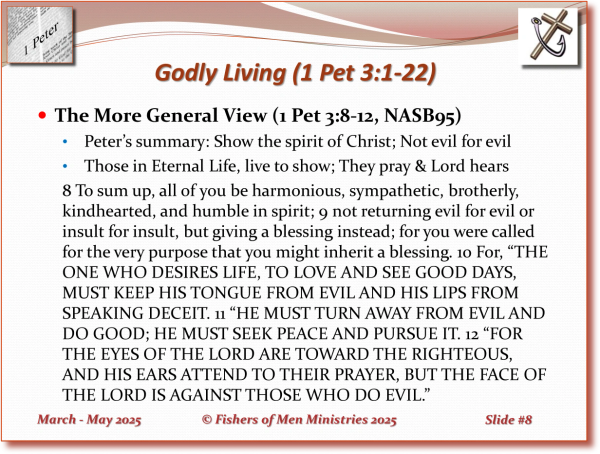
The More General View (1 Petere 3:8-12)
Here, Peter advertises he is going to “sum up” (vs. 8a). He says all of us need to be harmonious, sympathetic, brotherly, kindhearted and humble in spirit (vs 8b). In addition to not exhibiting some of the baser behaviors, we should also refrain from showing the following responses: returning evil for evil, or engaging in insult for insult battles but rather, giving a blessing instead. This alone is a steep hill to climb for many!
So, Peter quotes from the Old Testament at Psalms 34:12-16. King David started this passage by saying, “Come, ye children, hearken to me: I will teach you the fear of the Lord” (vs 34:11). The lesson from David is that, the person who loves life, enjoys love and good days must learn to control his tongue and his lips to steer them away from evil and deceit. Likewise, he must turn his entire being away from evil and do good work instead. Last, he must look for peace and continuously chase after it. If he will do these things, the eyes of the Lord will be turned toward him because the Lord is continuously seeking after righteousness and hears their prayers, that is enjoys fellowship with them. The opposite is true for those who do evil. The face of the Lord is against them (vs. 34:16).
How should a believer react to words of advice like these of David or any other contributor to Scripture? The primary understanding must be that we are not looking to the actual facial characteristics of God’s face as He reacts to these things. Rather, we are listening to the “man who is after God’s own heart” as he lists for us those things he has found that please the Lord and those things that do not. Heeding the advice of such a person is wise in general but recall that our view of the Scripture is that it is “God inspired and God breathed.” In other words, the Scripture can be trusted fully for doctrine to live by. The Apostle Paul said to his mentee, “16 All scripture is given by inspiration of God, and is profitable for doctrine, for reproof, for correction, for instruction in righteousness: 17 That the man of God may be perfect, thoroughly furnished unto all good works” (2 Tim 3:16-17). The Scriptures are where we find the “words of life,” i.e., how we should live.
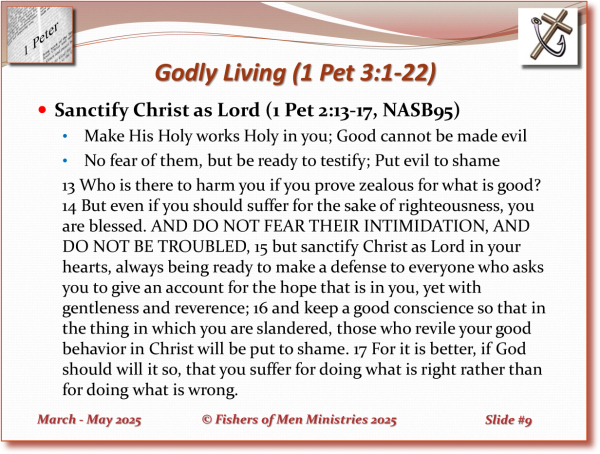
Sanctify Christ as Lord (1 Peter 3:13-17)
Now we see Peter turning to response on what he has forwarded to us from the words of the Lord. He starts, “Who is there to harm you if you prove zealous for what is good?” (vs. 13). Anyone who criticizes a person for doing what God has commanded is simply one who does not have a relationship with God. Nevertheless, God is still over them. Peter suggests that “even if you should suffer for the sake of righteousness, you are blessed” (vs. 14a, Matt 5:10).
Matthew Henry (renowned author of Bible Commentaries) makes three observations: 1) To follow always that which is good, is the best course we can take to keep out of harm’s way, 2) To suffer for righteousness sake is the honor and happiness of a Christian, and 3) Christians have no reason to be afraid of the threats or rage of any of their enemies.
Matthew Henries’ comments are, of course, valid as they stand, but Christian wisdom, knowledge and focus need to be added to his considerations. All twelve Apostles (Judas excluded but Paul included) led hundreds, if not thousands, of people to Jesus Christ before they were martyred for the cause of Christ. They took their stands and were persecuted vigorously and eventually killed by the organized religion of the time (Judaism) as well as the Roman Empire. We need to ask God for His specific guidance when to stand and die for today or elude and live to keep our message for Christ alive for tomorrow. That does not mean we ever compromise or dilute the message of Christ wherever God has sent us, it does mean that we should never give our lives up cheaply. Once we are killed or otherwise have our messages neutralized, that tremendous influence for Christ is quieted and Satan is the winner.
On the other hand, severe attack may be God’s message that our ministry might be more useful in a different place or position. Recall that Paul had to skip entire countries during his missionary journeys, yet he continued to establish new church all over the known world. Many of those places could not have been reached for Christ had he been captured or killed earlier. Remember that your ministry is God’s to use and He will not allow you to be taken out until He knows you are finished.
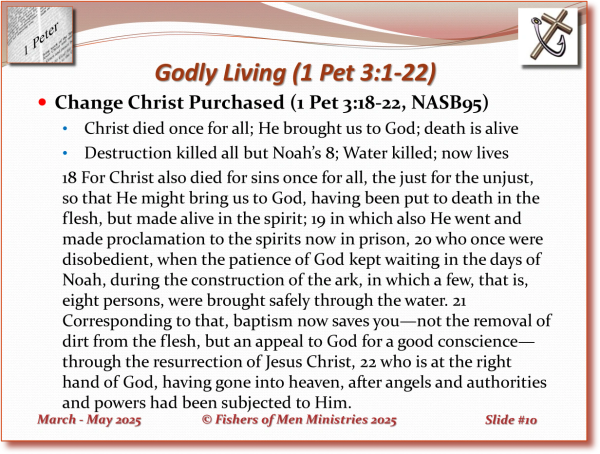
Change Christ Purchased (1 Peter 3:18-22)
So, what is it that God bought for us through the life, ministry. death and resurrection of Jesus, the Messiah and Christ? Briefly, “Christ also died for sins once and for all, the just for the unjust, so that He might bring us to God” (vs. 18a). The mission of Jesus Christ was to seek and the save that which was lost” (Luke 19:10). John says it this way, “10 He was in the world, and the world was made by him, and the world knew him not. 11 He came unto his own, and his own received him not. 12 But as many as received him, to them gave he power to become the sons of God, even to them that believe on his name:” (John 1:10-12). All those who acknowledged Jesus of Nazareth as the Messiah (Hebrew) or Christ (Greek) were given the authority to become the sons and daughters of God. When He was on the cross, just moments before He released His life, He said, “It is Finished” (John 19:30). The Greek word He used was tetelestai. The root word is telos meaning debt discharged. The ai at the end of that word means the verb tense is raised to the past perfect, continuous tense meaning the debt was discharged for all the past, all the present, all the future and all time forever and completely. He literally took sin out of the equation for all who believe. Paul wrote said in Ramans 8:1 says, “There is now, therefore, no condemnation for those in Christ Jesus.” That is what Jesus Christ purchased for all who are born again; those who, “9 confess with thy mouth the Lord Jesus, and shalt believe in thine heart that God hath raised him from the dead, thou shalt be saved. 10 For with the heart man believeth unto righteousness; and with the mouth confession is made unto salvation” (Rom 10:9-10). Jesus, the just, for us, the unjust, died that He might bring us to God, having been put to death in the flesh, but being made alive in the spirit” (vs. 18b).
Peter uses the illustration of Noah and how God waited for him to finish building the Ark before He brought the judgement of water upon all the earth except Noah and his seven souls (vs. 20). Now, Peter says, it is water that shows the salvation of people headed to sit with Christ at the righthand of the Father, through the resurrection of Christ, after all the angels, authorities and powers had been subjected to Jesus. Jesus bought the certainty of our redemption for God.
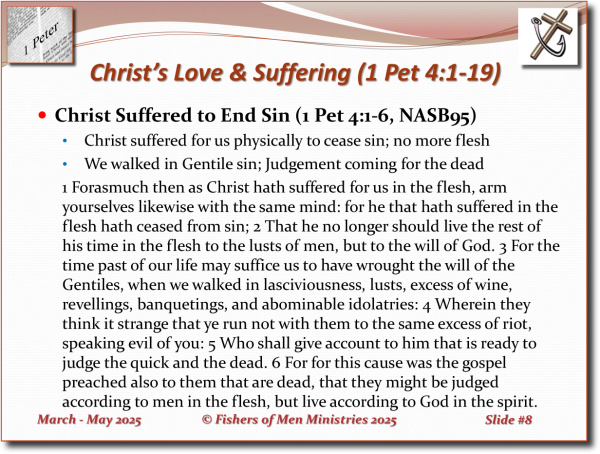
Christ Suffered to End Sin (1 Peter 4:1-6, NASB95)
Christian Commentary author, Matthew Henry is correct in his summary, “The work of a Christian is twofold doing the will of God and suffering his pleasure. This chapter directs us in both” (Commentary of 1 Peter 4). In fact, the first sentence of this chapter suggests we look again at the description of Christ’s suffering provided in the previous chapter. Peter states that it is because of Christ’s sufferings, as described, we should prepare ourselves to face the same or similar trials. Not only that but we need understand that Jesus died physically for us, that is, in our places, so we can have that death for ourselves. Verse 1 into verse 2 says that “He who has suffered in the flesh has ceased from sin, so as to live the rest of the time in the flesh no longer for the lusts of men, but for the will of God.” This is a part of the amazing fact of Jesus’ substitutionary death for us. The time for exercising all lust of men like “sensuality, lusts, drunkenness, carousing, drinking parties and abominable idolatries” is already past (vs. 3). As a matter of fact, in all this, those who are given to them are surprised that we no longer associate with them as they continue to live in such things (vs. 4a). For us (verse 4 continues), these excesses are now inconsistent with who we are. Paul states the new truth for us in 2 Corinthians 5:17, “Therefore if any man be in Christ, he is a new creature: old things are passed away; behold, all things are become new” (KJV). And this change in us is not acted out by us in our own power but is accomplished by the Holy Spirit within us. When He comes to live inside us, we simply no longer find comfort in these things. Quite the opposite, we experience discomfort taking part in them.
Verse 5 adds that those who do take part in these things will certainly be required to give account to the Lord who is ready to judge the quick (living) and the dead. This is not intended as some kind of guilt trip or fear tactic, rather, it is reporting the truth of what happens to us when we experience the rebirth. The flesh (the source of lust) is dead, even as Satan tries to resurrect it, because it no longer holds power of us. We live in the spirit according to the will of God (vs. 6).
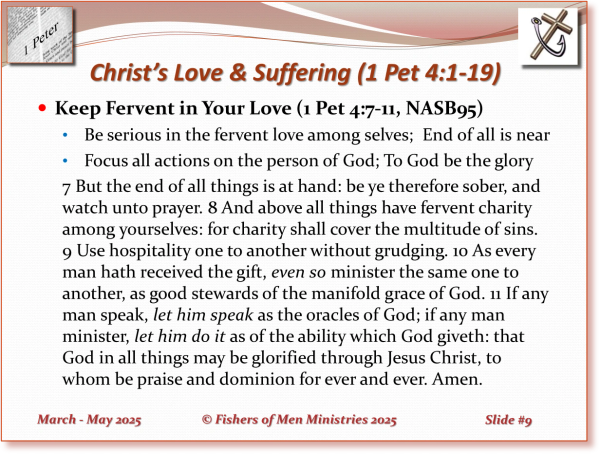
Keep Fervent in Your Love (1 Petere 4:7-11)
Peter says to think of it like this, “The end of all things is near, therefore, be of sound judgement and sober spirit for the purpose of answered prayer” (vs. 7). I know, as soon as anyone begins to talk about the end being near, we think of religious fanatics carrying signs of repentance while he is dressed in sackcloth and covered with ashes. That is certainly not what is intended. In today’s culture, the announcement that the end is near would be a call to sin more while you still could. No, the admonition is to understand that the day of reckoning is rapidly approaching (Rev 20:11-15). There is an eternity ahead after that reckoning and there will be no changes once one enters in (Luke 16:19-31). Once the rich man and Lazareth were assigned their destiny, there were no changes forthcoming. Lazareth was “comforted in the bosom of Abraham” while the rich man was burned but not devoured. Peter says it is much better to maintain sound judgement and sober spirit for the purpose of getting prayers answered. We have so many friends and neighbors who need our prayers and will not make the right decisions without them. I recall when a doctor stood before me when I was only 21 years old. My wife was in the delivery room, and because of a complication, he might have to make a choice between saving the baby or saving my wife. After I reluctantly gave him my answer, even though I was an atheist then, I prayed, “Oh God in Heaven, please don’t hurt my family because of what I have become.” No atheists there! Both came through the delivery, and my daughter is now 59 years old with three of her own children.
No, instead of some comedy, the end is deadly serious. Peter tells us to pray fervently for one another as the time approaches. To love one another because love changes things and can cover a multitude of sin by bringing people together and changing attitudes. He continues that we need to be hospitable to each other without complaint (vs. 9). Care for the visitors and strangers who need local help. Anyone who has been given special gifts, it is the time to use them for others. We need to take our time remaining to talk of the great things God has done and implore those who do not know Him to come to His saving arms for saving grace. Speak the words of God’s immeasurable love and compassion. Our blessings glorify the Father through His Son, Jesus.
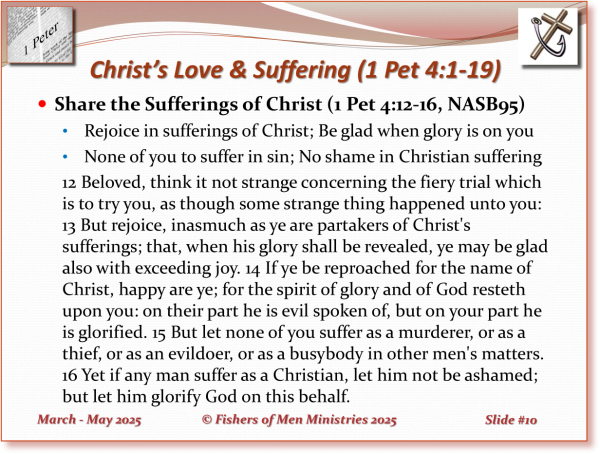
Share the Sufferings of Christ (1 Peter 4:12-16)
Peter walked so closely with Christ during His time on earth and even more closely after His ascension, that he knew His heart and here, He reveals some of the truths that only a man like Peter would know. Verse 12 begins, “Beloved, do not be surprised at the fiery ordeal among you, which comes upon you for your testing, as though some strange thing were happening to you.” Mattew tells us, “That ye may be the children of your Father which is in heaven: for he maketh his sun to rise on the evil and on the good, and sendeth rain on the just and on the unjust (Matt 5:45). All of us in the faith know that our faith can only grow through the testing God allows into our lives. We have the protection of God’s promise “There hath no temptation taken you but such as is common to man: but God is faithful, who will not suffer you to be tempted above that ye are able; but will with the temptation also make a way to escape, that ye may be able to bear it” (1 Cor 10:13). It helps to understand that every test God allows on us is to help or serve another. The test is designed to give us the wisdom and knowledge to assist someone else with addressing that issue. God is not some frivolous tempter who seeks ways to challenge and/or frustrate us. Rather, He is a caring, loving Savior who is willing to use His holy ones to minister to those all around them. He allows us to show His love to His people as He uses our touches to deliver His compassion. We share in Christ sufferings to save other from the pain.
In verse 13 Peter enters the familiar topic of “rejoicing through suffering.” The topic is familiar because Paul addresses it, “37 Nay, in all these things we are more than conquerors through him that loved us. 38 For I am persuaded, that neither death, nor life, nor angels, nor principalities, nor powers, nor things present, nor things to come, 39 Nor height, nor depth, nor any other creature, shall be able to separate us from the love of God, which is in Christ Jesus our Lord” (Rom 8:37-39). James does it in 1:2-4, “2 My brethren, count it all joy when ye fall into divers temptations; 3 Knowing this, that the trying of your faith worketh patience. 4 But let patience have her perfect work, that ye may be perfect and entire, wanting nothing. Trials benefit all involved and serve as a tool through which God can grow His people while helping others feel His loving touch,
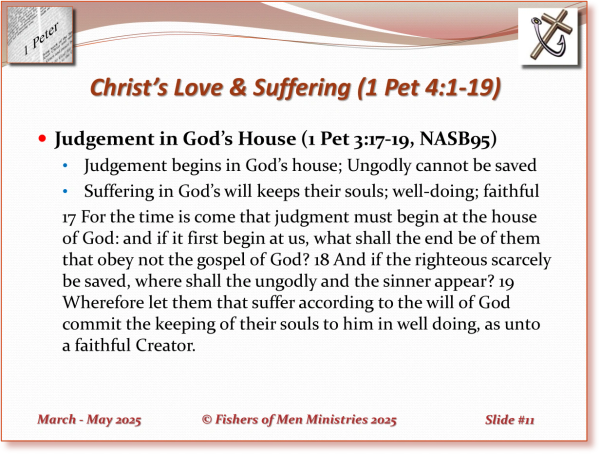
Judgement in God’s House (1 Peter 4:17-19)
God’s normal and usual way of bringing calamity upon the earth is to start with His own people in the House of God (Isa 10:12, Jer 25:29 and Eze 9:6). In each of these references, God cleaned His own house and His own people before He dealt with the foreigner. In Isaiah, He announced performing His whole work on Mount Zion before punishing the stout-hearted of Assyria; in Jerimiah 25:29, He states He will begin to bring evil on the “City called by my name” before He brings the sword upon the inhabitants of the earth; and in Ezechiel 9:6, He calls for slaying many old and young, both maids and little children; and women beginning at His sanctuary, then the men who had the mark on them (foreigners.) After these, He asked the question, “If this level of calamity begins with us, what will be the outcome for those who do not obey the Gospel of God?” Peter quotes the entirety of Proverbs 11:31 with his internal comments as he restates his warning that He will begin by cleaning God’s house before he cleans the houses of the Israel before He deals with the enemy. In fact, he says, “If it is with difficulty that the righteous is saved, what will become of the godless man and the sinner” (vs. 18)?
Peter’s conclusion is done in verse 19 after the word “Therefore.” There is a full belief that God would not allow His people to believe that the blessing of His grace and protection is available and enjoyed if the response of the people is no better than the godless masses of the past. God has watched through the millennia as His people deviated from their faith to follow after false gods and false religions while rejecting His law, His leaders and His logistics as they did during the forty years in the wilderness. These rejections are documented and illustrated in the contents of the Ark of the Covenants (Heb 9:4). The three items were the second set of ten commandments, Aaron’s rod that budded and the pot of manna from the wilderness. Peter is saying that those who suffer according to the will of God can entrust their souls and their spiritual survivability to the faithful God and Creator by “doing that which is right.” Paul says “doing right” is believing in their hearts and confessing with their mouths that Jesus died for our sin, was buried and raised from the dead, we would be reborn.
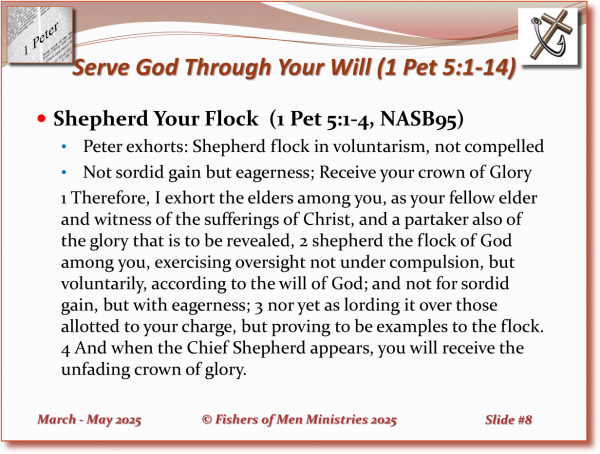
Shepherd Your Flock (1 Peter 5:1-4)
In today’s context, the advice from Peter to the Pastors of the first century Christian churches would seem a little naive. What kind of a person would be a pastor of a church and not know that he was responsible for shepherding the flock? But at least two factors make Peter’s advice very important and timely. Training and standardization of church leaders is always a great idea, especially in light of how quickly the churches were multiplying and growing. Also, the combined threats from the Roman Empire and the leaders of the local Sanhedrin (41 members) and the Great Sanhedrin (71 member) at Jerusalem across the world was having an impact on the longevity of people serving as pastors or elders. Further, upon a detailed look, the training Peter is suggesting speaks more to management style than management execution.
Using the word “shepherding” as the initial word for describing the position, set a remarkable word picture for the work. Most of the areas where this letter would find itself would recognize that word as requiring a management philosophy full of routine adjustments to overcome unexpected changes in the flock. That is probably why Peter started out saying that he was a partaker of the sufferings of Christ. That was instant credibility for these readers.
But Peter is making sure the pastors did not see him as “lording his experiences over them” (vs. 3): Notice that he said he wanted the leadership of the Pastors to be one of oversight without compulsion but with voluntarism in accordance with the will of God. Peter was looking for a management style that allowed people to see that it was being carried out through the miraculous power of Christ through the Holy Spirit of God. And when the movement was managed that way, when the Chief Shepherd appears, He will see the perfection of the work and reward those who did that work with the Perpetual Crown of Glory. The timing of the coming of the Chief Shephard is that first return for His saints where He does not personally touch the ground. First Thessalonians 4:13 ff and First Corinthians 15:51 ff describe this event and the great beauty of it.
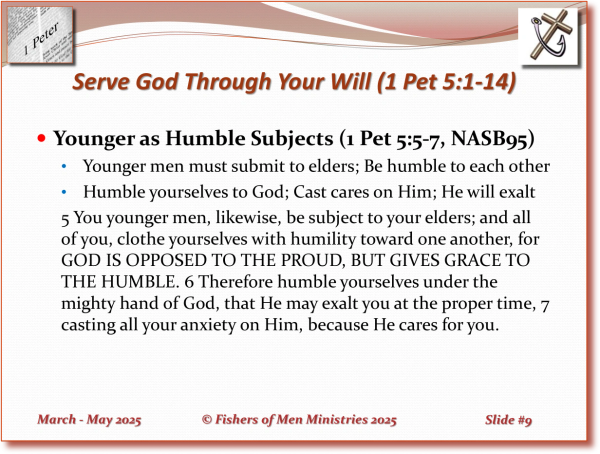
Younger as Humble Subjects (1 Petere 5:5-7)
The discussion on the proper behavior of the presbyter covered, it is time to talk to the rest of the congregation. Peter choses to call them “the younger” in contrast the “the elder” or older (vs. 5a & Luke 22:26). Note also that this far in the conversation the addressees are all male. If this was written today, we would acknowledge that there are believing women as well as the believing men. The first admonition is that the younger should be subject or submissive to the elders. This instruction seems intended not just by positional distinction but also by age. Recognition of the potential wisdom available from those who have gone before us is throughout the Scriptures. But Peter is not willing to stop there. He directs that the membership, in general, must be subject to one another and clothe themselves in humility toward (vs. 5b). In Hebrews 13:17, the writer (likely Paul) writes, “Obey them that have the rule over you, and submit yourselves: for they watch for your souls, as they that must give account, that they may do it with joy, and not with grief: for that is unprofitable for you” (KJV).
So now, the summary statement for the teaching is ready to be documented, and it starts with imploring us to act humbly toward one another under the mighty hand of God. The Hebrew part of the congregation knows very well what Peter is saying when he says, “under the mighty hand of God.” Hebrews have studied the history of the Scriptures and know very well, that if one will not humble himself as directed, the might hand of God will assist in causing humility. It is like being offered punish by either Mom or Dad; no one prefers punishment under the mighty hand of Dad when the light touch of Mom is a choice. But notice also that Peter adds the blessing of the Father in that “He may exalt you at the proper time.” Frequently after the punishment is done and the Father (Lord or earthly) sees that the lesson is learned, He (or he) will lift the younger up before the others showing His (or his) pleasure in the new or modified behavior which has resulted from the correction. It is in this feedback from the Lord that we recognize that while we may have drifted away, the Lord wants us back by His side. Knowing we can cast our anxieties on Him.
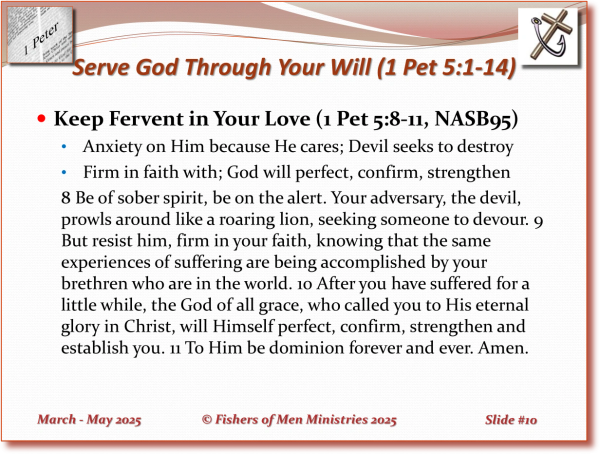
Keep Fervent in Your Love (1 Peter 5:8-11)
Now Peter sets about answering the question of how we might show that humility and submissiveness. We can start by having a serious (sober) spirit. That does not mean that we cannot have fun and rejoice with those who rejoice and weep with those who weep. What it means is that under the surface of our daily living is that constant awareness that there is much more to life than what happens in the open. When Paul tells us to “Pray without ceasing,” He expects those prayers to be taking place under the surface while the life all around us continues (1 Thess 5:17). We can certainly drive our cars, carry on a conversation in the car and also pray blessings on that person in the car. That is prayer without ceasing, and each of us can do it.
Next Peter reminds us of something we have all experienced. He says we need to be alert, or watch out, because “Our advisory, the devil prowls around like a roaring lion, seeking someone to devour” (vs. 8b). One though to keep in mind is that if you belong to Christ, the devil might oppress you but he cannot possess you. First John 4:4 says, “Greater is He who is in you than he who is in the world.” There is no contest if you will believe what the Bible says to us. The devil must retreat at you command under the strength of the Holy Spirit within you.
See how Peter says we need to “resist him, firm in our faith, knowing that the same experiences of suffering are being accomplished by your brethren who are in the world. After you have suffered for a little while, the God of all grace, who called you to His eternal glory in Christ, will Himself perfect, confirm, strengthen and establish you” (vss. 9-10). Being oppressed by the devil is not unique to you or any other individual; it is universal among Christians. Personally, I agree with James when he says we should “count it all joy when we enter into divers temptations,” because a true measure of the harm I am causing the devil is the amount of trouble he sends my way (James 1:3). So, the more effective I am in serving the Lord and winning the lost to Christ and believers to peace in Him, the more the devil will try to hinder my faith, my actions and my walk. “To Him be dominion forever and ever, Amen, ” indeed!!!
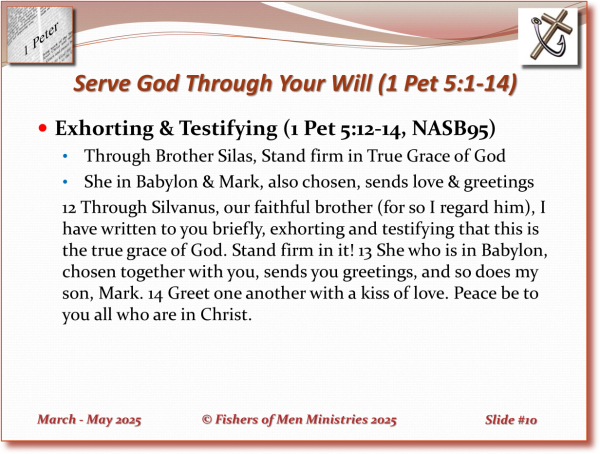
Exhorting & Testifying (1 Peter 5:12-14)
As Peter ends his letter, he departs abruptly to return to form and closes the letter appropriately. He provides inside the text of the letter the person he would use to get this letter to the intended churches. Verse 12 tells us it was by Silvanus, or better know to us by Luke naming him Silas, one of the chief men among the brethren (Acts 15:22). The men who went to Antioch for Paul’s Second Missionary Journey was Paul, Barnabas and Judas Barsabas. These were selected and sent to Antioch with Paul and Barnabas to go to Syria and Cilicia to the brethren which were of the Gentiles in those three cities (Acts 15:23). Here. Peter indorses Silas as a man he regards and trusts to deliver this letter, exhorting and testifying that this is a true grace of God. That one can stand firmly on its content pronouncing the former communication as bogus.
Acts 15:1 tells us that there were men who came down from Judea teaching that, “Except ye (believing Gentiles) be circumcised after the manner of Moses, ye cannot be saved.” This is one of the epistles which delivered the news that the Gentiles need not to be circumcised in order to join the faith of Jesus Christ. The message to the Gentile believers was that the established work of salvation is a true work of the grace of God and there was no requirement for the Gentiles to be circumcised to join the faith.
The words from the Apostles and saints as carried by Judas and Silas to establish what was required is stated in Acts 15:28-29: “28 For it seemed good to the Holy Ghost, and to us, to lay upon you no greater burden than these necessary things; 29 That ye abstain from meats offered to idols, and from blood, and from things strangled, and from fornication: from which if ye keep yourselves, ye shall do well. Fare ye well” (Acts 15:29).
Having completed the requirements of the apostles, saints and the Lord God, as well, Peter finishes the letter by mentioning that “She who is in Babylon, chosen together with you, sends greetings. That is “she” the church of Jesus Christ in Babylon, sends greetings along with Mark’s (that is John Mark) Pet,er’s own son (in the faith). He admonishes them to greet one another with a kiss.
Author, Title, Date
The book of 1 Peter is historically and traditionally attributed to the Apostle Peter, the Great Fisherman and leader of the faith after Jesus ascended. . The title “1 Peter” reflects its position as the first of two epistles attributed to Peter in the New Testament. The opening verse affirms his authorship. Scholars uphold Peter’s authorship, emphasizing his firsthand experience with Christ and his leadership role in the early church. 1 Peter was written in the early 60s.
2 Peter followed between 65-68 AD warning of severe persecution by the Roman Empire against the Christian Church. The title of Peter for both books represents internal evidence that the books were written by the Apostle Peter.Scholars uphold Peter’s authorship, emphasizing his firsthand experience with Christ and his leadership role in the early church. 1 Peter was written in the early 60s.
Purpose
2 Peter provides added warnings against false teachers and their deceptive practices to the incoutragements and strengthenings of First Peter.
Audience
Both letters were written to the dispersed believers (1 Peter 1:1). These were likely the people in the dozens of churches Paul had planted encouraged. These were more likely Gentile believers rather than Jewish believers, but there was certainly a mix of both..
Importance of This Letter
The Christian movement was believed by the Jewish religious leaders to be doomed to failure as soon as they murdered Jesus of Nazareth. Acts 9 tells us that Saul of Tarsus was permitted by the Sanhedrin to expand his geographical area for persecuting Christians outside Judea and into Asia. Saul was converted on the way to Damascus of Syria and became known as Paul, an Apostle of Jesus Christ. The hope that Christianity offered was far superior to the persecution of the Jews and Romans, and provided for strong belief for the thousands who faced death for their belief.

Second Peter picks up on October 18 with Christian Virtue Witnessed followed by False Prophets Coming on October 25 and Second Coming and All is New on November 1.
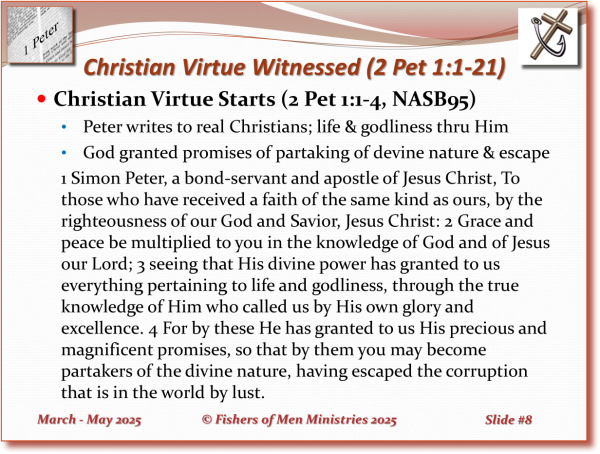
Christian Virtue Starts (2 Peter 1:1-4)
Verse 1-4 serve as the introduction or preface into a teaching of materials substantially brought by the apostle for the benefit of the others in ministry to the early faith of Christianity. The reading of the material, and understanding that Peter, Andrew, James and John were all professional fishermen, makes it obvious that letter is written under the power of the Holy Spirit of God. Part of the evidence that this letter and its former were written by the same author is that nearly everything in these introductory words are the same as the first rendition. Here we have the writer described as Simon Peter, the servant and the apostles listed as the names and/or traits of the writer. Peter ends up being the most frequent name used in this letter. It was given to him by the Master as he confessed Jesus as the Christ and the Son of the Living God. The name Simon is almost entirely missing in the first letter; it is used extensively in this second one. This is the name also given him at his circumcision which should be the favorite of those most familiar with the Law of Moses. Peter names himself a servant here along with being an apostle of Christ.
The greeting of “grace and peace being multiplied in knowledge of God and of Jesus our Lord” is a common but very warm greeting throughout the various letters between the leaders of the faith. Peter is saying that those who have received faith of the same kind as his, have received His (Jesus’) divine power which has granted us all that we need for life and godliness, through the true knowledge of Him who called us by His own glory and excellence. Further, Peter is saying that Christians of faith have the full sufficiency of supernatural power through the Holy Spirit of God indwelling them through a sincere commitment to Christ (Rom 10:9-10, 2 Pet 11-3).
In verse 4, Peter says God has granted to us “His precious and magnificent promises.” This is a fulfillment of God’s promise as stated by John the Baptist who came baptizing with water, but One coming who will baptize with fire and the Holy Spirit. With that Holy Spirit, we become partakers in His divine nature and live in His power rather than power of the human flesh.
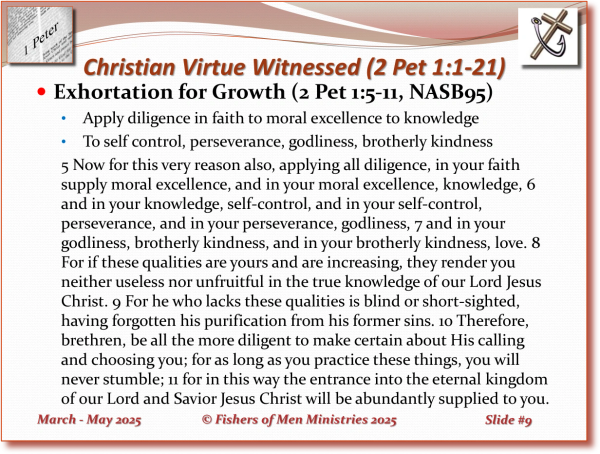
Exhortation for Groth (2 Peter 1:5-11)
In 2 Peter, Chapter 1:5-8, Peter describes a bit of a Christian chain reaction. He says that applying moral excellence to our faith, knowledge to our moral excellence, self-control to our knowledge, perseverance to out self-control, godliness to our perseverance, brotherly love to our godliness and kindness to our love is God’s way of it fulfilling the Christian mission through us. What is also interesting about this list is that it is the same thought process as demonstrated by Paul and James in their descriptions of how Christ, through the Holy Spirit within us, will cause us to grow and advance in the Christian faith (1 Cor 13:4-7 and James 1:2-4). Mathew Henry says that, “Without giving all diligence, there is no gaining any ground in the work of holiness; those who are slothful in the business of religion will make nothing of it; we must strive if we enter in at the Strait Gate (Luke 13:24)” (M. Henry on 2 Peter 1.5).
Peter talks to each of these attributes to be built upon build upon each before, and birth still another. And the very strange thing is that the reborn need not expend any personal energy to make any part of this chain-reaction to take place. It is ignited and propagated through and by the God who initiated it. It is entirely internal to the reborn; not requiring any additional push or power from the outside. Verse 8 finishes the God-initiated thrust of our power by saying that as a reborn Christian, the only limit on our power under God is our belief that these qualities are already present in us and lay waiting for us to generate the personal faith to use them (vs. 8).
Verses 9-11 reminds us of the sobering statements of God’s faith in us through our Lord Jesus Christ, and His indwelling Holy Spirit. Verse 9 states that the truth has been spoken and the only thing preventing us from using all of what God has given us is our personal blindness and shortsightedness of the facts that He has rendered us purified from all past sin. Because of this, God tells us we can never stumble or fail as long as we are operating in those things He has called us to do. In other words, if we are doing His will; nothing can stop us. And verse 11 sums that this is the entrance into the eternal kingdom of Christ, knowing that we are abundantly supplied.
Great Advantage Accrued (2 Peter 1:12-17)
Here Peter is making a personal commitment to those who follow him, even us. He says that he will always be ready to remind us of these things even though he knows we know them very well (vs. 12). He is saying that he will be a constant reminder of the power and blessing we already carry as we walk with him. He says it is a personal duty God gave him to be a source of empowerment and encouragement to remember and use the power Christ has put in us for the good of all those God has placed in our lives. In verse 13, Peter says he will do these things in all the limited time he is in this earthly body. He adds that he knows his time is limited, but he also knows that laying aside his earthly body will not end his influence among the saints. There is no one in any denomination I know of that does not acknowledge the name of the Great Fisherman and Apostle, Peter.
In verse 14, Peter says he knows that the time is near for him to leave his earthy body but that Jesus has made it clear to him that any time after his departure the people will be able to recall his teachings as they come immediately back into the minds of the saints. Peter has long since departed for Heaven but look at us this very night as we teach and recall his words and his accomplishments. We are accomplishing what Peter asked us to do hundreds and thousands of years ago; we are bringing alive his words again in 2026.
Verse 16 assures us that they were not following some cleverly devised tales when they told us of the power and coming of the Lord Jesus Christ. Instead, these words were told us by people who saw the majesty of Jesus Christ. They were there when He received the words from the Heavens saying, “This is my Son with whom I am well-pleased.” (vs 17). But it was Peter, James and John again who were with Him at the Jesus’ Transfiguration on a high mountain with Moses and Elijah in their presence (Matt 16:28-17:9 & Mark 9:1-9). In both references that Jesus prophesizes, and said unto them, “Verily I say unto you, That there be some of them that stand here, which shall not taste of death, till they have seen the kingdom of God come” (Mark 9:1). They saw!
Eyewitnesses to Apostolic Work (2 Peter 1:18-21)
Verse 18 finishes off the previous slide by saying, “and we ourselves heard this utterance made from heaven when we were with Him on the holy mountain.” Peter once again pressing the truth of his personal viewing of each of these miraculous happenings. This provides them with firsthand testimony of what they saw. With the miracles of Jesus’ Baptism and His transfiguration along with Moses and Elijah; Peter, James and John heard the words of the Father and saw the two great prophets who died hundreds of years earlier talking with the transfigured Jesus. It was sure.
In verse 19, Peter restates how amazingly miraculous these prophetic words, now made sure, really was. Hundreds of prophecies are stated but never seen in the lifetimes of those involved. Peter is saying these prophecies are made sure because the people telling of them were actually present when the fulfillments took place. That is, they saw Moses and Elijah alive and talking with Jesus. They saw the dove land on Jesus’ head (signifying the blessing of the Holy Spirit) and they heard God’s voice from Heaven saying, “Behold my beloved Son in whom I am well pleased.”
Peter is saying this could not be made plainer; Jesus made the prophecy that some standing there would not die before they saw Jesus in His majesty. In the very next verse, in two of the Gospels,, Jesus takes His inner circle of Apostles up on a high mountain and is seen with a man who lived 1,500 years earlier and another man who lived in 875 BC. Jesus was the third Man. He was currently alive and changed into the same kind of person as the first two. All three had clothes brighter white than the others had ever seen. But, wonder of all wonders, all three were alive together! The prophecy of Jesus that “some standing here will not die before they see Christ’s glory” is accurately fulfilled.
Peter says this revelation should be treated like “a lamp shining in a dark place,” like “the dawning of a new day” or like “a morning star rising in your hearts.” In each case, one can see and perceive like they have never seen or understood before. The light brings revelation along with new ability to understand or perceive what they were seeing.
Understand the Context (2 Peter 2:1-22; Jude)
Peter’s first letter to believers in Asia Minor completed by emphasizing the content of the Scriptures and the teachings of Jesus Christ. It is important to our foundational concept of what the Scripture is, to believe that the Scriptures were and are God-breathed. Jesus scolded the devil early in the New Testament saying, “It is written, Man shall not live by bread alone, but by every word that proceedeth out of the mouth of God” (Matt 4:4). Mark warns that practicing works based on traditions instead of the Word of God is like “Making the word of God of none effect through your tradition, which ye have delivered: and many such like things do ye” (Mark 7:13). Warnings of these dangers are provided in Second Peter and Jude. Peter goes immediately into warnimgs against false prophets and false teachers and how they cause divisions in the church. Peter and Jude lay out response strategyies to combat this kind of heresey. Often we think we should not raise our voices when we hear erronious teaching in the church in the name of keeping the peace, but the repetition of such bogus information might be repeated hundreds of times before it is corrected. Jude correctly wans believers of the overwhelming danger in leaving false teaching unchecked. Since God is not the author of confusion, there is only one correct answer on Bible.
Jude showed how the false teachers were (and are) arrogant, immoral and greedy. He speaks of how false teachers have spoken themselves into everlasting condemnation through their words. Alternatively, we need to focus on the authentic, infallible, flawless Word of God. Jude talks of authentic teachings that save souls from needless pain.
Some ask how they might make sure they are not teaching false doctrine. I always repeat the experience I had at the Philadelphia Mint many years ago. We were on a tour through the mint and I asked a plate engraver, “With the countless number of counterfeit bills circulating around the world, how can you identify them and destroy them?” He held up a set of plates for a $50 bill and said with a stern smile, “Because we are the experts on the real ones.” Study your Bible!
False Teachers (2 Peter 2:1-3)
Peter begins his discussion of false teachers by warning us that there will be some among us. He compares the existence of false prophets in the Old Testament to the certainty of false teachers in the New Testament. Part of the nature of “discussion” is to allow opinions to be spoken which have not been researched nor tested. In a Bible Study environment, the opinions which are obviously wrong ought to be corrected bur are not. Some will believe those statements are true because they were not corrected. One difference between a person expressing an opinion and a false teacher can be the intent of that person. A person purposely introducing error sounds like the person in 2 Peter 2:1. This is one of the “false teachers among you, who will secretly introduce destructive heresies.” Peter says some of those might even “deny the Master who bought them, bringing destruction upon themselves” (vs. 1).
Other false teachers might be those who “follow their own sensuality, and because of them the (true) way of the truth will be maligned” or criticized” (vs. 2). This kind of false teacher might, “in their greed” try to exploit others with false words. Further, they might even do this while their judgement makes them fully aware of what the truth is (vs. 3). Their judgement caused them to react, but they ignored those internal warnings because of their greed for recognition. They may well be very aware that they are risking their personal destruction because of their purposeful teaching of false doctrine. In other words, their personal judgement warns them of their error. They know they should change what they said, thereby demonstrating that their knowledge of personal destruction is certainly not asleep (vs. 3).
Early in my ministry, there was a Jewish man in the congregation who brough notice on himself by wearing a yarmulke (a scarf worn over the head and shoulders while reading the Scriptures or hearing them read). As the attention grew around this man’s, he hinted that he knew the date of the Lord’s return (Rapture of the saints). He taught large audiences for months about the Lord’s immanent return. Of course, he was wrong, he was a false teacher, but did not stop.
False Teachers (2 Peter 2:1-3)
Peter begins his discussion of false teachers by warning us that there will be some among us. He compares the existence of false prophets in the Old Testament to the certainty of false teachers in the New Testament. Part of the nature of “discussion” is to allow opinions to be spoken which have not been researched nor tested. In a Bible Study environment, the opinions which are obviously wrong ought to be corrected bur are not. Some will believe those statements are true because they were not corrected. One difference between a person expressing an opinion and a false teacher can be the intent of that person. A person purposely introducing error sounds like the person in 2 Peter 2:1. This is one of the “false teachers among you, who will secretly introduce destructive heresies.” Peter says some of those might even “deny the Master who bought them, bringing destruction upon themselves” (vs. 1).
Other false teachers might be those who “follow their own sensuality, and because of them the (true) way of the truth will be maligned” or criticized” (vs. 2). This kind of false teacher might, “in their greed” try to exploit others with false words. Further, they might even do this while their judgement makes them fully aware of what the truth is (vs. 3). Their judgement caused them to react, but they ignored those internal warnings because of their greed for recognition. They may well be very aware that they are risking their personal destruction because of their purposeful teaching of false doctrine. In other words, their personal judgement warns them of their error. They know they should change what they said, thereby demonstrating that their knowledge of personal destruction is certainly not asleep (vs. 3).
Early in my ministry, there was a Jewish man in the congregation who brough notice on himself by wearing a yarmulke (a scarf worn over the head and shoulders while reading the Scriptures or hearing them read). As the attention grew around this man’s, he hinted that he knew the date of the Lord’s return (Rapture of the saints). He taught large audiences for months about the Lord’s immanent return. Of course, he was wrong, he was a false teacher, but did not stop.
Empty Promises (2 Peter 2:17-19)
Peter begins his discussion of “Empty Promises” by using metaphor to describe what they are like. In verse 17, he says “they are like springs without water and mists driven by a storm.” These two illustrations show us that Peter is not impressed with these kinds of promises. They are strikingly empty, void and worthless. He states even more harshly, “for whom the black darkness has been reserved.” The Scriptures often use darkness to illustrate the place of no light at all, as the state of total desolation and its place called Hell. Peter uses the verses 4-16 to provide strong evidence of the general and specific judgements against those who have denied truth and chased after confusion and false teaching. He talks of the condemnations of the fallen angels, the entire world destroyed by the flood of Noah’s time, Sodom and Gomorrah, Lot, walking in the lust of uncleanliness and despise of government, with eyes full of adultery, speaking evil of those things understand not, shall utterly perish in their own corruption, receive the reward of their unrighteousness, getting pleasure out of rioting in the daytime, being spots and blemishes, sporting themselves with their own deceit while feasting with you, having eyes full of adultery, with ceaseless sin, having unstable souls and on and on.
These lost and misguided people promised freedom and peace while they are sinking in the quagmire of their own slavery to corruption. It is so very hard for a person, a people or a nation to extract themselves from the overwhelming corruption of their surroundings while promising others the quicksand of their own slavery. Peter states that “while they promise them liberty, they themselves are the servants of the corruption of its own sort: for by what a man is overcome, by this is he enslaved” (vs. 19).
Take a close look at the wisdom, knowledge and power spoken here by Peter. He spent most of his life as a fisherman. Doctor Luke says when he says that as the best and the brightest came together and were amazed at the speech of Peter and John, as such uneducated and ignorant men, but the they took knowledge that these men had been with Jesus (Acts 4:13)!
Understand the Context (2 Peter 3:1-18)
Peter’s second letter was written to shock or alert the believers in Asia Minor of the dangers of false teachers. Chapter 2 stands in great contrast to Chapter 1. The first chapter speaks of the great virtues of the Christians in Asia Minor while the second chapter lifts up the Scriptures as presented before us. In this chapter, however, Peter tries to link Old Testament prophecy to New Testament applications. That is, he shows how the heretical teaching can lead to predicted apostasy. Add the terrible persecutions by the occupying Romans, the Greco-Roman culture and the Jews who were losing countless numbers of their membership to those believing that Jesus of Nazareth was the promised Messiah, and the Christians of Asia Minor were under unimaginable stress in daily life. The false teachers were trying to say Jesus was not the messiah, that there was no redemption in the cross and the Old Testament prophecy of the coming of the great and terrible Day of the Lord would hold only judgement and punishment for Christians, as well.
What the false teachers proved, however, was that the great and terrible Day of the Lord was real. But instead of horrible judgement for Christians, they would experience the mid-air Rapture of the Saints who died being rejoined with their bodies and then rejoined with those who were alive and remained. Together they would be taken to the Father’s Heaven. The terror of the Day of the Lord would be reserved for those who did not have Jesus Christ. Peter says that Paul joined him in that great message, and we see John joining both of them in the same, end-time scenario.
2 Peter 3:5-7 (this week’s study) shows the preaching of judgement but not with water, as with Noah, but with fire. So, the prophecy of the end times provided both salvation and sorrow. Salvation because the Rapture of the Saints provided the joy of knowing that Jesus would raise us up and take us off the Earth before God’s judgement on unbelievers, and sorrow because many of our loved ones who refused a relationship with Christ would remain for His judgement on the Earth. After the Rapture comes 7 years of tribulation upon those left behind as recorded in the Book of Revelation. We must do our level best every day to lead as many to Christ as we can.
Christ’s Certain Return (2 Peter 3:8-10)
Peter’s first comment is for the Christians of Asian Minor to remember that one day is like a thousand years and a thousand years is like one day with the Lord (Psa 90:4). In other words, God’s timing is not the same as our timing. While the Lord’s return for us has been imminent ever since these statements were made, His instruction for us is that we should live in a belief that He could return at any moment, but be prepared to live a lifetime before He does. It is the expectation of His immediate return that provides the hope needed to persevere under the worst of situations, and the Christians of this age in Asia Minor are certainly in the worst of situations.
Verse 9 presents two impart statements: First, “The Lord is not slow about His promise, as some count slowness, but is patient toward you.” This part follows from verse 8 regarding God’s timing in returning for us. While some might think He is late or slow, He is neither. Because He is God, whenever He comes for us, He is right on time! Second, Peter says that “[the Lord] is patient toward you, not wishing for any to perish but for all to come to repentance” (vs. 8b, author’s brackets). This part of the Lord’s words shows the very important concept that Jesus is not willing for any person to be left behind when He comes for us. This is a sister statement to Paul’s saying, “[God our Savior] will have all men to be to be saved, and come to the knowledge of the truth” (1 Tim 2:4, author’s brackets). These two verses stand in obvious contradiction to the Reformed Theology tenet that God has predestined some to be condemned without hope of salvation. John 3:16 and Romans 10:10 also states that any who believe and confess shall be saved.
Verse 10 reenforces the idea concerning God’s timing being in accord with His clock. That is, “The Lord’s coming as a thief in the night” means that it will have all the characteristics of a robber coming to rob from your home. He will not come when you might expect him, nor will he come when he thinks he might get caught. Rather, the robber will come when he thinks he will not get caught. So will the coming of the Lord be. Now, this return of the Lord refers to a time of judgement on the entire earth; it is the purging of the earth by fire; not the Rapture of the Saints.
Holy Living (2 Peter 3:11-14)
So, Peter seems to ask at this point, since everything we currently have will be destroyed by fire, what kind of people shall we be? How shall we behave? We already know that we have been instructed in holiness and godly living (vs. 11). We have been told that we should be “looking for the coming of the Day of God and doing whatever we can to hasten or speed up that coming because the heavens will be destroyed by burning, and the elements will melt with intense heat” (vs. 12). Peter is not asking what efforts we should make to survive under such circumstances, rather, he is asking how we should behave in the situation. Maybe the best response could be that with all the destruction described, there are no solutions to this scenario.
But according to God’s promises in His holy Scriptures, we are not looking for another rescued world with cleverly fashioned, reconstructed furnishings. We are looking for something significantly different. We are looking for that place in God’s kingdom constructed by Him for us. It is called “the new heaven and the new earth.” The Apostle John says, “1And I saw a new heaven and a new earth: for the first heaven and the first earth were passed away; and there was no more sea. 2And I John saw the holy city, new Jerusalem, coming down from God out of heaven, prepared as a bride adorned for her husband. 3And I heard a great voice out of heaven saying, Behold, the tabernacle of God is with men, and he will dwell with them, and they shall be his people, and God himself shall be with them, and be their God” (Rev 21:1-3). Notice that the beginning of verse 3 says “Behold, the tabernacle of God is with men.” And we know that God cannot dwell where sin lives, so this “new heaven and new earth” where God is with men, and He will dwell with them, must be a place where man has been made righteous. Verse 13 says it is a place “in which righteousness dwells.” The instructions of verse 14 say that we should “be diligent to be found by Him is peace, spotless and blameless.” The only way for any member of humankind to achieve that level of righteousness is to have it imputed unto him. “21And being fully persuaded that, what he had promised, he was able also to perform. 22And therefore it was imputed to him for righteousness” (Rom 4:21-22). Now, therefore we are found in Him righteous in His sight.
Stand Firm (2 Peter 3:15-18)
Verse 15 begins this passage with another obvious statement unity from Peter to Paul. Peter says we should consider the patience of our Lord as salvation in the same way our brother Paul did in accordance with all the wisdom given him and he wrote to you, also in all his letters (vss. 15-16). Peter is saying that he and Paul agree that any delay in the Lord’s return can be counted as salvation for hundreds or even thousands more people. It is certainly another way to envision the perfect grace of our Lord. The church was growing, the challenges were tough but the more the persecution increased, the more people would turn to Christ to find that peace that passes all understanding.. Peter continues by specifying that Paul spoke of the same things Peter spoke of, recognizing that some of them were hard to understand. Some of those might be exploited by the untaught and unstable to distort and confuse as they do the rest of the Scripture to their own destruction. Recall that Peter has been talking of false teachers throughout 2 Peter. Now, he is referring to conversations he had with Paul which both of them had addressed in their individual works. It seems the doctrines were particularly difficult to the point that Peter wanted to keep the discussion between them (maybe just Peter and Paul) for the immediate future. Given to the wrong people, misunderstanding and distortion might result.
Because of this, Peter is warning Paul as well as the church leaders in Asia Minor to be on guard that they do not get misled by the errors of unprincipled men (false teachers) which might lead to falling from leadership (vs. 17). Instead, Peter insists, grow in grace and knowledge of our Lord and Savior Jesus Christ. Let any glory to be earned, be earned by Him along with all glory in the present as we discuss them, or in all eternity. Peter’s second letter to Asia Minor ends with extremely strong writing that shows Peter and Paul as unified in thought and doctrine.