Signed in as:
filler@godaddy.com

As the temperatures change from the blistering heat of Summer 2026 to the cold, lonely and freezing tempuratures of Winter, the Lakeland Sunday Night Bible Blog (Lakeland SNBB) is going to stay warm and cozy studying the "Nine Little Letters" of the New Testament.
Click Here for 1, 2 & 3 John, Jude and Philemon (Part 1),
Click Here for 1 & 2 Peter (Part 2) and
Click Here for James and Titus (Part 3).
Author, Title, Date
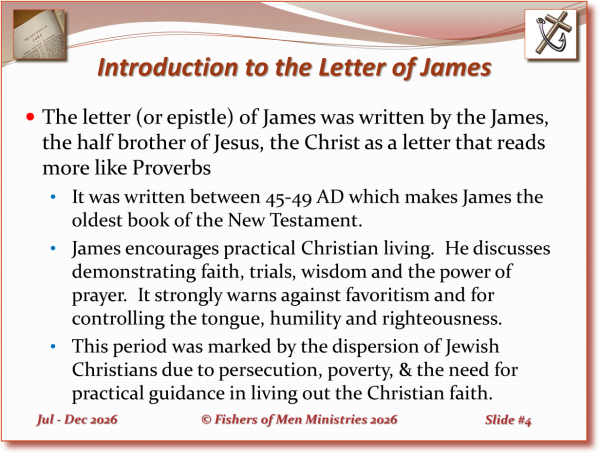
The Epiustle of James is traditionally attributed to James, the half brother of Jesus, the Christ (Matt 13:55; Mark 6:3). He was also known as James the Just. He was a prominent leader in the early Christian church in Jerusalem. James encourages practical Christian living and urges believers to demonstrate their faith through actions. It addresses trials, wisdom, and the power of prayer, highlighting the importance of controlling one’s tongue and caring for the needy. James calls for genuine faith, warning against favoritism and encouraging perseverance, humility, and righteousness.
The Epistle of James was likely written around AD 45-49, making it one of the earliest New Testament writings. This period was marked by the dispersion of Jewish Christians due to persecution, which is reflected in the opening address to “the twelve tribes of the Dispersion” (James 1:1).
Purpose
James addresses his letter to Jewish Christians scattered abroad who were facing many trials and temptations. James emphasizes the importance of faith being demonstrated through actions, addressing issues such as favoritism, the use of the tongue, and the need for patience and prayer.
Audience
James addresses his letter to Jewish Christians scattered abroad who were facing many trials and temptations. James emphasizes the importance of faith being demonstrated through actions, addressing issues such as favoritism, the use of the tongue, and the need for patience and prayer. The letter was intended for a broad audience rather than a specific individual or congregation.
Importance of This Letter
The early church faced challenges such as poverty, persecution, and the need for practical guidance in living out the Christian faith. The Christian movement was believed by the Jewish religious leaders to be doomed to failure as soon as those leaders murdered Jesus of Nazareth. Acts 9 tells us that Saul of Tarsus was permitted by the Sanhedrin to expand his geographical area for persecuting Christians outside Judea and into Asia. Saul was converted on the way to Damascus of Syria and became known as Paul, an Apostle of Jesus Christ. The hope that Christianity offered was far superior to the persecutions of the Jews and Romans on the Christians, and served to strengthen believers for the thousands who faced death for their beliefs.
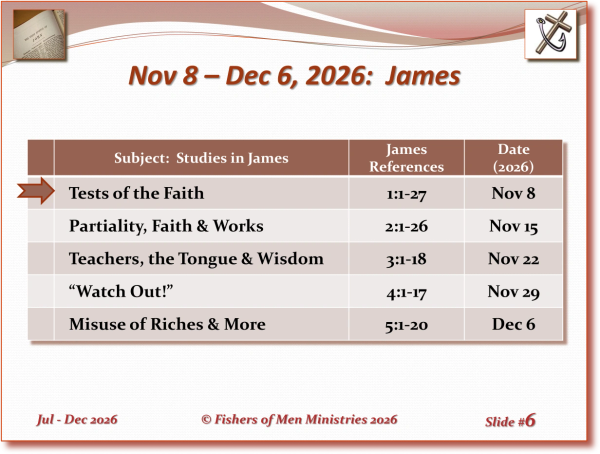
There are many religions in the world, each with its own set of beliefs, practices, and traditions. Some of the major religions include Christianity, Islam, Hinduism, Buddhism, and Judaism. James starts here with the Tests of Faith on November 8, 2026. He answers the question of how one can tell if they are worshiping inside a genuine faith or some kind of cult or false religion. On November 15, the topic moves to Partiality, Faith & Words. James provides a bit of a different look at the relationship between faith and works. Paul said, "For by Gace ye are saved, through faith. It is the gift of God least any man should boast" (Eph 2:8-9). James says, "Yea, a man may say, Thou hast faith, and I have works: shew me thy faith without thy works, and I will shew thee my faith by my work ... But wilt thou know, O vain man, that faith without works is dead? " (James 2:18 ?20). At first, the two leaders seem to disagree, but if each is taken in context, they agree fully. Paul is speaking of Faith that saves us is by the grace of God, having nothing to do with works. James is saying that AFTER a person is saved, his salvation is shown by his works. If his salvation does not result in works, his faith is dead.
At Tanksgiving time, James explaing how teachers need to be careful of what they say and need to show wisdom in their words. On November 29, James warns us to "Watch Out!" He list a number of issues Christians need to avoid. On December 6, James finishes with more warnings on the misuse of wealth and other final warnings for this letter.

UNDER CONSTRUCTION
UNDER CONSTRUCTION
UNDER CONSTRUCTION
Author, Title, Date
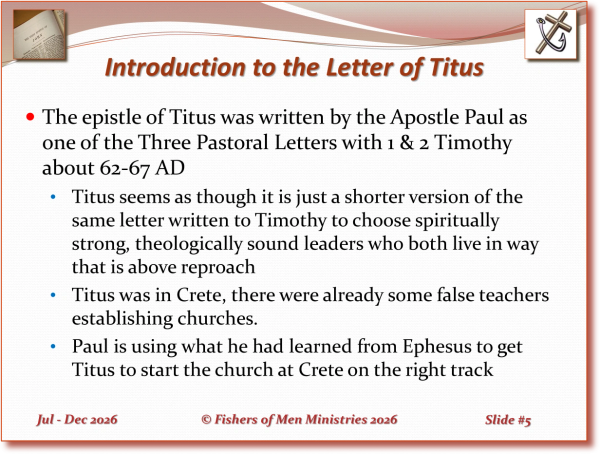
Titus is part of the Pastoral Epistle.s 1 Timothy and Titus were written around the same time (62-65 AD), while 2 Timothy was written later (67 AD). At first glance, Titus seems as though it is just a shorter version of the first letter Paul wrote to Timothy. It addresses a lot of the same issues, particularly the importance of choosing spiritually strong, theologically sound leaders who both live in way that is above reproach, as a positive example to the outside world and are not afraid to call out false teachers. But upon deeper examination, we can see the difference between the two. Timothy was in Ephesus, where the church had been in existence for 12 years, and false teachers had cropped up and had been leading the people astray from the truth. Titus was in Crete, where he was organizing new churches out of the believers there. There were already some false teachers in Crete, even before they had officially established their churches. Paul is using what he had learned from Ephesus to get Titus to start the church at Crete on the right track, with a firm foundation of strong leadership and sound doctrine.1
Titus was written by Paul around the same time as 1 Timothy, around A.D. 62–63. Paul was writing from Nicopolis, Macedonia, where Titus would later join him. Paul had been released from his imprisonment in Rome (where he wrote Philippians and Colossians) and had been traveling to many churches to help with problems they were having. When he visited Crete, he left Titus there to finish setting up the churches, and he and Timothy went on to Ephesus, where he left Timothy to settle troubles they were having there.
Date of the Letter Conservative scholars believe Paul went on to Macedonia, leaving his two “fixers” in those cities to organize the churches, stop false teaching, build strong leadership and strengthen their communities.2 In the book of Titus, Paul gives us a very brief guideline for what is most important in establishing a healthy church: - - - Build on a firm foundation of the truth Establish strong leaders who know sound doctrine and live it out in their lives Live together in unity, supporting one another in community It is only by having strong, healthy churches that we can successfully accomplish our mission to advance the Gospel to the world.
Purpose
Titus was not mentioned in the book of Acts, so we don’t know much about his early life or career. He was noted in Galatians as a Gentile believer who became a companion of Paul, journeying with him and Barnabas to Jerusalem (Galatians 2:1–3). He was then dispatched to Corinth, where he successfully reconciled the Christian community there with Paul, who had founded it. After he was freed from his imprisonment in Rome, Paul then left Titus on the island of Crete to help organize the church there, which is what this letter is about. After he successfully did that, he met again with Paul in Nicopolis and went on to Dalmatia.
As with the letters to Timothy, this letter was to encourage Paul's fellow workers to press on under the Lord to furnish the ministerial needs of the church doing its birthing and early adolesence. As Titus served as an evangelist, he no doubt provided the early training for the pastors and saints at several of Paul's churches.
Audience
Titus' letter was written to the dispersed believers just like 1 Peter and Jude. These were likely the people in the dozens of churches Paul had planted and many missionaries encouraged and trained through the years. These were mostly Gentile believers rather than Jewish believers. Titus tries to stay away from quoting Jewish traditions and ritual observance.
Importance of This Letter
The Christian movement was believed by the Jewish religious leaders to be doomed to failure as soon as those leaders murdered Jesus of Nazareth. Acts 9 tells us that Saul of Tarsus was permitted by the Sanhedrin to expand his geographical area for persecuting Christians outside Judea and into Asia. Saul was converted on the way to Damascus of Syria and became known as Paul, an Apostle of Jesus Christ. The hope that Christianity offered was far superior to the persecutions of the Jews and Romans on the Christians, and served to strengthen believers for the thousands who faced death for their beliefs.
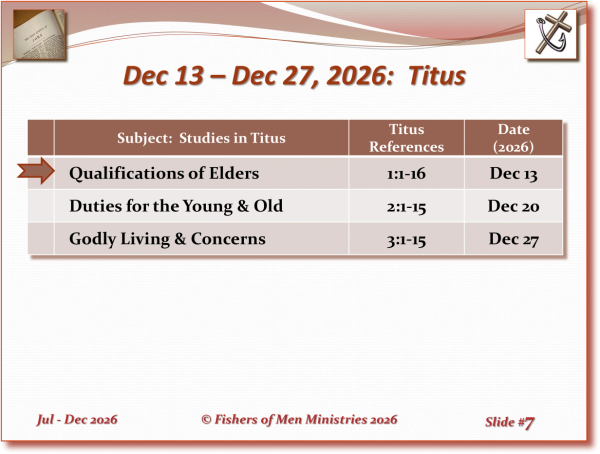
Paul wrote three pastoral letters trying to help the pastors he put in place to handle several of the administrative and behavior issues in the church. The letter to Titus begins by repeating Paul lesson the Timothy concerning the qualifications for church leaders. In Chapter 2, he continues instructions but switches to behaviors for the member of the church. Last, Paul advises on Godly Liviving and Concerns. He writes of several issues and answers regard the Christian and his or her interactions.
UNDER CONSTRUCTION
UNDER CONSTRUCTION
UNDER CONSTRUCTION
UNDER CONSTRUCTION
